Tag Archives: writing

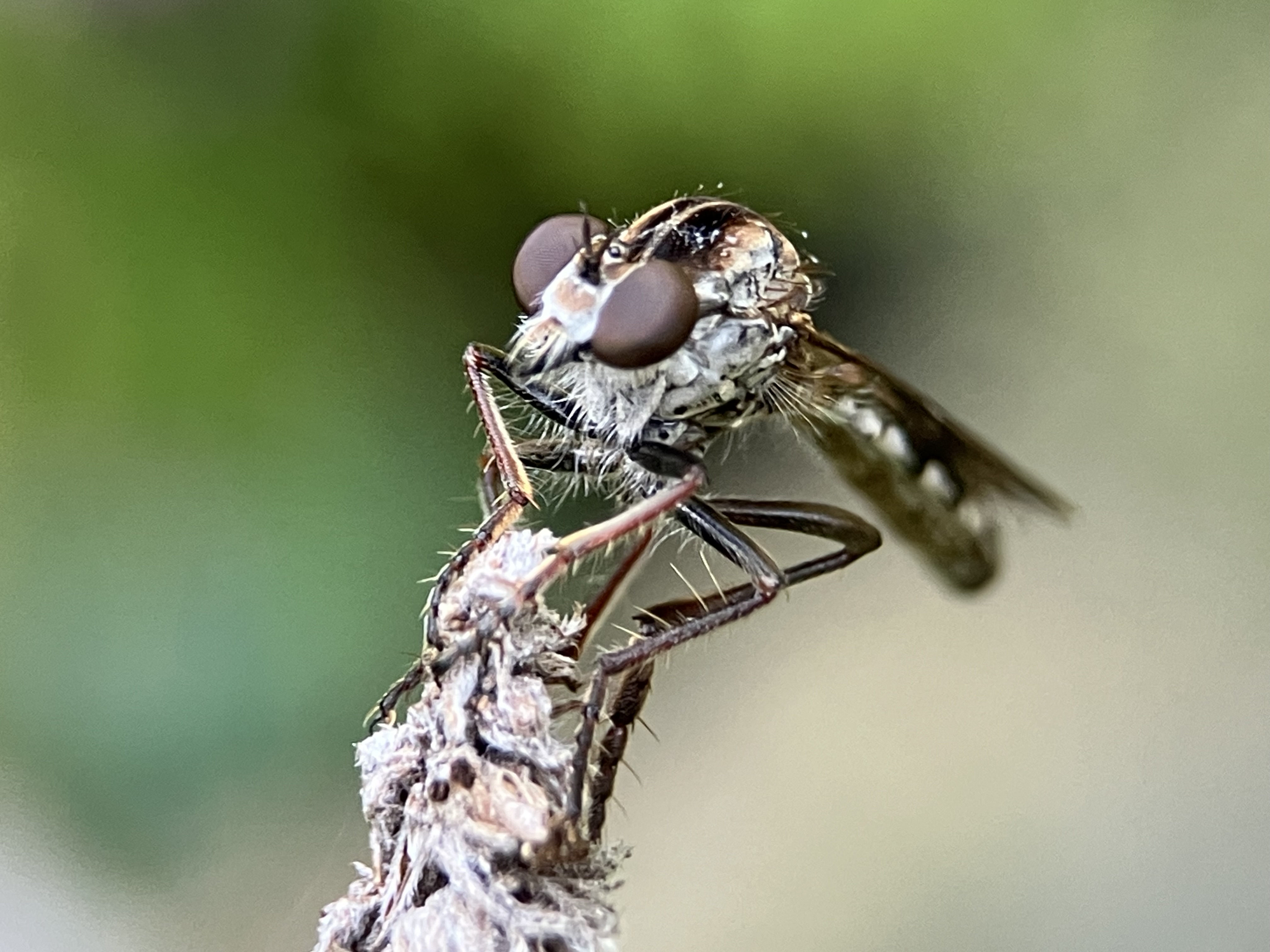
Identifying the Nicocles canadensis Robber Fly
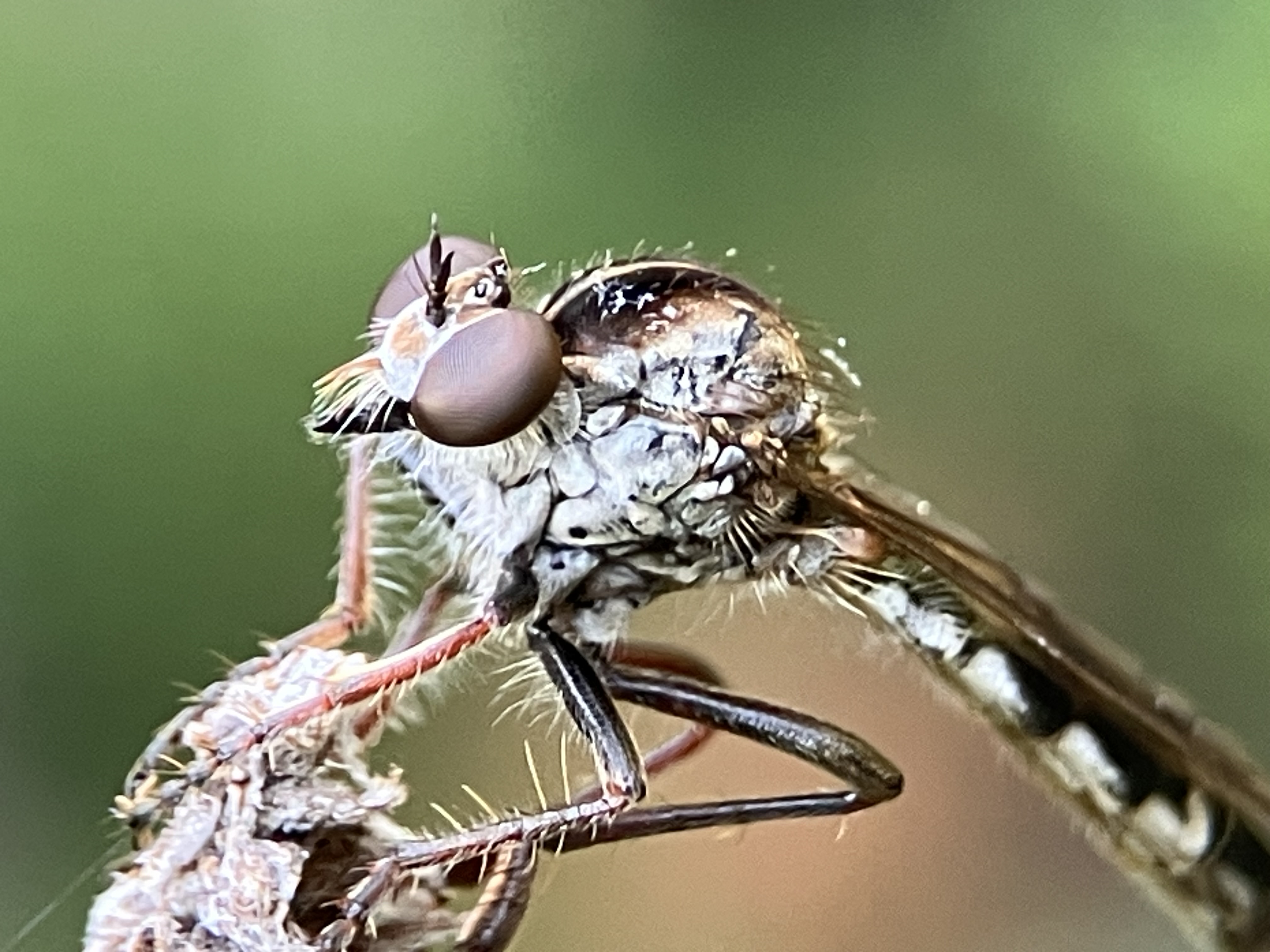
Robber Fly (Asilidae), Nicocles sp.

It has taken a bit of time to finally sort out genus and species for this very cool Robber fly with beautiful caramel-brown mottled wings I spied the evening of June 6, 2025. It perched on a dried apple mint stem from last season, no doubt scouting the terrain to see what might be on the menu for dinner. Robber flies (Family Asilidae) are predatory. They catch other small invertebrates to eat, paralyzing them with special salivary digestive enzymes and then sucking up the liquified contents through the proboscis (Cannings, 2013).

Getting to an identification beyond Genus for this one has been incredibly frustrating, and complicating the process is the limitation of the key I was using (Wilcox, 1946), which primarily describes male specimens.

Robert Cannings has studied the Asilidae for many years in British Columbia and states this genus “sorely requires systematic attention.” I finally just gave up and reached out to Rob for help. He wrote me and said, “I’m pretty sure this is Nicocles canadensis. It’s a female, and some females are difficult, even when under a scope, because the Wilcox key, which is the best we have for now, deals with them poorly and concentrates on males. Nicocles canadensis is the species in the genus most often seen on BC’s south coast and, I assume, in your area.”

This is the only Nicocles fly I’ve ever found on our property on San Juan. According to Rob’s 2014 publication (linked in the references below) in Canada, ” Nicocles canadensis is restricted to Garry oak savanna and adjacent dry woodland on southern Vancouver Island (Saanich is the type locality),” so I anticipate this may be similar for our neighboring area.

Check out the attached references if you are interested in learning more about Robber Flies in our region.

Thanks for reading!
References

Cannings, R.A. 2014. The Robber Flies (Diptera: Asilidae) of Western Canadian Grasslands. 10.3752/9780968932179.ch7. https://www.researchgate.net/publication/268524943_The_Robber_Flies_Diptera_Asilidae_of_Western_Canadian_Grasslands

Cannings, R.A. 2013. Robber Flies (INSECTA: DIPTERA: ASILIDAE) Of The Montane Cordillera Ecozone.

Cannings, R.A. 1994. Robber Flies (Diptera: Asilidae) new to Canada, British Columbia, Yukon,
and the Northwest Territories with notes on distribution and habitat. J. Entomol. Soc.
British Columbia
: 91: 19-26. https://www.biodiversitylibrary.org/part/213777

Cole, F. R. 1969. The Flies of Western North America. University of California Press. Berkeley and Los Angeles.

Fisher, E.M., and Wilcox, J. 1997. Catalogue of the robber flies (Diptera: Asilidae) of the
Nearctic Region. Unpublished preliminary draft.https://staff.royalbcmuseum.bc.ca/wp-content/uploads/2013/08/Catalog-Nearctic-Fisher-Wilcox-1997-manuscript-copy.pdf

Geller-Grimm, F. 2008. Robber Flies (Asilidae). Internet site at http://www.geller-grimm.de/asilidae.htm

Melander, A.L. (1924) Studies in Asilidae (Diptera). Psyche [1923] 30: 207-19. https://onlinelibrary.wiley.com/doi/pdf/10.1155/1923/83461

Wilcox, J. 1946. New Nicocles with a key to the species (Diptera, Asilidae). Bulletin of the Brooklyn Entomological Society 40 (1945): 161-165; New York – Lancaster. https://www.biodiversitylibrary.org/page/50573094#page/180/mode/1up
April 7, 2025 – A Million or More

Tiny springtails (Hypogastrura sp.)

I woke up this morning feeling like my head is going to explode. Migraine sufferers will identify. The throbbing continues, regardless of whatever you might throw at it. I managed to get little Olivia to the vet by 09:40 to get her spay stitches out and our vet cleaned her ears. She had a lot of wax buildup and came home with some antibiotic ear drops to ward off any potential infection that might be developing. Olivia is our latest rescue cat. She’s a sweet little Tortie Persian. Age 2. It’s been a delight to have her sharing our space and she’s made fast friends with our other two resident kitties (Herman and Nimbus).

Olivia the cat

After I got back home from town, I went back outside to walk around the yard a bit hoping the cool air would calm down my headache. I wandered over to look in the above ground pools we have for water catchment. One is in the shade and the other is in the sun. It’s pretty cool how they each have their own mini ecosystems going on.

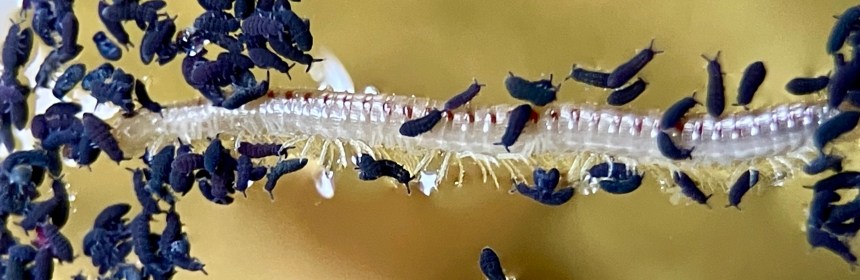
Hypogastrura sp. Springtails and a millipede raft

The shaded pool was the active one today. It was literally covered with a million or more of these teeny aquatic springtails. Initially, I believed the species to be Podura aquatica in the family Poduridae, but someone has suggested a different family (Hypogastruridae) altogether as a possibility. I may have to revisit my ID. Springtails or Collembola are tiny hexapods. The ones in my photo looked to be approx. 1mm in size. The blue-ish ones you see in the photo are mature specimens and the pinkish/orange ones are juveniles. I believe this could be a mating aggregation (Sánchez-García et. al, 2018). *** note *** Updating ID to family Hypogastruidae (Genus Hypogastrura) after looking at these under a microscope and seeing they have a reduced furcula (the little appendage on the back end that helps them jump).

Hypogastrura sp. springtails

There were so many of these that it looked as if the surface of the pool had been sprinkled with pepper. I found some in a water dish I had on the ground that were easier to photograph. There were a few rafting on a poor little millipede that somehow ended up in the water. It was still alive, so I fished it out and moved it to a nice damp spot in the soil.

An aggregation of tiny springtails (Hypogastrura sp.)
Hypogastrura sp. springtails

Some species of springtails are semi aquatic, living in fresh water. Others are common in soil and leaf litter where they influence decomposition processes and nutrient availability. Some are arboreal and are abundant in rain forest canopies. There are even springtails living successfully in polar regions (Hopkin,1997 ; Sanchez-Garcia et al, 2018).

Springtails hanging out with a deceased backswimmer (Notonectidae)

Raft of Hypogastrura sp. springtails photographed March 27, 2025 – San Juan Island, WA

Check out the reference list I have attached below for further reading. Some of these are really interesting!

References

Ádám Egri, György Kriska. 2019. How does the water springtail optically locate suitable habitats? Spectral sensitivity of phototaxis and polarotaxis in Podura aquatica. J Exp Biol 222 (9): jeb199760. https://journals.biologists.com/jeb/article/222/9/jeb199760/688/How-does-the-water-springtail-optically-locate

Bellini, B. C., Weiner, W. M., & Winck, B. R. 2023. Systematics, Ecology and Taxonomy of Collembola: Introduction to the Special Issue. Diversity, 15(2), 221. https://doi.org/10.3390/d15020221

Bugguide. 2025. Hypogastrura.

Childs, G. H. 1915. Some observations on the life history of the water springtail (Podura aquatica – 1758). MSc thesis, University of Minnesota, Minneapolis.

Heckman, C. W. 2018. Ecological Strategies of Aquatic Insects. Boca Raton: CRC Press, Taylor & Francis Group.

Hopkin SP. 1997. Biology of the Springtails (Insecta: Collembola). New York: Oxford Univ. Press.

Möllerke A, Brasse G, Bello J, Vidal DM, Dettner K, Zettel J, Berg MP, Scheu S, Leinaas HP, Schulz S. 2024. The unique epicuticular chemistry of Collembola – A cross-species analysis. iScience. 27(8):110416. doi: 10.1016/j.isci.2024.110416. PMID: 39139403; PMCID: PMC11321324.

Noble-Nesbitt, J. 1963. A site of water and ionic exchange with the medium in Podura aquatica L. (Collembola, Isotomidae). J. Exp. Biol. 40, 701-711.

Ortega-Jimenez VM, Challita EJ, Kim B, Ko H, Gwon M, Koh JS, Bhamla MS. 2022. Directional takeoff, aerial righting, and adhesion landing of semiaquatic springtails. Proc Natl Acad Sci U S A. 119(46):e2211283119. doi: 10.1073/pnas.2211283119. Epub 2022 Nov 7. PMID: 36343251; PMCID: PMC9674249.

Silje Marie Kristiansen, Katrine Borgå, Jan Thomas Rundberget, Hans Petter Leinaas, Effects on Life‐History Traits of Hypogastrura viatica (Collembola) Exposed to Imidacloprid Through Soil or Diet, Environmental Toxicology and Chemistry, Volume 40, Issue 11, 1 November 2021, Pages 3111–3122, https://doi.org/10.1002/etc.5187

Rusek, J. 1998. Biodiversity of Collembola and their functional role in the ecosystem. Biodiv. Conserv. 7, 1207-1219. https://doi.org/10.1023/A:1008887817883

Sánchez-García A, Peñalver E, Delclòs X, Engel MS. 2018. Mating and aggregative behaviors among basal hexapods in the Early Cretaceous. PLoS ONE 13(2): e0191669. https://doi.org/10.1371/journal.pone.0191669

Schulz, S., Messer, C., & Dettner, K. 1997. Poduran, an unusual tetraterpene from the springtail Podura aquatica. Tetrahedron Letters, 38(12), 2077–2080. doi:10.1016/s0040-4039(97)00341-9

Silje Marie Kristiansen, Katrine Borgå, Jan Thomas Rundberget, Hans Petter Leinaas, 2021. Effects on Life‐History Traits of Hypogastrura viatica (Collembola) Exposed to Imidacloprid Through Soil or Diet, Environmental Toxicology and Chemistry, Volume 40, Issue 11, Pages 3111–3122, https://doi.org/10.1002/etc.5187

Yule, Catherine & Yong, Hoi Sen. (2012). 33. Collembola. https://www.researchgate.net/publication/233727118_33_Collembola