Hang On…

Aren’t we all? Hanging on for dear life? Whether it is financial, emotional, or health-related, it sure seems like folks in the world are facing a crisis of one sort or another. Some are facing outright catastrophic ones. We need a global re-set for the chaos. To calm my mind, I ponder bugs. How do you cope?
If you are just seeing my blog, it’s Fantasic Fly Friday. Flies are so varied and amazing. They literally fuel the world as we know it.
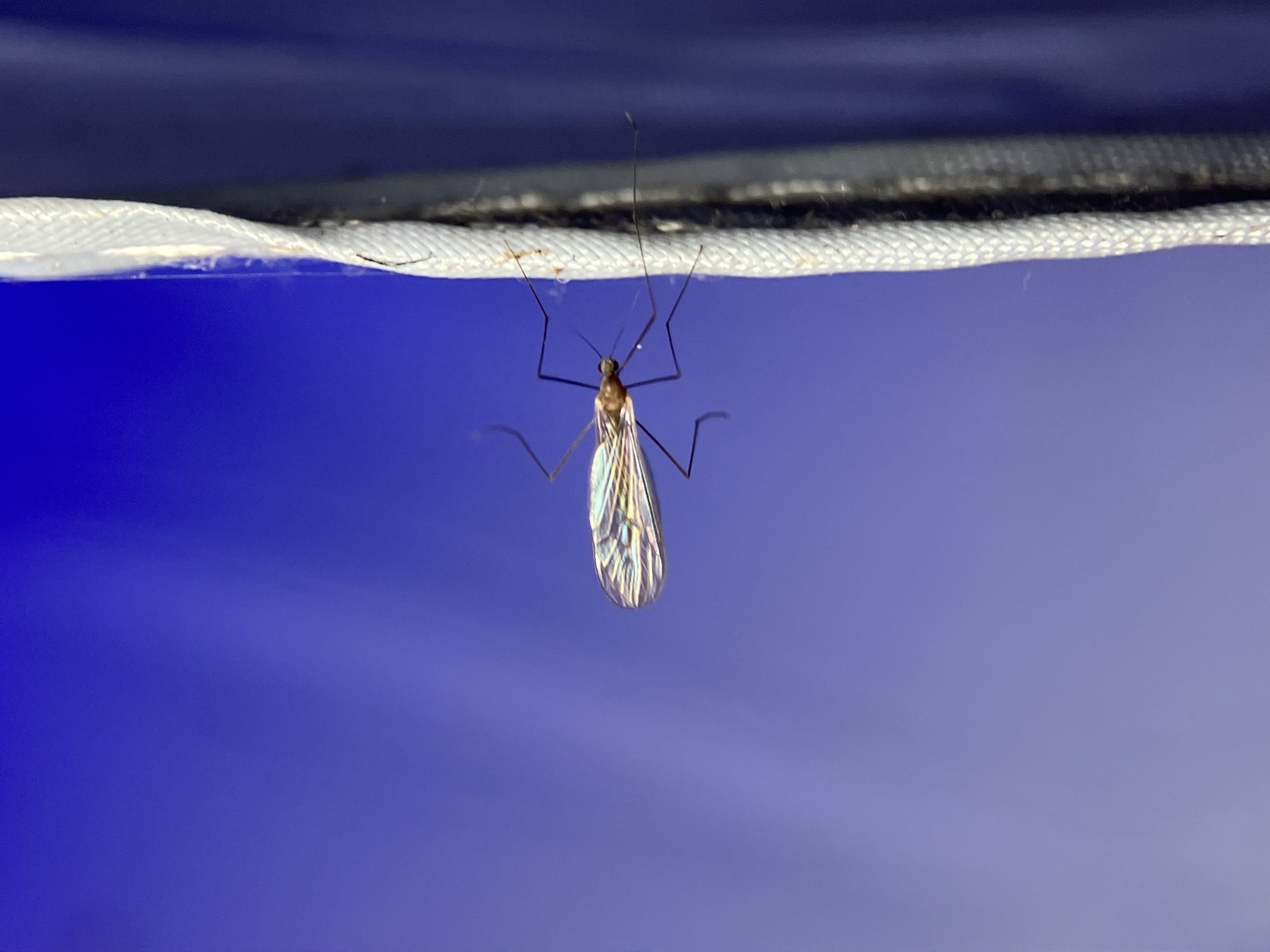
I photographed this one last night at my moth light. It was raining on San Juan Island, so there were more than a few bugs enjoying the refugia beneath our covered deck. Some nights it’s quite a party. A bug disco!
This is one of the more primitive flies in the family Trichoceridae (the Winter Gnats or Winter Crane Flies). Sometimes people call them hanging flies. I believe this one here is in the Genus Trichocera. However, I didn’t pluck my specimen off and take his or her life to determine that for certain under the microscope. I rather enjoy watching them alive because they all have quirky behaviors that are far more interesting to observe than counting wing veins on a dead bug.
The Trichoceridae are a family of Nematoceran flies grouped in the overarching infraorder Tipulomorpha (Crane Flies). There are approximately twenty-seven to thirty species of winter crane flies in the family Trichoceridae found in North America north of Mexico, depending on what source you use (Bugguide, 2021; Pratt, 2003). These are small to medium sized flies (wing up to 12mm), with a slender body and long, slender legs are distinguished from other families of crane flies by the presence of three ocelli (the primitive light detecting “eyes” found on the top of the head. Other identifying features include a V-shaped suture on the mesonotum that is incomplete in the middle, and long, hairlike 16-segmented antennae.
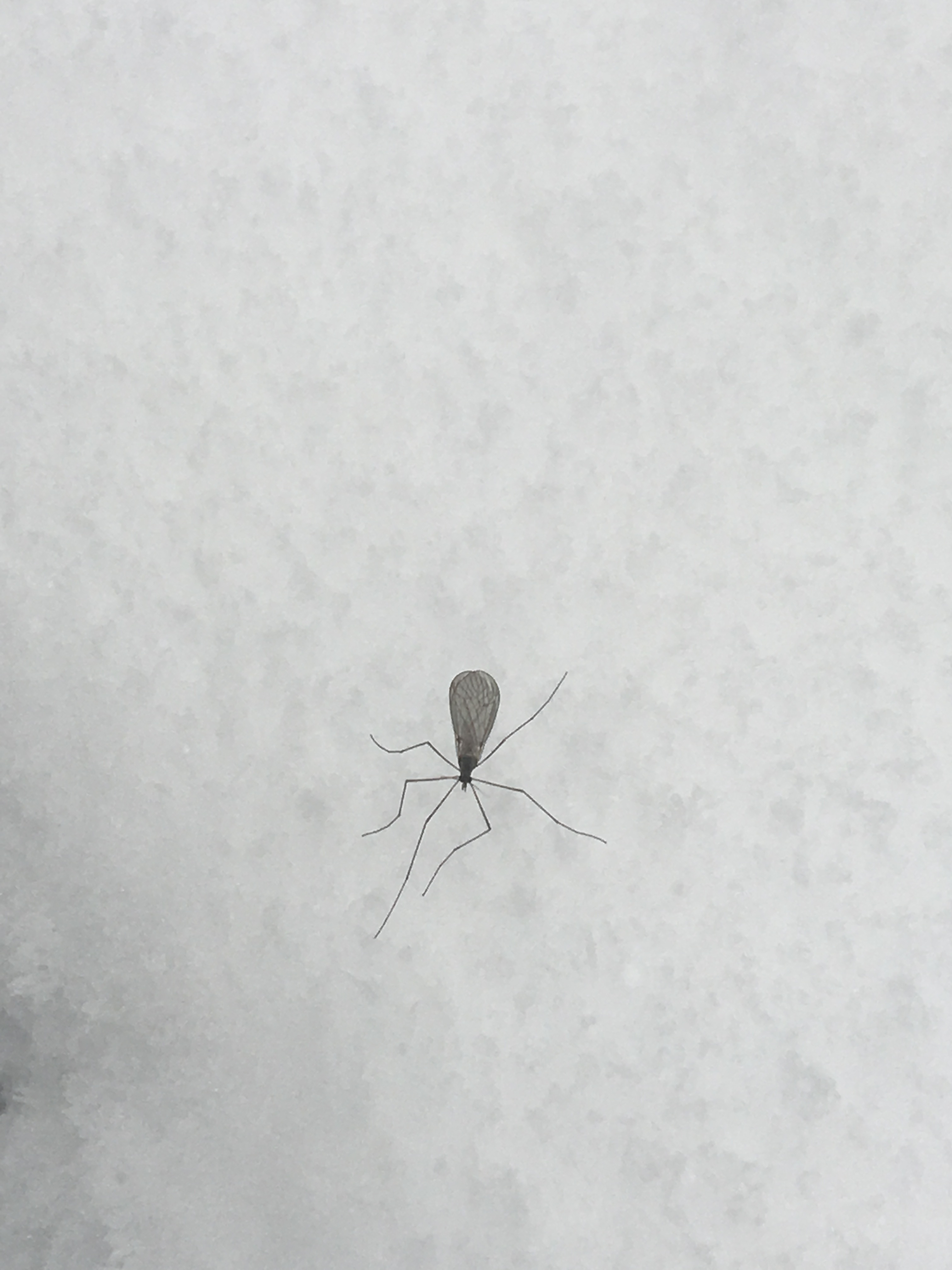
The larvae of Trichoceridae develop in moist or wet terrestrial biotopes. They can be found in decaying leaves, manure, fungi, stored roots/tubers, and rodent burrows (Bugguide, 2021). Adults are able to tolerate cool temperatures and sometimes, like I have seen, you may find them out walking on the surface in snow. Being active in winter, means there is little food available, but adults may feed on sap, or other carbohydrate sources. According to The Bug Lady (2015), they have been collected in molasses traps, and I have found them in our hummingbird feeder in winter when I take it down to change the sugar water and they are often on the sides of our seed and suet bird feeders as well. Perhaps taking nutrients in small amounts from the fruit in the bird feed mixes.
Even though they are small (perhaps you have never even noticed them), these flies are significant in ecosystems, with the short-lived adults providing a winter protein source for birds and even bats. The larvae feed other organisms that go unseen in the winter (beetles, spiders, millipedes and such) that wake up hungry on warmer days. They are important decomposers, nutrient recyclers, and a wonderful bioindicator of ecosystem health. They do not bite, nor do they transmit disease.

Remember the behaviors I mentioned? Well, these flies dance like the world is ending. At least the males do. They can be find swarming on cool winter afternoons, bobbing up and down in what are known as ghosts (Burton-Hargreaves, 2026). Friendly ones! When I read that, it reminded me of a book by Robert Bright my mother read to me often as a child, Georgie and the Noisy Ghost. Just like the ghost in this childrens’ book, I find these little flies dancing about at my moth light to be delightful.
Winter Crane Flies may have a brief existence, but they make the most of it. We can too. Live in the moment. Read to your child. Be present and helpful. Check on your neighbor. Maybe Clang and Rattle a Bit about the state of our country to your representatives (in a polite email, of course). Stay connected, and hang on for the wild ride that is LIFE.
References
Brast, C. 2017. Winter Crane Fly. Bugging You From San Juan Island. https://buggingyoufromsanjuanisland.com/2017/02/09/winter-crane-fly/
Bugguide.net. 2021. Trichocera. Bugguide.net. Iowa State University. https://www.bugguide.net/node/view/31296
Burton-Hargreaves, A. 2026. Winter Gnats. Northwest Nature and History, All about the Natural History and History of the Northwest of England. https://northwestnatureandhistory.co.uk/2026/02/18/winter-gnats/
Pratt, Harry D. (2003). The winter crane flies of North America north of Mexico (Diptera: Trichoceridae). Proceedings of the Entomological Society of Washington, 105, 901–914. https://www.biodiversitylibrary.org/part/55628
Redmond, K. 2015. Winter Crane Fly (Family Trichoceridae). The Bug Lady. University of Milwaukee. https://uwm.edu/field-station/bug-of-the-week/winter-crane-fly/
 Bugging You From San Juan Island