Category Archives: Hymenoptera

Discovering Ceropales maculata ssp. fraterna: A Unusual Spider Wasp on San Juan Island

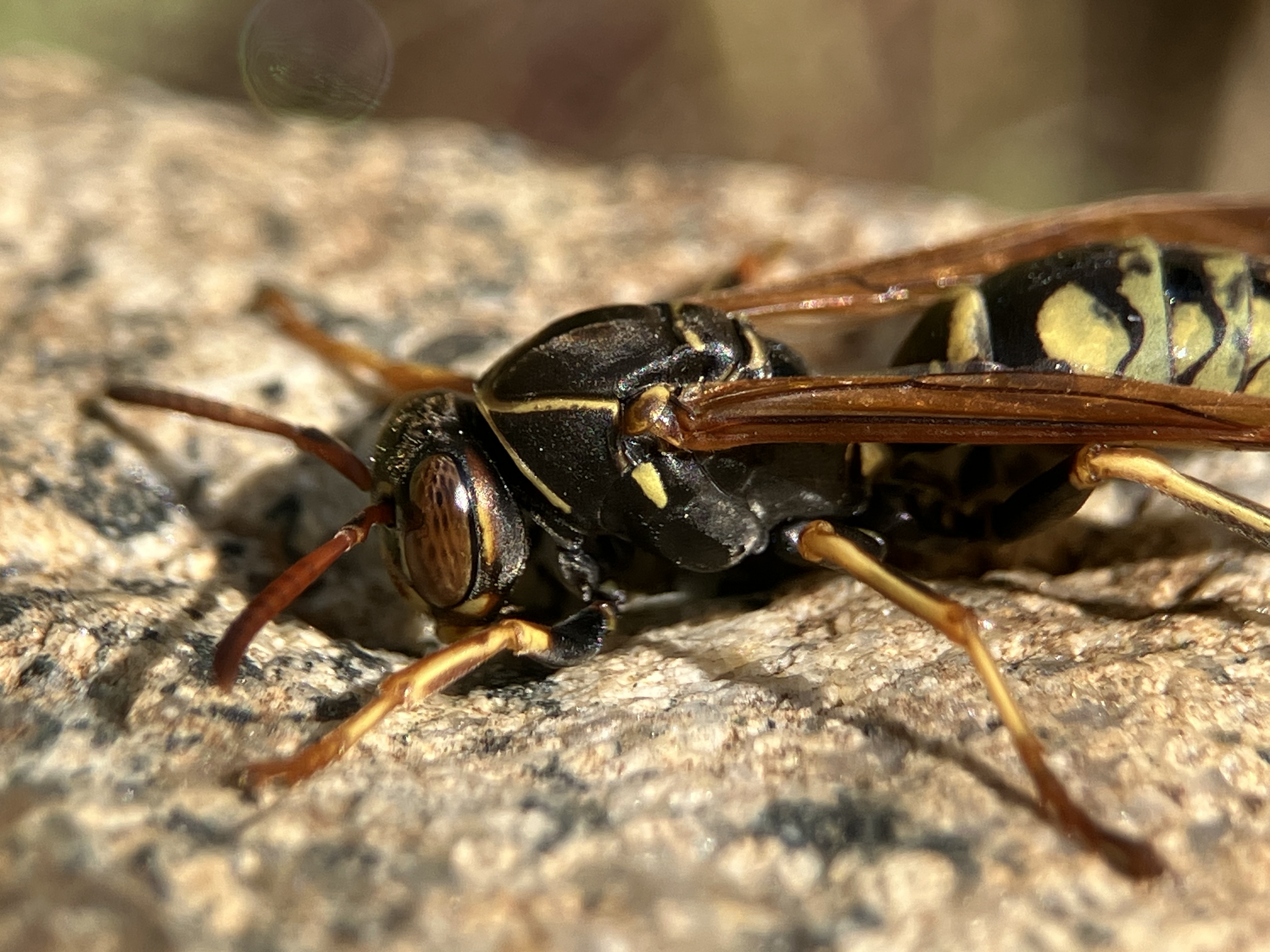
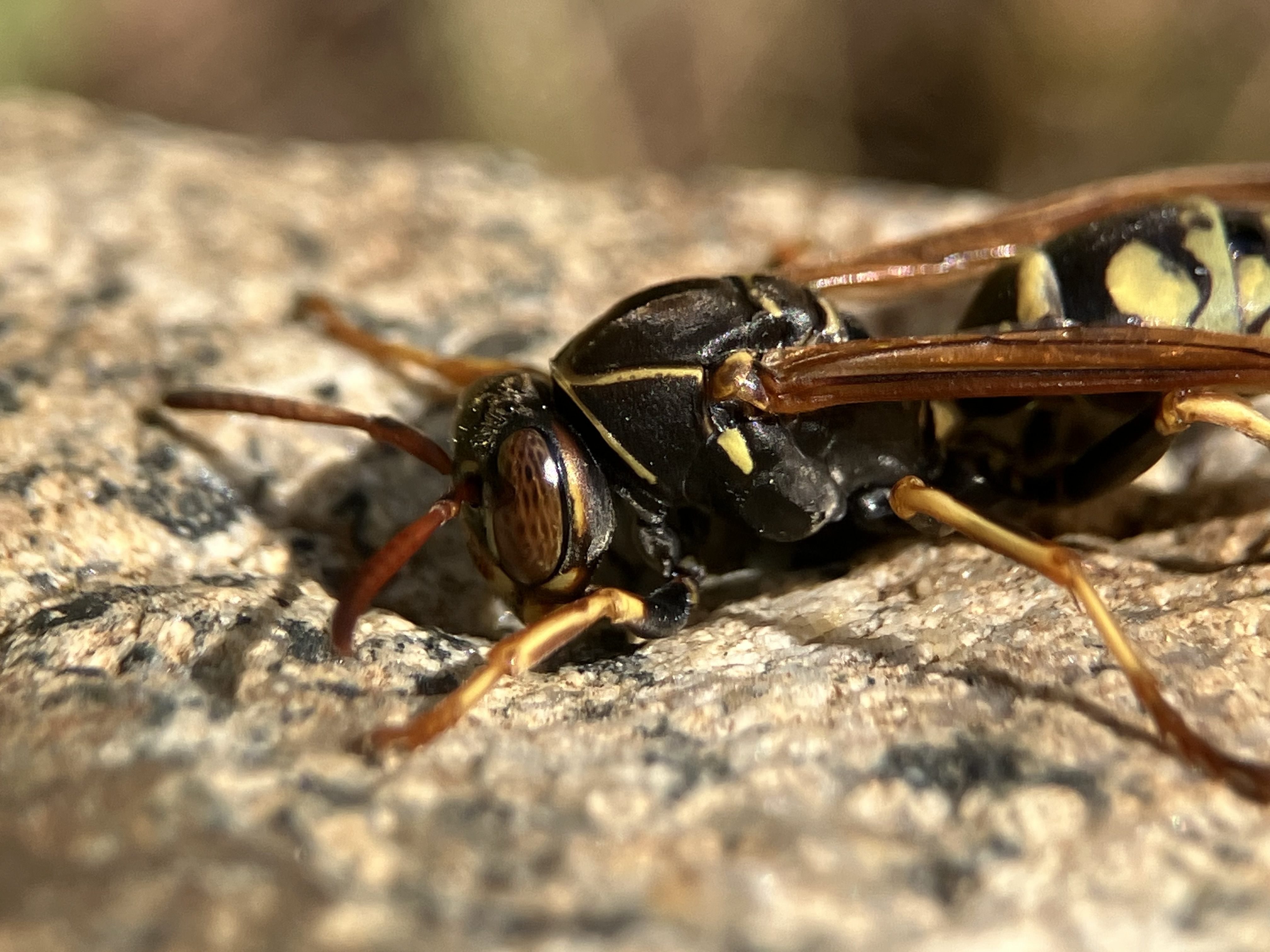
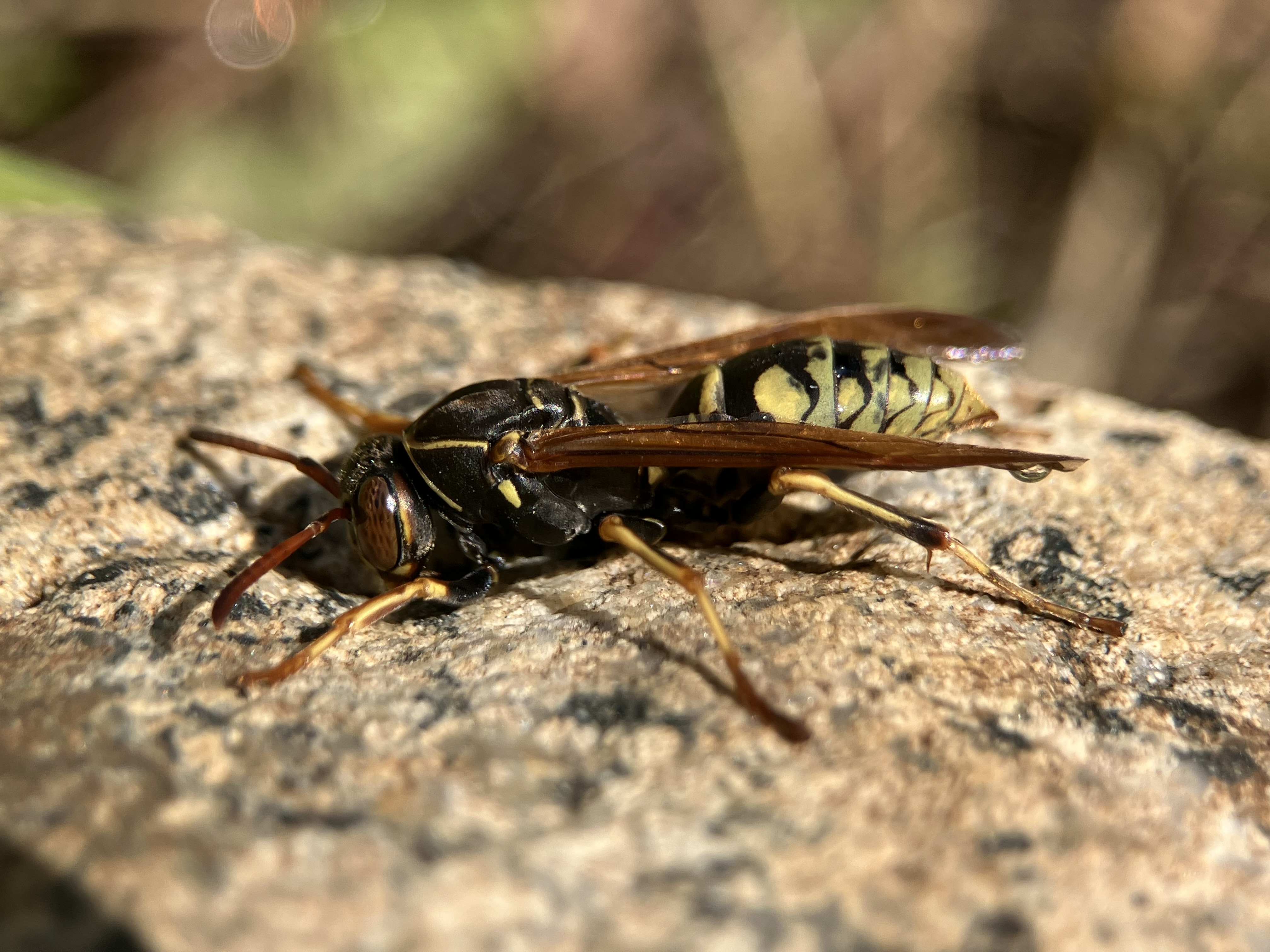
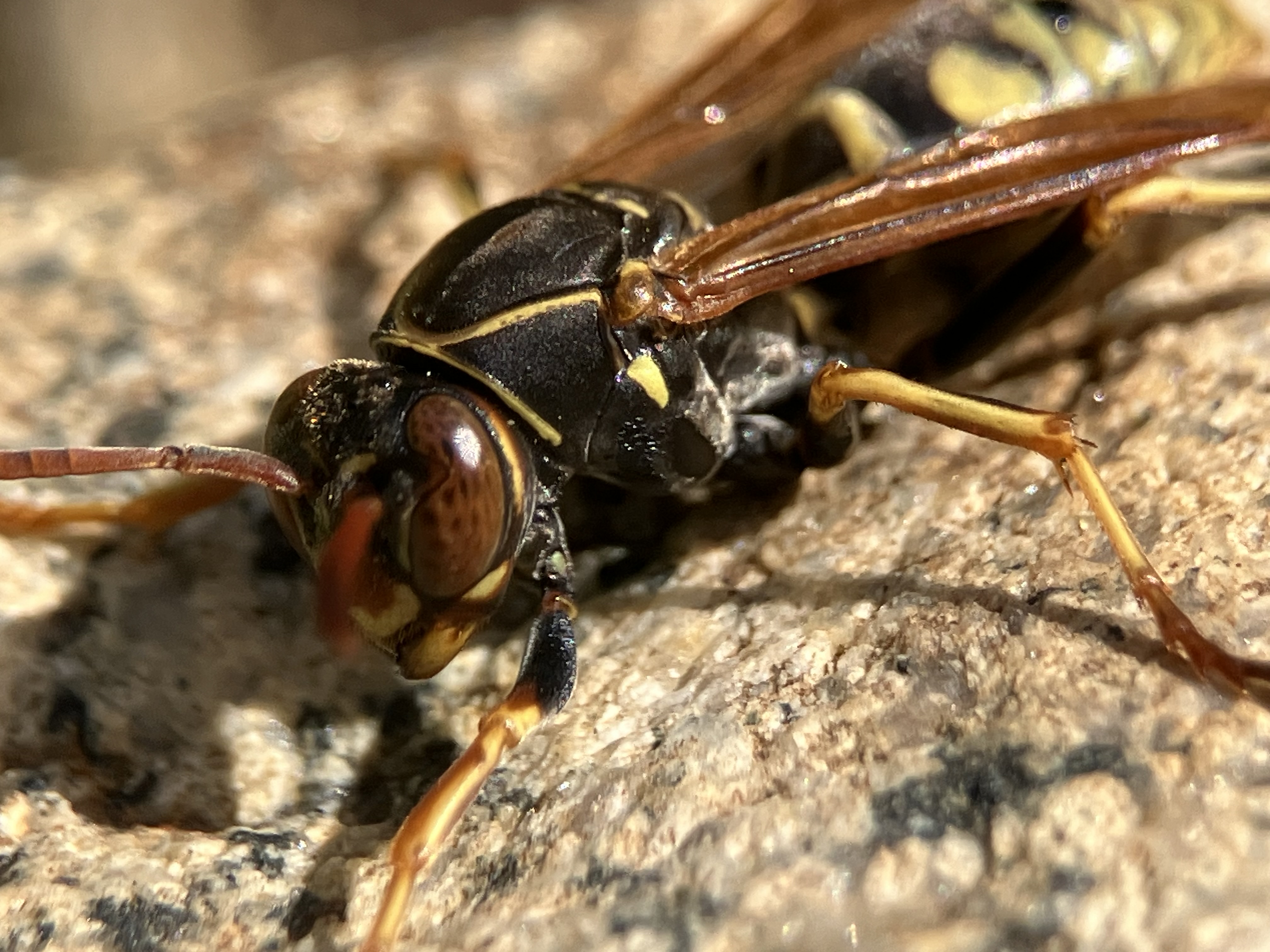
A spider wasp
Ceropales maculata ssp. fraterna

Sunday afternoon, at precisely 2:42 p.m., I found a very cool wasp in the garden.   I also nearly fell over trying to get the video footage to record my observation.  I think it was worth it though!

After I had my photos and videos, I walked back up to the house. Next, I did some investigation to find additional material about this species.  It’s a type of spider wasp in the family Pompilidae.   I came across a paper with a taxonomic key by Townes, 1957 and took at look at Bugguide.net as well. If you are wondering, my specimen’s scientific name is Ceropales maculata

However, Townes’ (1957) key also describes subspecies. I saw on his maps two subspecies that appear to overlap in geographic distribution. While I am not well-versed, nor confident in my skills in Pompilidae taxonomy, I do believe my specimen is the subspecies Ceropales maculata fraterna.  When I looked at a thread of commentary on Bugguide.net about the species, it also seems that perhaps some revision is in order, or more studies are necessary to update and enhance the work of Townes.

Out of curiosity, I also looked up the translation of the Greek/Latin name. Ceropales comes from the Ancient Greek kerkos (κέρκος), meaning “tail”, or referencing the Cercopes (mischievous mythical forest creatures) and -opes / -ops (ṓps): Meaning “eye” or “face.” So, to translate simply, it means “tailed-face” or “tail-eyed.” This name is given to the Genus Ceropales as a a way to describe these cuckoo or kleptoparasitic members. Maybe you are cuckoo if you have a tail face? Don’t trust my interpretation here (at all!!!), but do take a look at the Greek mythology about Cercops referenced here https://en.wikipedia.org/wiki/Cercopes The species epithet, maculata, translates from Latin to spotted, blotched, or speckled. If you read through Townes’ species descriptions, you will find some species do have certain diagnostic spots or dots.

Ceropales maculata fraterna.

The information I’ve shared below is taken from the Ceropales Genus page at Bugguide.net.

These wasps have a transcontinental range. Some species are restricted, others are small and poorly known and may be more widespread than collection records indicate.

They have a varied habitat, typically related to their host (see life cycle). Many species are known to inhabit woods.

Adults can be found throughout the warm season from May (early records from late April in Townes (1957)) to October.

Adults often visit flowers for nectar.  Spider prey varied (see Life Cycle).

Here’s the most interesting part of all! The LIFE Cycle! 

Ceropales spider wasps are cleptoparasites of other pompilidae (wasps in the same taxonomic family). Females perch on vegetation, stalking a host female until it has found and paralyzed a prey item. Then, the female Ceropales wasp will oviposit or lay an egg in the book lungs of the paralyzed spider prey of other spider wasps when the prey is left unattended during nest construction. The Ceropales wasp larva that hatches eats the host egg (the egg laid by the Pompilidae wasp that caught the spider in the first place), and then it continues to consume the spider. Some species of Ceropales wasps have several generations per year; larger species are normally univoltine.  ***Univoltine means only one round of offspring per year.  

Ceropales maculata fraterna.

I am hoping to eventually piece together the eco-web that exists between this wasp, which, to me at least, has a mud dauber look about it, and the other species of Pompilid wasp it sneaks up on. If I can at least figure out that part, then I may learn which species of spiders is being predated and used for development. That will enable me to spin a paragraph or two to add here in the future. 🙂

Thanks for reading. Be curious! Support habitat conservation for invertebrates. Bugs = Life!

References

Bugguide.net 2026. Ceropales. Iowa State University. https://www.bugguide.net/node/view/39892 

(Townes,  Henry. (1957). Nearctic wasps of the subfamilies Pepsinae and Ceropalinae. Bulletin, 209, 1–286. https://doi.org/10.5479/si.03629236.209.1

Shield Man

Crabro latipes (male) Observed 6/22/2026) at 11:57 a.m. San Juan Island, WA

I found this darling little male wasp the other day in the mint in our garden. According to what I am reading about this genus, I may have to go out in the evening to scout for female activity.  Digging through literature to learn about these wasps has been fascinating.  

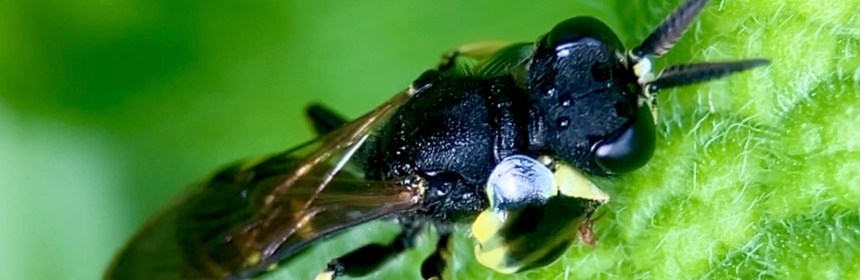
My identification for this one (and it’s a male) is Crabro latipes. The name Crabro translates from Latin as “wasp-like,” and latipes translates from Latin “latus” as broad or wide, and “pes” or “pedis” as foot.   I referenced Bohart, 1976 for a description:  

Both sexes have the mandible partly and scape mostly pale, orbital silvery stripe ending before apex of scape, scutal punctures separated by two or more diameters medially, and proposal enclosure with close longitudinal ridging, especially in female.  Male latices have flagellomere I broader than long, but without a ventral hair tuft, forefemur with basoventral spine long and curved, outer fore femoral angle stoutly projecting backward, foretibia proper with an apical black spot or line, shield with three pale stripes of which most ventral one reaches posterior membranous tip (usually frayed fig. 69), basal declivity of mesopleural venter polished and sharply margined posteriorly, middle nearly all pale ventrally, midtarsomere I twice as long as rest of articles combined.  Female latipes have clypeal bevel weakly impressed and about half as high as broad, hair of upper front fulvous to brown, mesopleural side extensively polished, tergal bands often complete except on II-III where spots are usually close.  Markings on the shield are unique and diagnostic (fig. 69). 
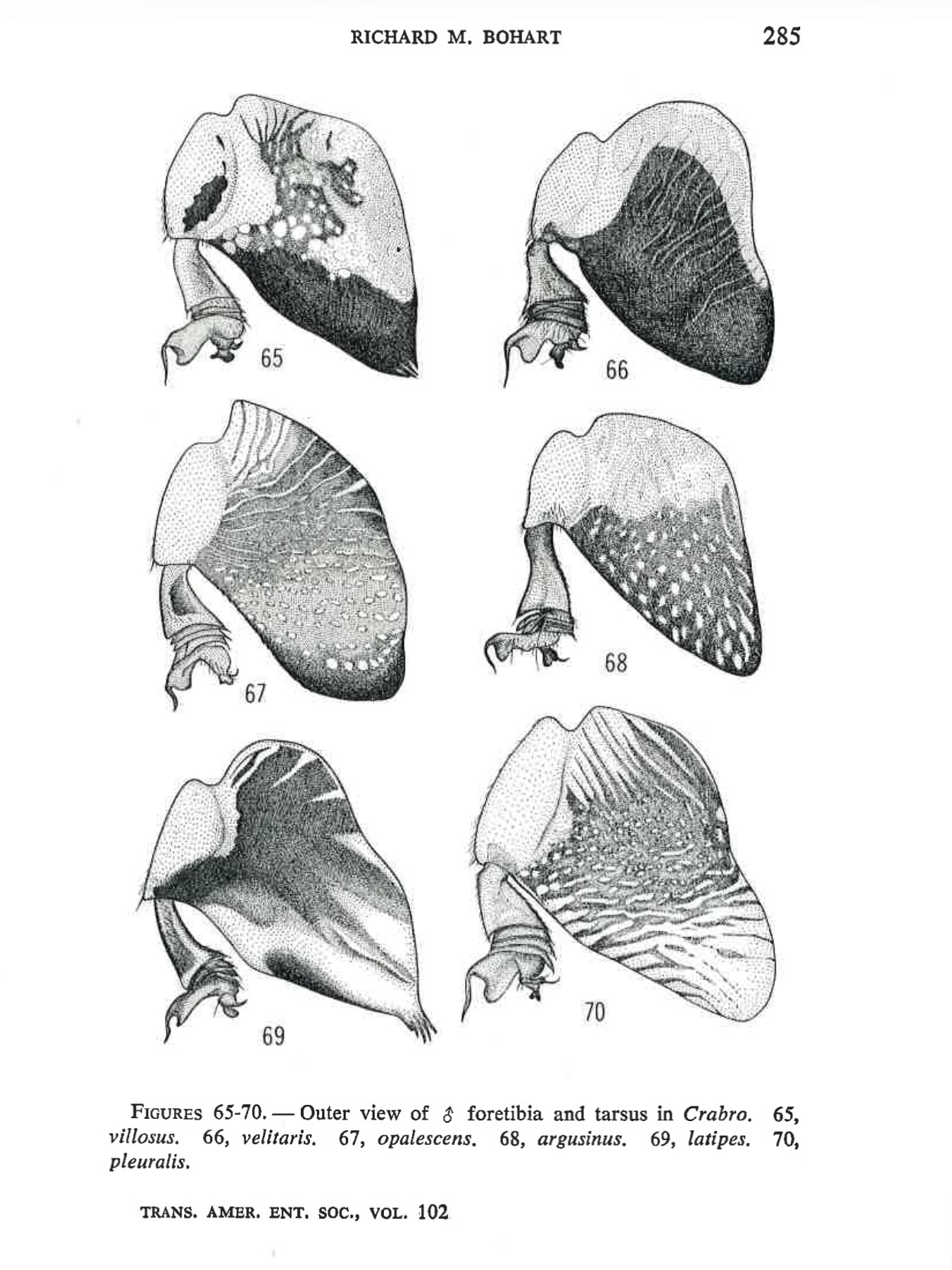
Bohart, 1976
From Bohart, 1976

I also learned reading Bohart that C. latipes is the most abundant species in America north of Mexico, accounting for at least half of all Crabro in collections. In spite of this, their biology not well known.  He records observing one female provisioning a nest with mucoid flies (Musca domestic) in gravelly meadow soil at an elevation of 8,000 feet on Mt. Rose, Nevada.  

Digging further, I turned to Crompton, 1955, Peckham & Peckham, 1898, and also Evans, 1960 & 1963.  There was, as Bohart suggested, little to be found about the biology of this particular species. However, Evans describes another species, C. advenus  as collecting cluster flies (Pollenia) for nest provisioning. We do have Pollenia flies about our garden space as you can see here. They are interesting enough themselves, being parasites of earthworms. More on that perhaps in a to-be-written blog post.

Pollenia fly in Pineapple mint

Other Crabro species were described as collecting flies belonging to families Muscidae, Calliphoridae,Tabanidae, Rhagionidae, Sarcophagidae, and Otitidae.   Apparently these wasps exhibit a strong preference for flies, though Peckham and Peckham observed one species (C. interruptus) provisioning a nest near a shoreline with white moths.  

Interestingly, Peckham and Peckham also reported finding live flies interred into the nest cells with no indication of paralysis.  Paralyzing prey is typical in other groups of solitary wasps provisioning nests. Crompton and Peckham recount observations of the genus as well, describing them toiling through the night excavating pithy stems (raspberry and blackberry briars or other woody perennials), though one species reportedly excavates tunnels into tree roots.    

And the shield?  Well, according to Bohart (1976), the shield is utilized by the male who holds these over the female’s eyes during mating.  He also suggests that due to the variety in shape and ornamentation of the shield, that it may perhaps be a display function to entice females during courtship.  

This is as far as I got tonight. I’m going to post, but will likely come back to make updates and revisions. Sometimes these write ups are as much for me as for anyone else reading. I like to write up my notes and keep references and this is a handy way to organize them for future use.

Thanks for reading! If you find anything you’d like to share, please feel free to send me a note. I like hearing from my readers.

References

Bohart, R. M. 1976. A Review of the Nearctic Species of Crabro (Hymenoptera: Sphecidae). Transactions of the American Entomological Society (1890-), 102(2), 229–287. http://www.jstor.org/stable/25078192

Crompton, J. 1948. The hunting wasp. London: Collins.

Evans, H.E. 1963. Wasp Farm. American Museum of Natural History. 178 pp.

Evans, H.E. 1960. Observations on the nesting behavior of three species of the Genus Crabro (Hymenoptera: Sphecidae). Journal of the New York Entomological Society,  68:123-134.   https://researcharchive.calacademy.org/research/entomology/Entomology_Resources/Hymenoptera/sphecidae/copies/Evans_1960_Crabro.pdf

Fabre, J. Henri 1823-1915. (1916). The hunting wasps. London: Hodder and Stoughton.

Peckham, G. W.  1898. On the instincts and habits of the solitary wasps. Madison, Wis.: Published by the State.
Discovering the Golden Paper Wasp: A Native Treasure

Polistes aurifer, a native paper wasp

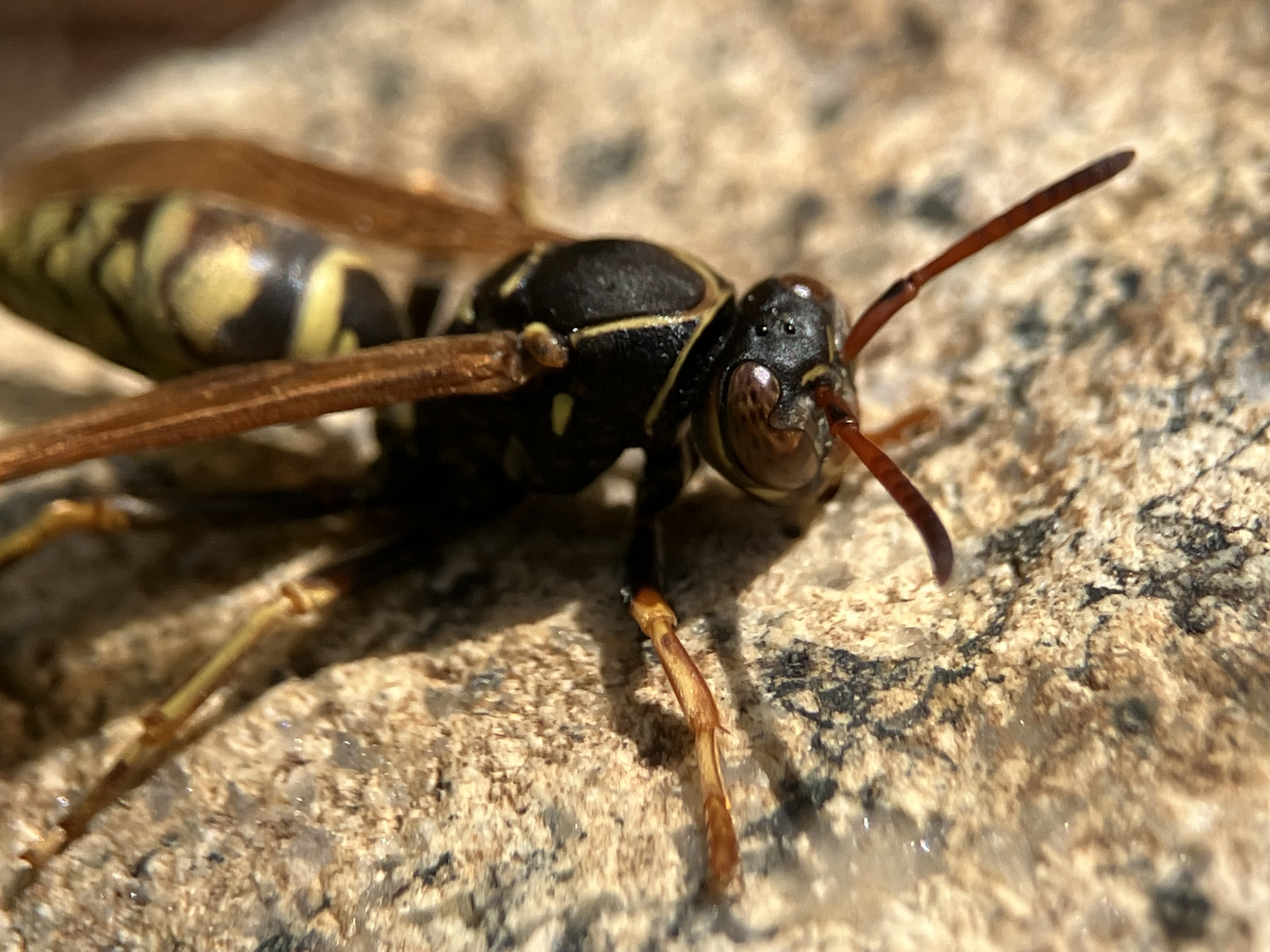
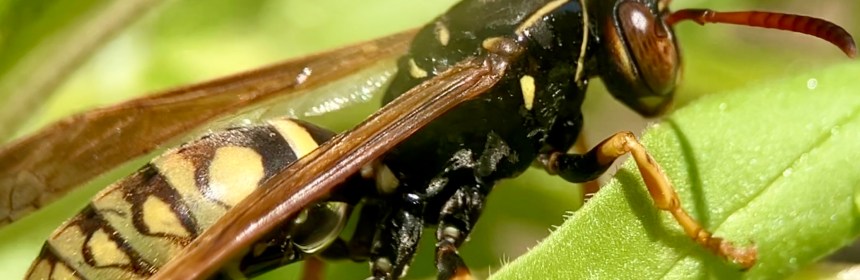
The other morning when I was watering our garden, I spied the most beautiful creature I’ve seen in a long time, a Golden Paper Wasp (Polistes aurifer). In fact, in sixteen years of living on San Juan Island, I have only seen one colony of these wasps (April 14, 2024) at the San Juan County Land Bank’s Mount Grant nature preserve. These wasps are native to North America and once considered a subspecies of Polistes fuscatus. However, P. aurifer has a western geographic distribution ranging from BC-CA to AB-MT-w.TX; ne. Mexico (Bugguide.net).

Polistes wasps build open faced nests suspended by a petiole in varied sites. Some select relatively exposed areas under eaves of structures or in shrub-type vegetation, while others utilize more protected cavities such as abandoned rodent burrows or hollow trees. Most often, the ones we see are the non native European paper wasp species (Polistes dominula), that seem very comfortable establishing their nests under the eaves of our homes.

It is believed the more frequently observed (P. dominula) are displacing native Polistes aurifer, but since it is more difficult for scientists studying insects in natural or wild habitats, most formal observations have taken place utilizing sites associated with man-made dwellings (Liebert, 2004). Liebert published a short communication in Insectes Sociaux (2004) where she describes finding ground nesting colonies of this species at an observation site in California, and concludes that the “displacement” theory may be overstated. However, given the loss of natural areas due to habitat loss/conversion, a decline in populations of the native P. aurifer (I believe) would more accurately be attributed to humans. Humans also unfortunately resort to wasp spray to eradicate nests around their homes without understanding that most nests pose minimal or no risk to human comings and goings.

Polistes wasps (native and non-native) are generally considered to be beneficial insects. They are pest predators, capturing and dismembering caterpillars to feed larvae they are rearing. In Eastern and Southern regions of the U.S., some species of Polistes wasps exert significant pressure on the cotton bollworm and the tobacco hornworm, both pests of considerable economic significance.

If you spy one of these Western natives, you’ll know immediately because they have the most beautiful golden brown or caramel colored eyes!

Thanks for reading. 🙂

Polistes aurifer
Polistes aurifer
Polistes aurifer

References

Bohart, G. E. 1942. Notes on Some Feeding and Hibernation Habits of California Polistes (Hymenoptera, Vespidae). Pan-Pac. Ent. 18(1): 30-31. https://digitalcommons.usu.edu/piru_pubs/15/

Buck, M., Marshall, S.A. and Cheung D.K.B. 2008. Identification Atlas of the Vespidae (Hymenoptera, Aculeata) of the northeastern Nearctic region. Canadian Journal of Arthropod Identification No. 5: 492 pp. (PDF version).
Published on 19 February 2008. With 3 Tables and 1073 Figures.

Bugguide. 2023. Polistes aurifer. Bugguide.net. https://bugguide.net/node/view/24972

Liebert, Aviva. (2004). Ground nesting in the paper wasp Polistes aurifer (Hymenoptera, Vespidae). Insectes Sociaux – INSECTES SOC. 51. 99-100. 10.1007/s00040-003-0714-0.

p.s. I found another (naturally deceased) individual in our barn/shop, so perhaps we have had these around and I’ve just been missing them.

Polistes aurifer

The Hitch-hiker

Spilichneumon Wasp at Marketplace in Friday Harbor

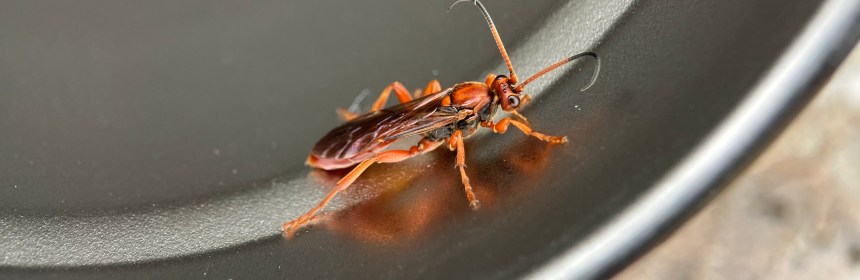
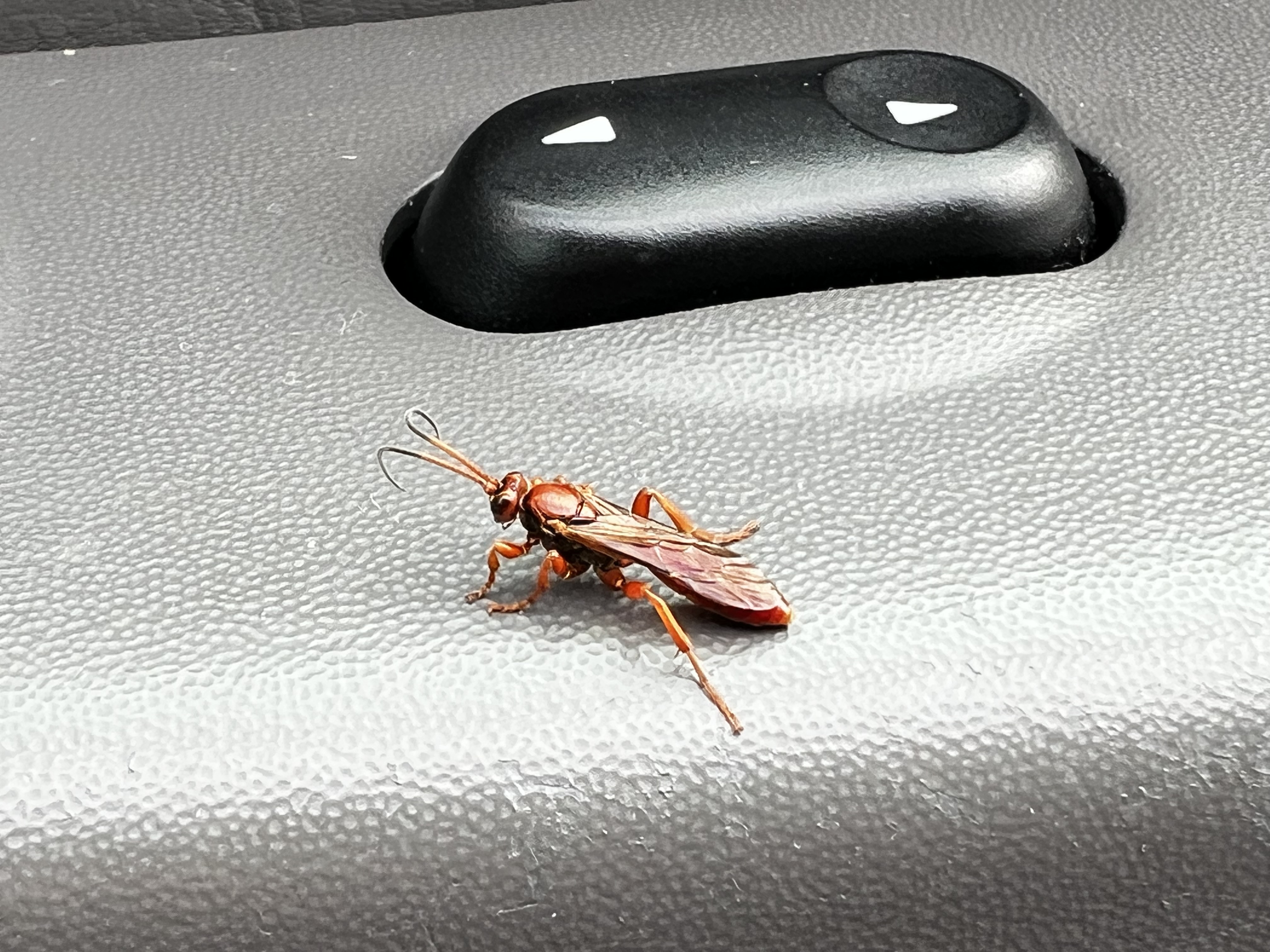
Today as I was leaving the store after grocery shopping in Friday Harbor at Marketplace (the store it took me forever to find when I first moved here, and known as the store for the “locals”), I opened the door to my truck and found this cute little red wasp on the door handle. I’m not sure how it got there, but this is one hitch-hiker I had no problem picking up. And, pick it up, I did! I conveniently scooped it to safety in a brand new insulated cup I scored on sale at our local Ace Hardware for $10. It has little bears and forest trees on it. It was also perfect for securing the wasp for our ride back to the house.

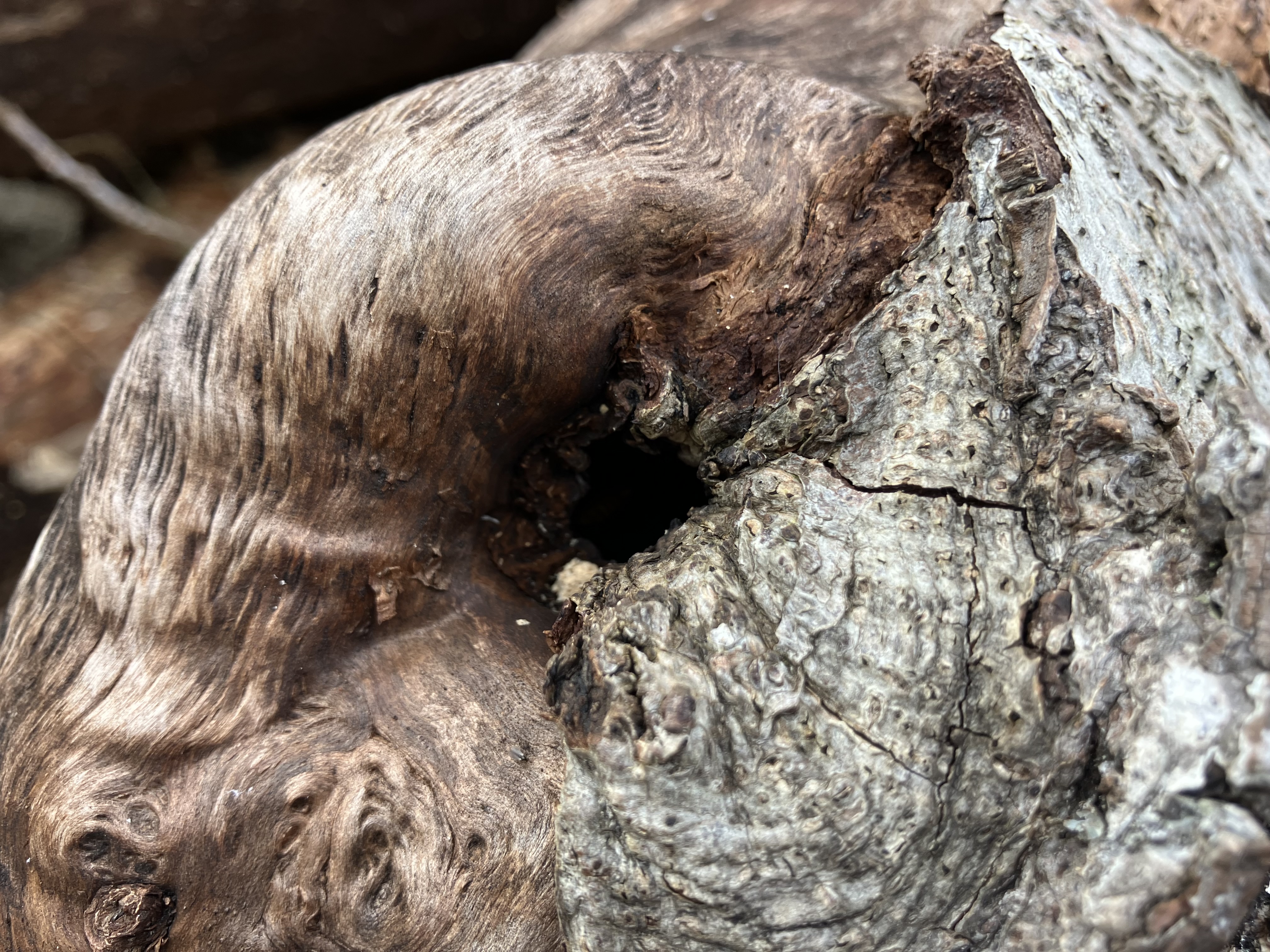
When I got home, I left the cup by the door for a bit to unload my groceries, but got my camera afterwards and carried my hitch-hiker over to a stack of alder logs we collected and piled up into a wildlife stack. Those logs are “dead” to most humans, but for all the little critters that were in them when they blew over and broke into chunks, they are FULL of life! One had a perfect knot hole that my wasp targeted right away and will probably stay holed up for the better part of next week since we have rain in the forecast. I wish more people would see dead and dying trees as something of value (other than to chip or burn). They are stores of food for birds, and shelter for many other organisms. Dead and dying trees are often more interesting to me than live ones. You just have to change your perspective and perhaps you will see what I do too!

The wasp critter is in the family Ichneumonidae. It’s in the Genus Spilichneumon, I believe. These wasps hunt and parasitize Noctuid moth caterpillars. They are most excellent pest predators! The female wasp will lay one egg inside each caterpillar she finds and then her egg will hatch and the larva will develop in the caterpillar’s body. That’s THE END of the caterpillar. 🐛

Thanks for reading!

Knothole in tree

If you are curious to learn more, here are two links to get you started. https://bugeric.blogspot.com/2012/03/wasp-wednesday-spilichneumon.html and https://bugguide.net/node/view/444129

Second Post in the Series: “NOT A MURDERER! JUST BECAUSE WE WEAR STRIPES, WE DIDN’T ESCAPE FROM PRISON AND WE AREN’T OUT TO KILL YOU!” I’m not BAAAAd, I’m A Wool Carder BEE 🐝

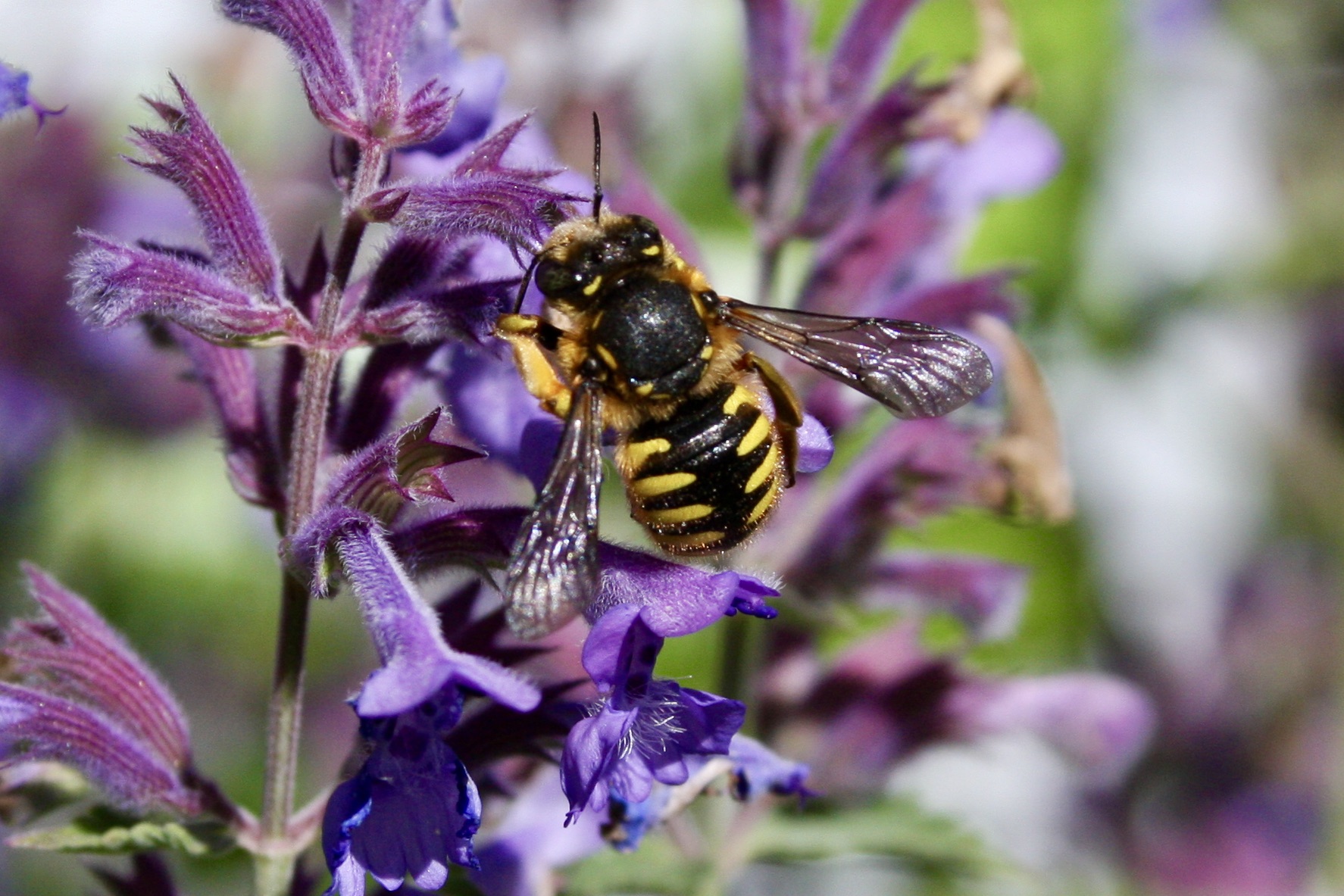
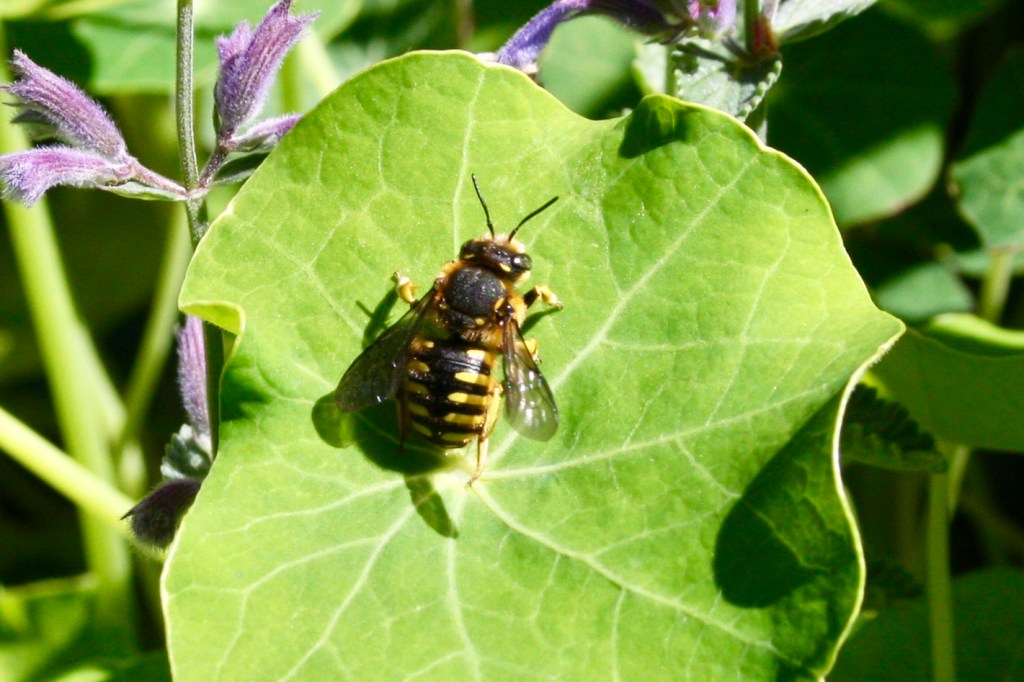
Meet Woolly Wool Carder. Woolly gets a bad rep because Woolly LOOKS like a Yellowjacket Wasp. All Woolly wants to do is find that patch of Lambswool in your garden or flower bed and take enough to make a nice cozy bed for its babies.

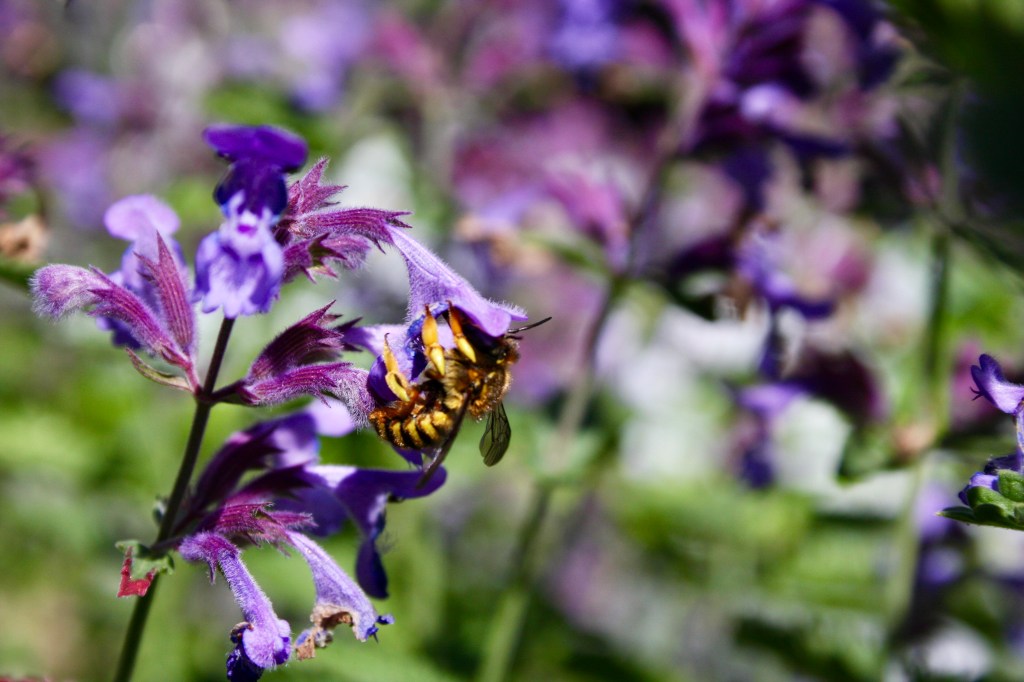
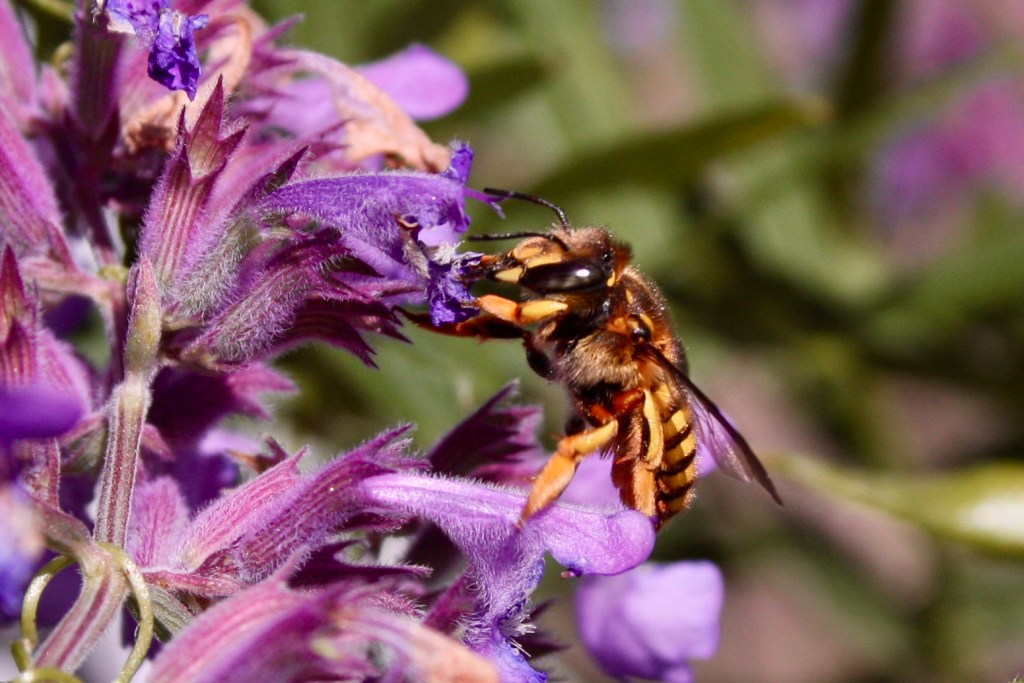
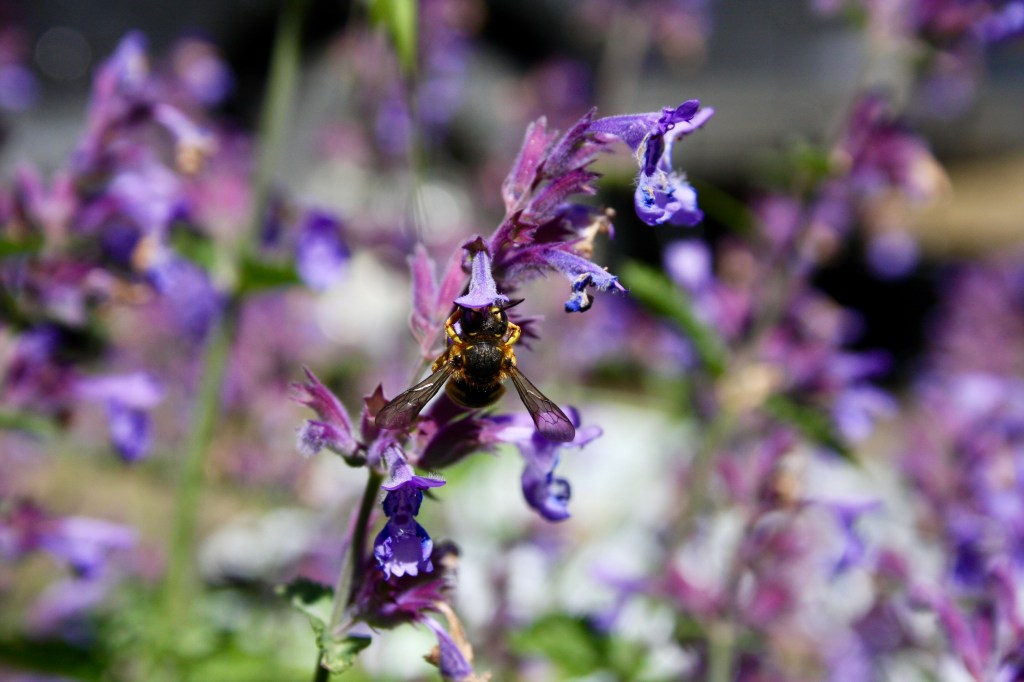
Wool Carder Bee (Anthidium manicatum) on Nepeta spp. (Catmint)

The European Wool Carder Bee (Anthidium manicatum) at first glance, looks like a somewhat chubby Yellowjacket. While these stouter and hairy-bodied bees mimic the barbed stingers everyone wants to avoid, they aren’t going to harm you at all. They don’t even have stingers, though the males do have some spines at the end of their abdomen they can use defensively against other flying insects that might be perceived as a threat to their food source or territory.

Wool Carders are smaller than most Yellowjackets. They are about the size of honey bees or between 11 and 17 mm. They are very brightly colored with yellow and black markings, but again, the distinguishing features to differentiate them from Yellowjackets are 1) they’re hairy and 2) they’re stout!

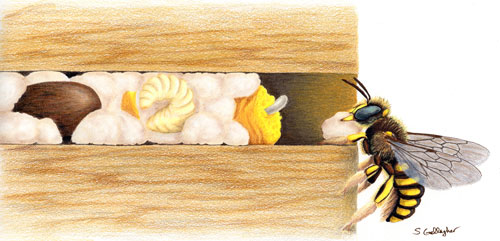
Other than sipping nectar from flowers, these solitary, cavity nesters are all about finding wool to make a cozy bed for their babies. Actually, aside from the uhm…deed, the female is the one doing all the provisioning for a nest. She will card “wool,” using her mandibles to scrape bits of trichomes (or hairs) from lambs ears or other fuzzy plants (especially those in the mint family) to make a cushioned bed on which to lay her egg. Each egg is provisioned with enough nectar and pollen to supply the developing larva with nutrients to reach pupation.

Wool Carder Bee nest – Illustration by Samantha Gallagher, University of Florida

The European Wool Carder Bee is native to Europe, Northern Africa, and Western Asia, but has become cosmopolitan in distribution. While non-native, it has become widely adapted to various habitats in North America. These bees are not dangerous to humans or pets. They are effective pollinators, but sometimes outcompete native bees for resources.

Human or Pet Risk factor NONE

References and Additional Reading:

  1. Species Anthidium manicatum – European Woolcarder http://Species Anthidium manicatum – European Woolcarder

2. Featured Creatures http://entnemdept.ufl.edu/creatures/MISC/BEES/Anthidium_manicatum.html

3. Campion, A. European Wool Carder Bees: Likable Bullies The World’s Best Gardening Blog

4. Bumblebee Conservation Trust Wool carder bee (Anthidium manicatum) https://www.bumblebeeconservation.org/woolcarderbee/