Meet Woolly Wool Carder. Woolly gets a bad rep because Woolly LOOKS like a Yellowjacket Wasp. All Woolly wants to do is find that patch of Lambswool in your garden or flower bed and take enough to make a nice cozy bed for its babies.
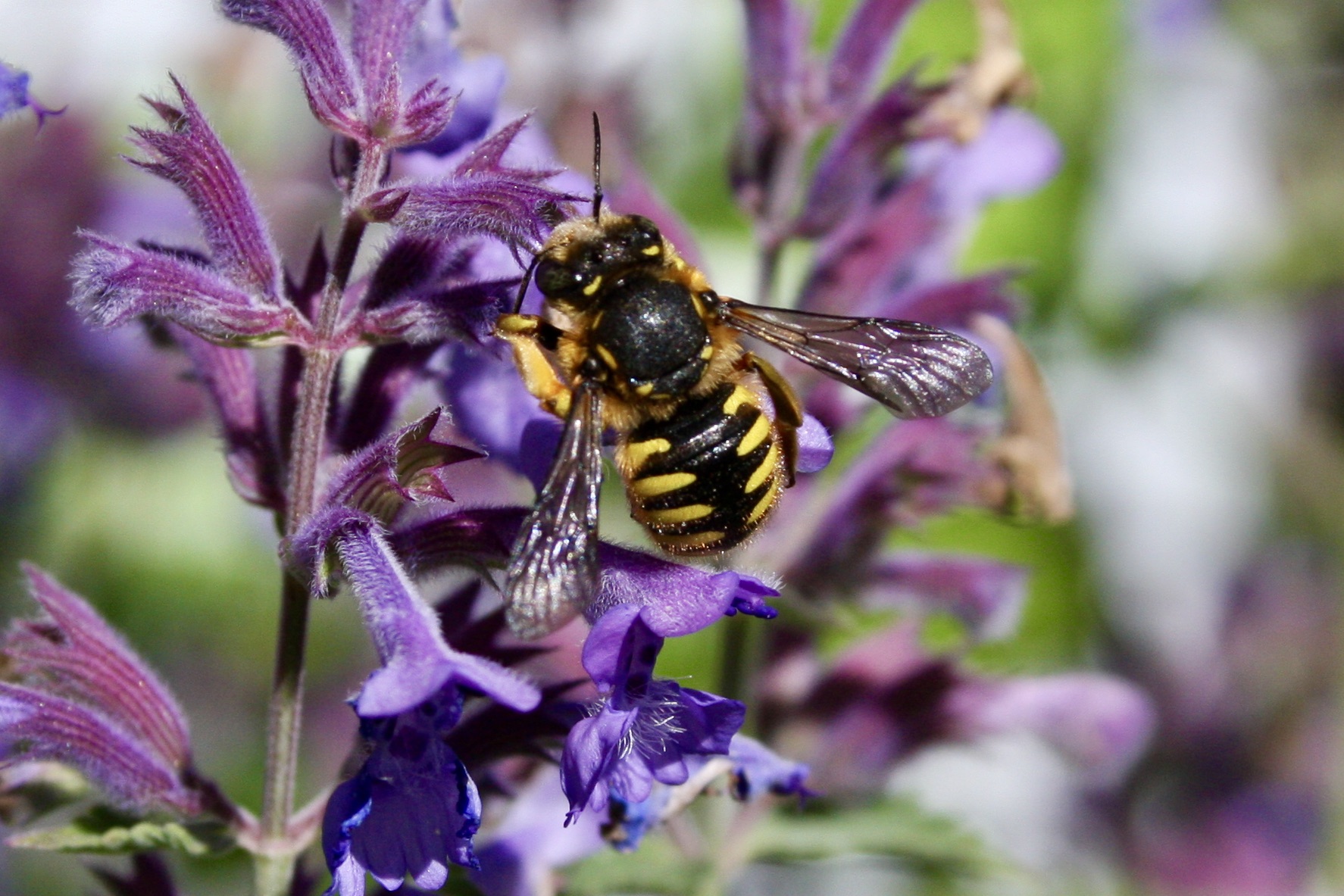
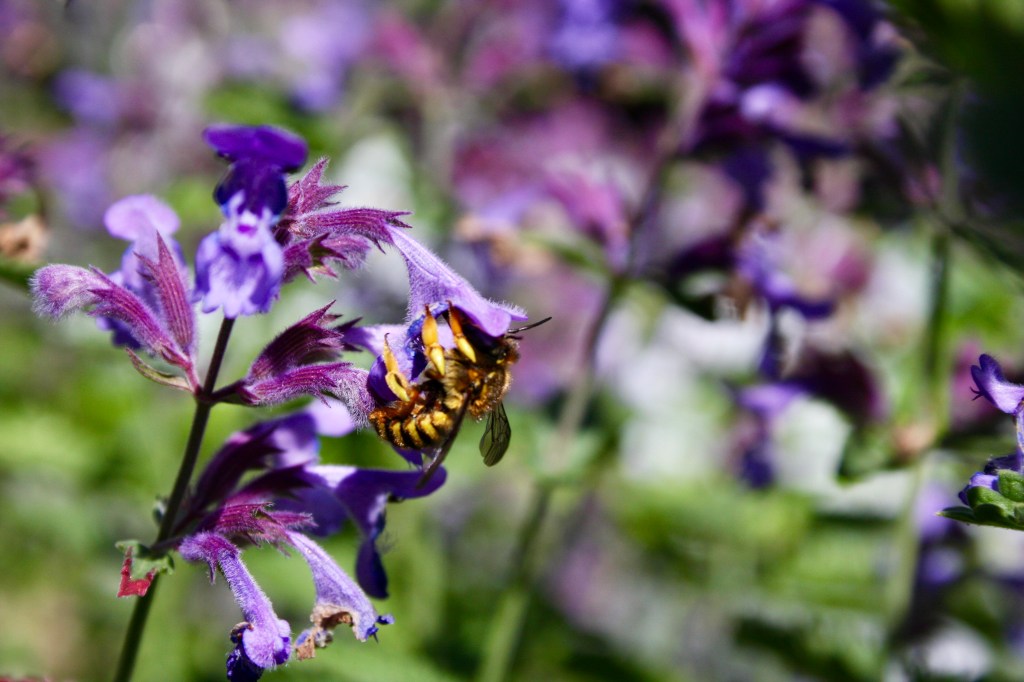
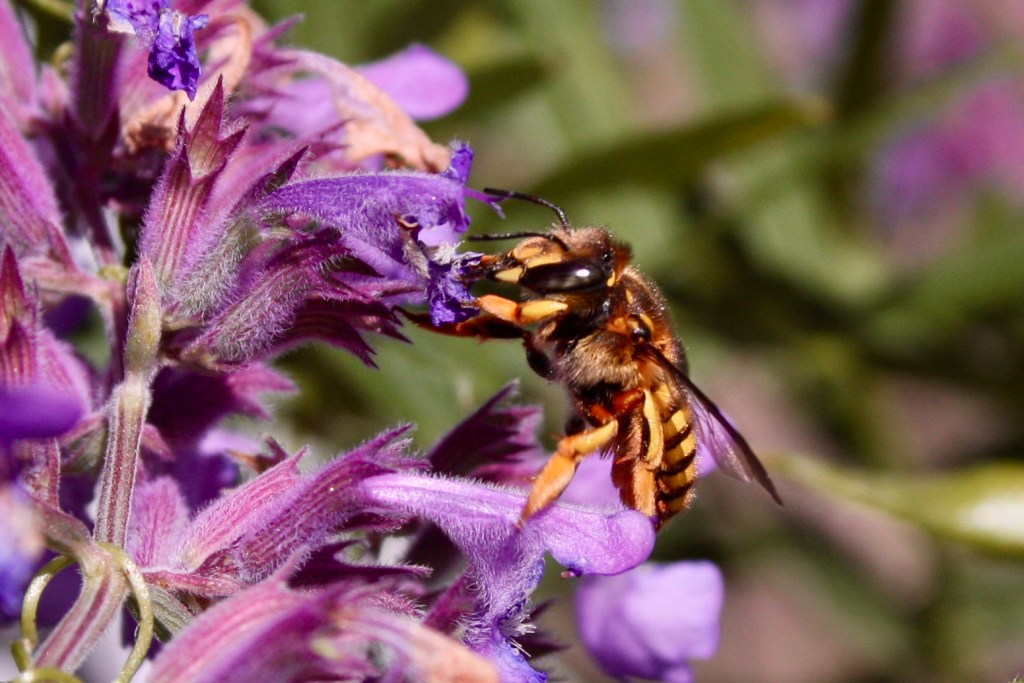
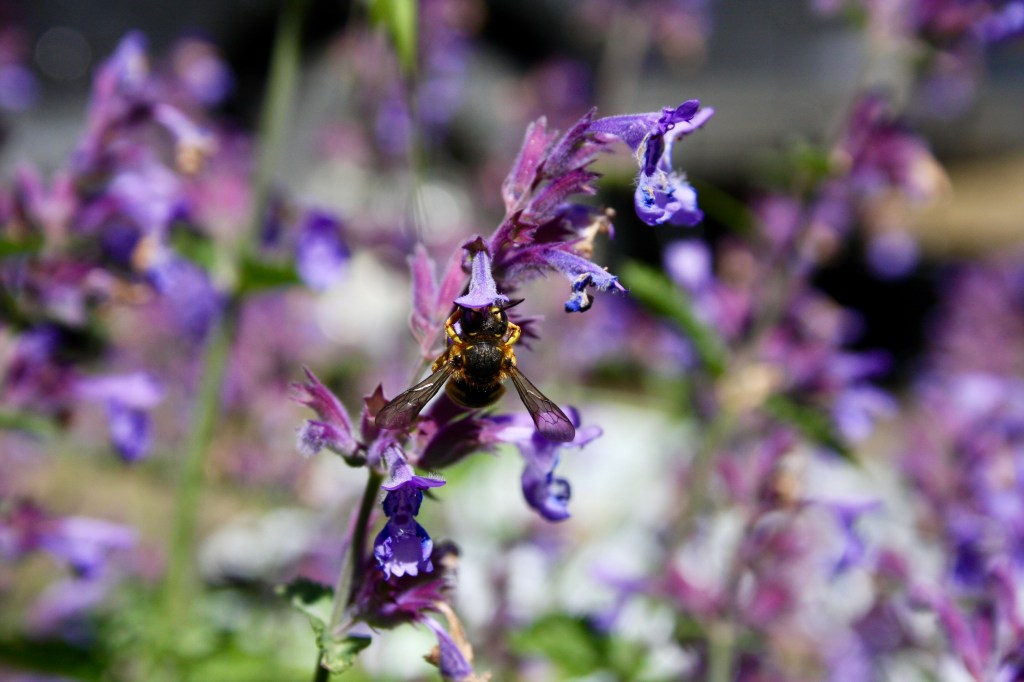
Wool Carder Bee (Anthidium manicatum) on Nepeta spp. (Catmint)
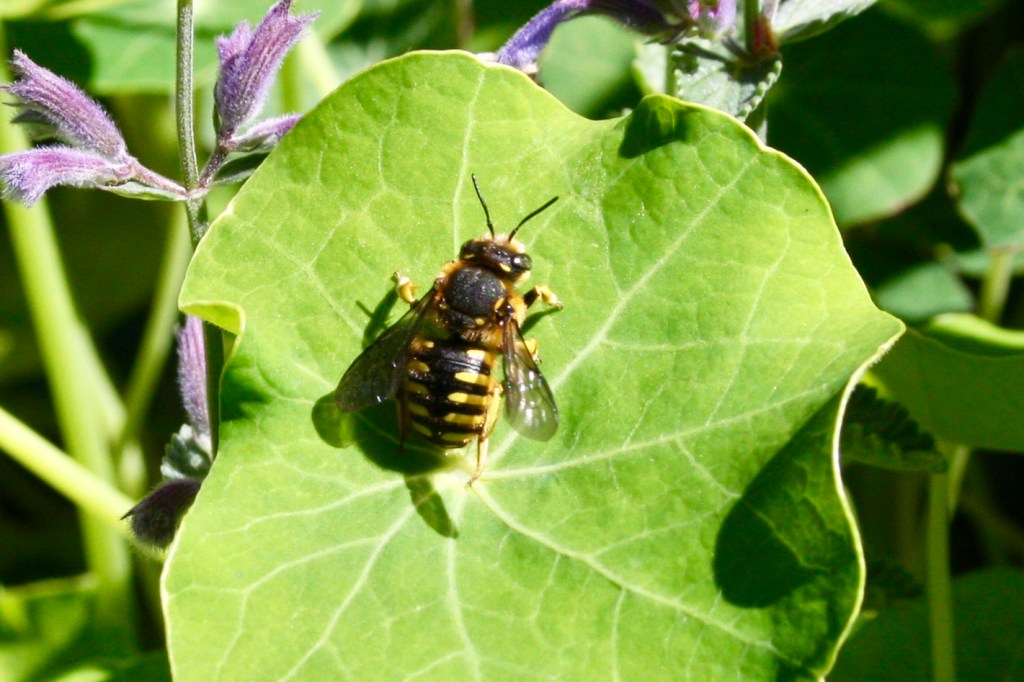
The European Wool Carder Bee (Anthidium manicatum) at first glance, looks like a somewhat chubby Yellowjacket. While these stouter and hairy-bodied bees mimic the barbed stingers everyone wants to avoid, they aren’t going to harm you at all. They don’t even have stingers, though the males do have some spines at the end of their abdomen they can use defensively against other flying insects that might be perceived as a threat to their food source or territory.
Wool Carders are smaller than most Yellowjackets. They are about the size of honey bees or between 11 and 17 mm. They are very brightly colored with yellow and black markings, but again, the distinguishing features to differentiate them from Yellowjackets are 1) they’re hairy and 2) they’re stout!
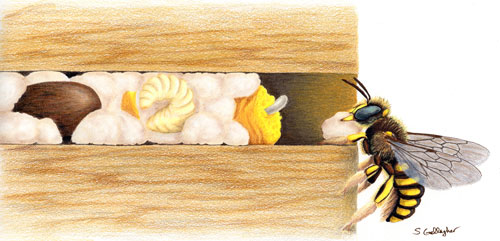
Other than sipping nectar from flowers, these solitary, cavity nesters are all about finding wool to make a cozy bed for their babies. Actually, aside from the uhm…deed, the female is the one doing all the provisioning for a nest. She will card “wool,” using her mandibles to scrape bits of trichomes (or hairs) from lambs ears or other fuzzy plants (especially those in the mint family) to make a cushioned bed on which to lay her egg. Each egg is provisioned with enough nectar and pollen to supply the developing larva with nutrients to reach pupation.
Wool Carder Bee nest – Illustration by Samantha Gallagher, University of Florida
Anthidium manicatum European Wool Carder Bee 06.28.2020
Anthidium manicatum European Wool Carder Bee 06.28.2020
Anthidium manicatum European Wool Carder Bee 06.28.2020
Anthidium manicatum European Wool Carder Bee 06.28.2020
Anthidium manicatum European Wool Carder bee on Nepeta 06.28.2020
Anthidium manicatum European Wool Carder Bee 06.28.2020
Anthidium manicatum European Wool Carder Bee 06.28.2020
The European Wool Carder Bee is native to Europe, Northern Africa, and Western Asia, but has become cosmopolitan in distribution. While non-native, it has become widely adapted to various habitats in North America. These bees are not dangerous to humans or pets. They are effective pollinators, but sometimes outcompete native bees for resources.
Menacing Murder Hornets are making headlines everywhere these days and giving many of our beneficial wasps a bad rap. Before you grab that can of bug spray, follow along for the next week or two while I profile the good guys and give you tips on how to ID the ones you’ll see on the San Juan Islands.
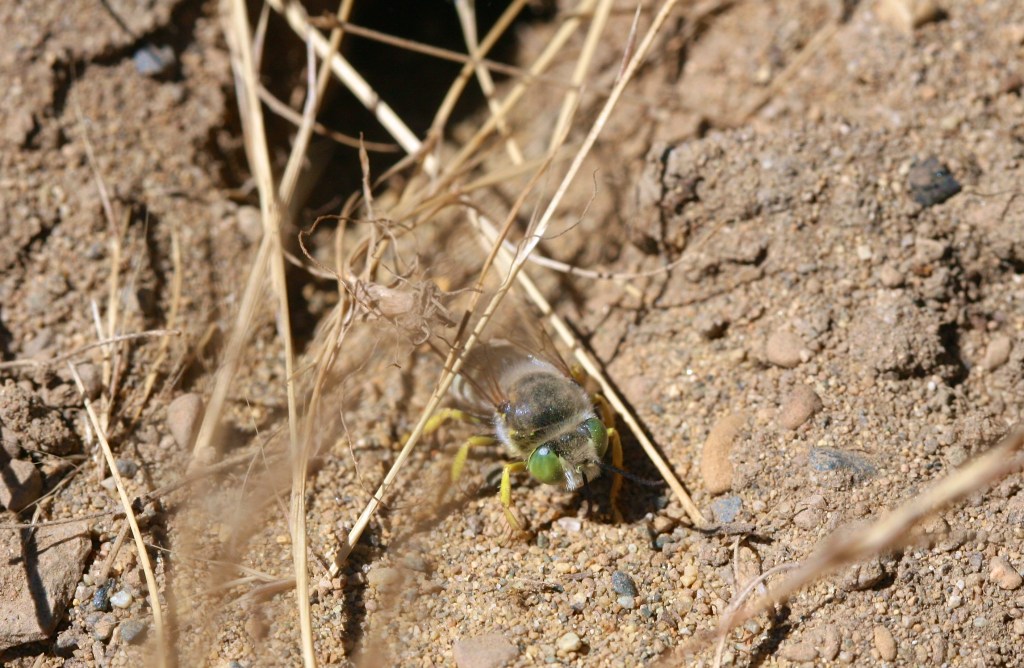
Wasp #1 – The Western Sand Wasp (Bembix americana)
Bembix americana – Western Sand Wasp – San Juan Island, WA
On San Juan Island, if you’re out along the beach bluffs on the west side or anywhere at American Camp, Eagle Cove, or Jackson’s Beach and the nearby quarry, you may notice them hovering and darting about above the sand or spots of bare earth. Western Sand Wasps are solitary digger wasps in the family Crabronidae. Males and females emerge simultaneously and their entire adult life is to sip nectar from flowers, mate, and reproduce.
After mating, it is the female who will provision her nest. She scours the sand and nearby areas, hunting insects and arachnids to supply her developing offspring in underground burrows. She will oviposit one egg in a single burrow, leaving it with a zombied insect, continuing until all her eggs are laid. But her work is not over. She must continue to check and feed each of her larvae in their individual burrows after the eggs hatch, making sure that they do not starve as they develop. Fast fact…a single larva can eat more than 20 flies before it pupates!
So she digs…and digs…and digs! These wasps are able to dig so fast, they can disappear under the sand in a matter of seconds.
video by Cynthia Brast-Bormann, San Juan Island, WA
Human or Pet Risk factor – LOW
Unless you are walking barefoot in the sand and mange to step on one of these, you are highly unlikely to be stung. Wear foot coverings and enjoy your hike or picnic. They’re not going to murder you!
I had my bearded dragon outdoors the other afternoon to get his 20 minutes of sunshine (me too!) when I spied something unusual moving in the grass. The object of my attention was a fairly large caterpillar lying in the middle of 25-30 voracious Thatching Ants (Formica obscuripes), intent on relocating the caterpillar (their dinner), even if they had to do it one bite at a time.
Observing them at work, I thought of how the Egyptian pyramids were built. Humans. Lots of them. Carrying those giant blocks and stacking them required formidable effort. Perhaps these ants in their orchestrated labor efforts would successfully lug this lepidopteran larvae back to their nest.
I did not stay and watch to the end. I watched just long enough and filmed this clip. I felt a bit sad for the caterpillar, wondered about the butterfly or moth it might have become, and I marveled a little about these industrious ants that cooperate for the collective benefit of the colony.
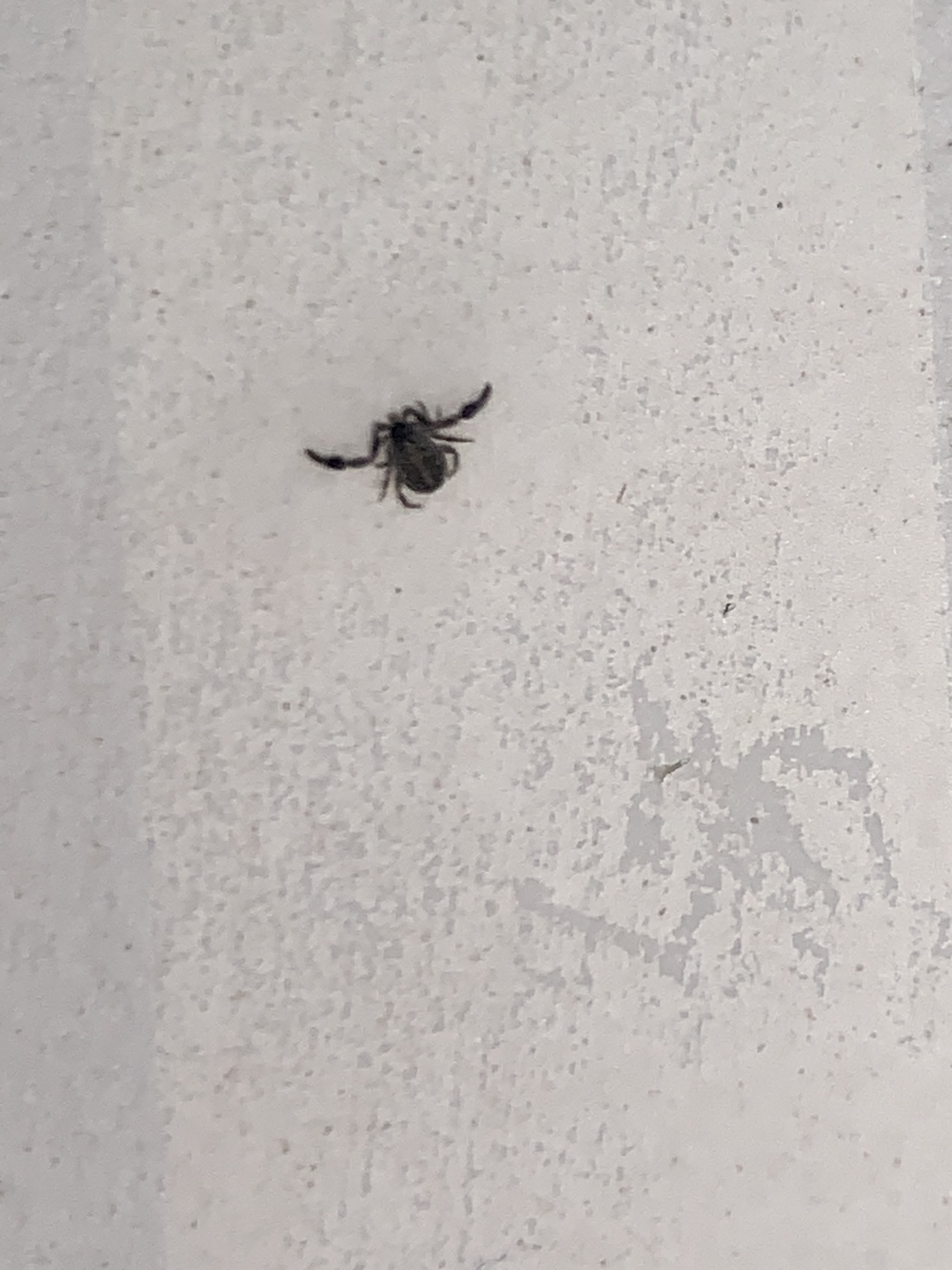
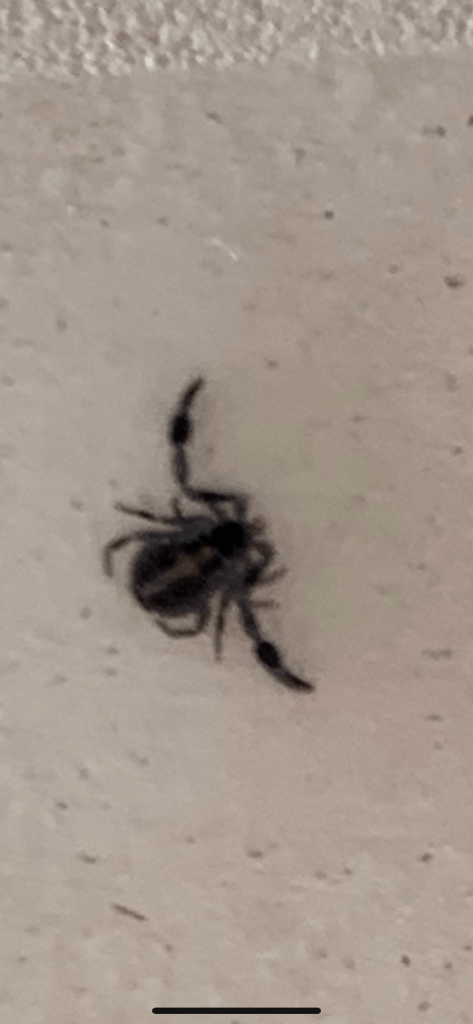
House Pseudoscorpion (Cheliferidae cancroides) 2/28/2020 San Juan Island photo by T. SantoraHouse Pseudoscorpion (Cheliferidae cancroides) 2/28/2020 San Juan Island photo by T. Santora
House Pseudoscorpion (Cheliferidae cancroides)
House Pseudoscorpion (Cheliferidae cancroides)
House Pseudoscorpion (Cheliferidae cancroides)
House Pseudoscorpion (Cheliferidae cancroides) 2/28/2020 San Juan Island photos by T. Santora
This little creature was photographed on February 28, 2020 by Trever Santora on San Juan Island, WA.
It’s a Pseudoscorpion! Found on the windowsill of his house and no larger than a tiny sesame seed, I believe it to be an immature House Pseudoscorpion (Cheliferidae cancroides).
Keep an eye out for these. They’re quite harmless to humans and can’t sting or bite you. Pseudoscorpions are predacious and beneficial because they eat other organisms that are pests. Some live in birds’ nests and eat the mites that can build up and harm nestlings.
Since they don’t have wings and can’t fly, pseudoscorpions move around by phoresy. That means they’ll hitch a ride on someone who can! Not just birds, but bees, wasps, and flies can also provide a free lift.
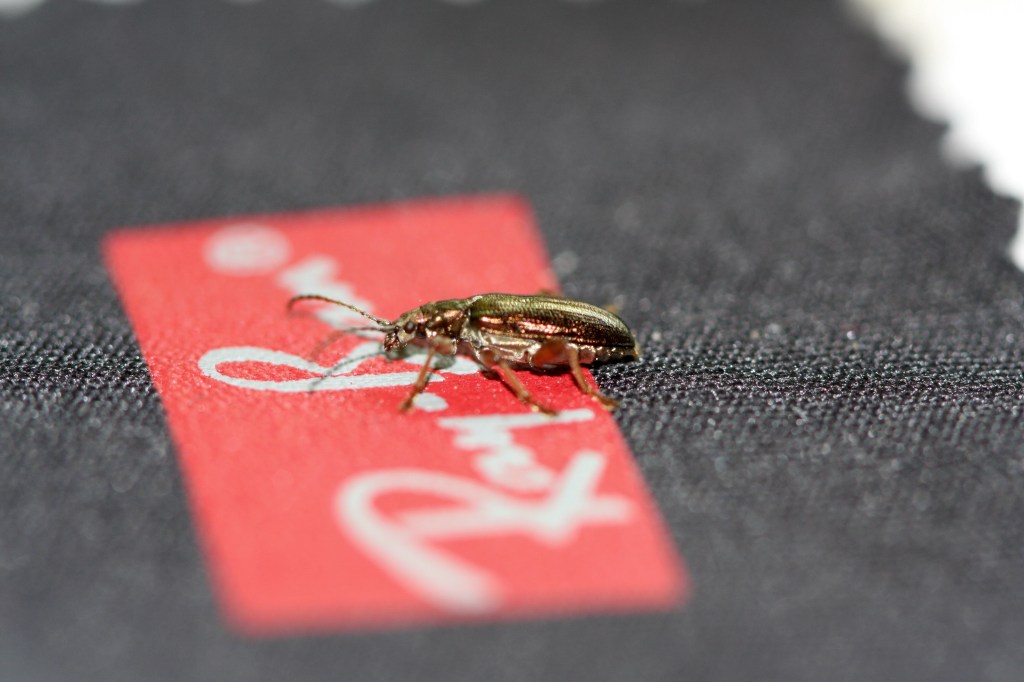
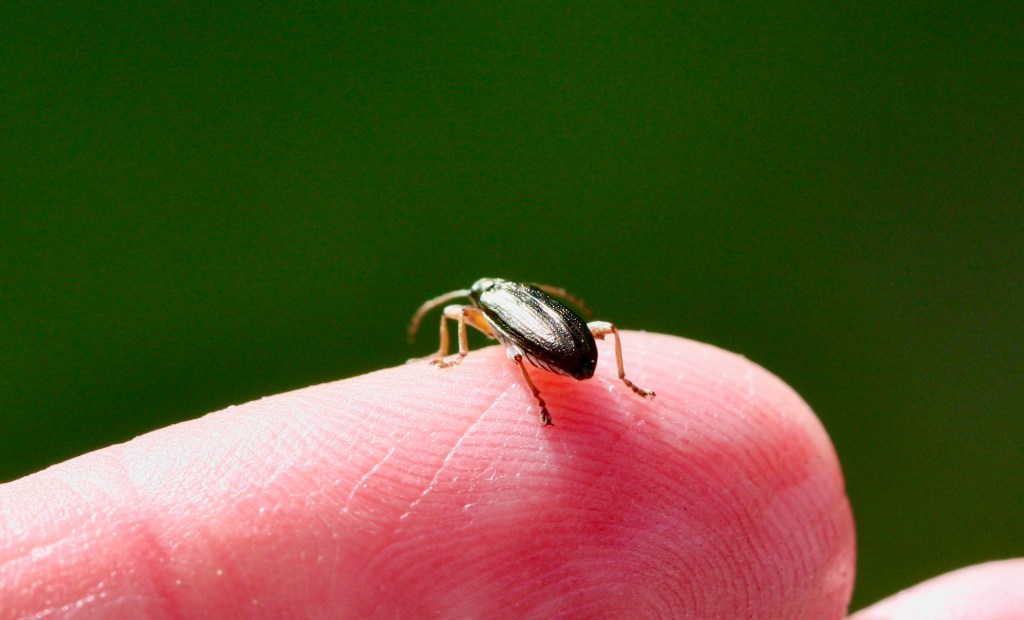
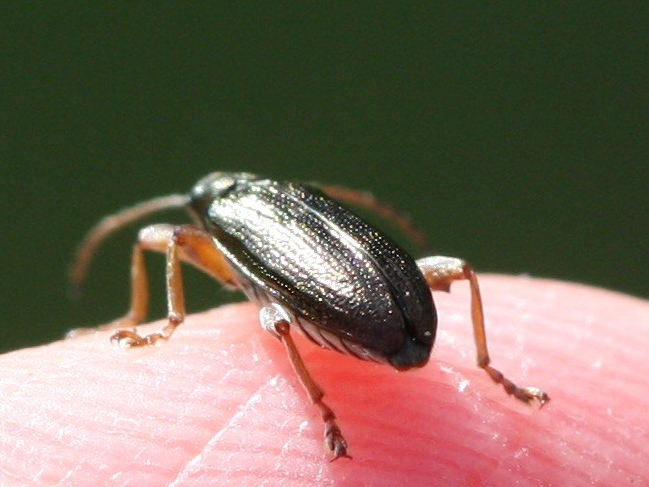
I really enjoy the days when I have an opportunity to go over insect images I’ve taken, but haven’t yet had the chance to identify. This small (approx 7-8mm), metallic beetle is a leaf beetle in the family Chrysomelidae. It’s a Long-horned Leaf Beetle (Plateumaris germari). They are associated with aquatic habitats and this specimen was found near a wetland habitat on San Juan Island, WA., May 12, 2015. Yes. I’m slow at getting around to sorting things, but was happy to share this one today.
Long-horned Leaf Beetle Plateumaris germari San Juan Island, WA May 12, 2015 photo by Cynthia BrastLong-horned Leaf Beetle Plateumaris germariLong-horned Leaf Beetle Plateumaris germariLong-horned Leaf Beetle Plateumaris germariLong-horned Leaf Beetle Plateumaris germari
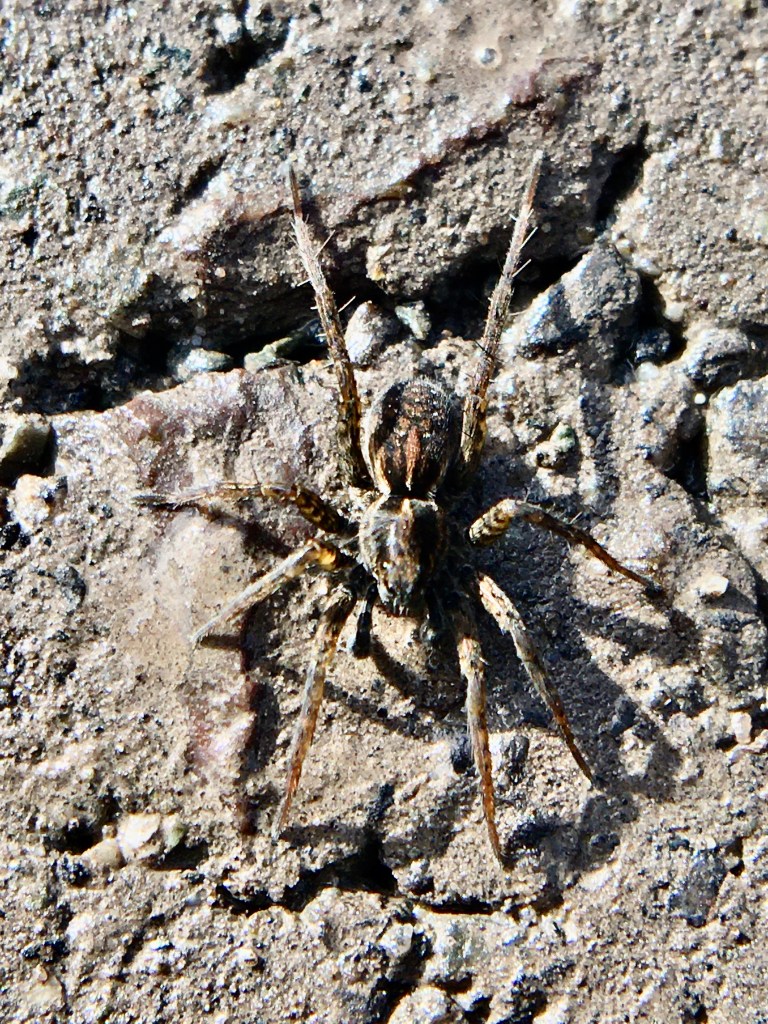
Here’s another spider for you. I photographed this one yesterday, February 22, 2019, on the dirt road near my home on San Juan Island, WA. There were two of them, but in the past, I’ve seen up to twenty crawling around (and they move extremely fast) in this (usually sunny) spot. My ID attempt here is that it’s some type of wolf spider. Size is approximately 3-4mm. The photos were taken with a macro clip on lens for iPhone.
Pardosa spp. Thin-legged wolf spider 2.22.2020 Three Corner Lake Road, San Juan Island, WA ID credits thanks to A. Pelegrin and L. PaxsonPardosa spp. Thin-legged wolf spider 2.22.2020 Three Corner Lake Road, San Juan Island, WA ID credits thanks to A. Pelegrin and L. Paxson
The short video clip below is from the same spot in the road on April 20, 2019. On this occasion, there were LOTS of these long-legged wanderers and they are super fast!
Pardosa spp. Thin-legged Wolf Spider San Juan Island,WA April 20, 2019
Yesterday, my husband took me for a walk in the woods near our home and while I always enjoy the fresh air and the quiet beauty of the woods, I especially appreciate the opportunity to discover new bugs. I was really hoping to come across one beetle in particular, a ground beetle that I’ve only seen three times since September 2009, when I first moved to San Juan Island.
It’s called Matthews’ Angry Gnashing Beetle or Zacotus matthewsii. Zacotus means “very angry” in Greek, though I’m not sure why this beetle would ever act in an angry manner unless you were poking it with a stick. In that case, it’s likely it would attempt to defend itself by gnashing at you with its mandibles, and any bites you receive would be well deserved indeed!
The last sighting I had of a live Zacotus matthewsii was February 18, 2015 at 5:56 p.m. I’m hoping to walk along the same spot again this evening about the same time in hopes of sighting another.
These ground beetles are extremely unique. Their maroon-red metallic coloring is often ringed with a green shimmer along the margins of its body.
Zacotus matthewsii 2/18/15
Three Corner Lake Road
San Juan Island, WA
Sadly, the life history of these beetles is understudied. We do know they are only associated with old growth forest ecosystems and rarely seen. When old-growth forests are cut down, the beetles disappear and our opportunity to know them is lost.
While I didn’t find one of these beetles yesterday on our walk in the forest, I did come across some equally interesting residents, cohabitating in a rotten log near a stream. I might have missed them entirely, but for my curiosity leading me to lift off a section of the log. It was a bit like lifting the roof off a house, and being able to see all the rooms and inhabitants, only instead of being a multi-family unit, this was a multi-species, multi-family unit!
I’d packed my cellphone and my handy clip on macro lens, so I was able to take some video and photos to share with you. Here’s what I found!
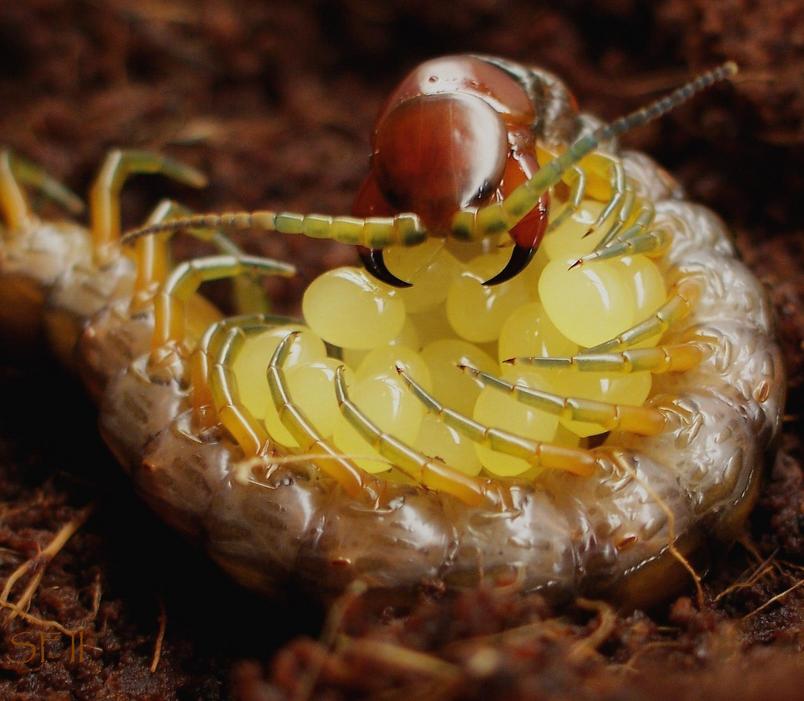
The first amazing creature that was exposed in the log was a centipede. This is Scolopocryptops spinicaudus. I noticed nearby, there was a grouping of eggs, so after a bit of internet searching, I discovered the very neat fact that these (and other species) of centipedes stay with their eggs.
The mother will wrap herself around the cluster to better protect them, staying with her brood even weeks after they hatch, leaving them only after they are able to fend for themselves. I believe this mother centipede moved away from her eggs when I removed the section from the log in order to draw my attention away from them.
***Eggs were not disturbed and I replaced the log section after taking my photos.
Scolopocryptops spinicaudus Centipede with eggsScolopocryptops spinicaudus with eggs 2/16/2020 Lester ParcelScolopocryptops spinicaudus (Centipede) eggs 2/16/2020 Lester Parcel
Below is a photo I found when I was searching about centipedes and parental care. I find it amazing that even invertebrates show such care for their offspring!
The next resident in the log that caught my eye was the very tiny, whitish-translucent, globular creature that looked a lot like a bark or booklouse, but turned out to be a “baby” termite. These were larvae of the Pacific Dampwood Termite, Zootermopsis angusticollis. I wasn’t able to get a good view, but it looked as if these were being tended by an older family member.
Dampwood termites are widespread in Pacific Northwest forests. They rarely cause damage to structures, but play a very important ecological role, recycling nutrients from decaying trees. They are also food for Pileated Woodpeckers and other birds and animals.
Pacific Dampwood Termite (Zootermopsis angusticollis) larvae 2/16/2020 Three Corner Lake Road, San Juan Island, WA
Zootermopsis angusticollis larvae
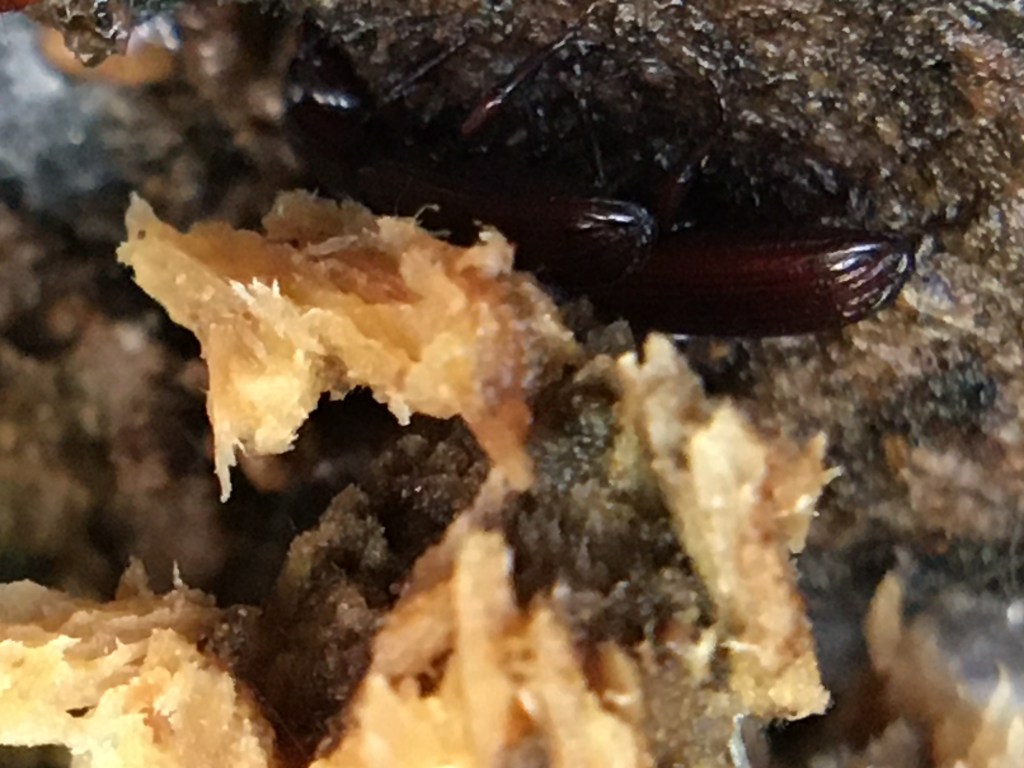
Finally, the last residents I spied cohabitating in this section of rotting log were the very tiny Wrinkled Bark Beetles (Clinidium spp.) Clinidium spp. of bark beetles feed on slime molds (Myxomycetes), found in decaying or dead hardwoods and conifers. They are in the Family Rhysodidae and there are only two genera and eight species in North America. Only two of these eight species range in the West (from California to B.C. ) (White, 1983).
At about 5mm in length, these were hard to detect with the naked eye. I took the following photos with my macro lens, showing the striations along the elytra and the lateral grooves on the basal half of the pronoun.
Wrinkled Bark Beetle (Clinidium spp) 2/16/2020
The next photo shows two adults together, presumably hibernating together in a cavity in the rotting log (White, 1983) .
Wrinkled Bark Beetle adults hibernating together (Clinidium spp) 2/16/2020
References
Lattin, John, D. 1993. Arthropod Diversity and Conservation in Old-Growth Northwest Forests. American Zoologist. 33 (6) pp. 578-587. https://www.jstor.org/stable/3883721
White, Richard. 1983. A Field Guide to the Beetles of North America. Peterson Field Guide Series. Houghton Mifflin Company, NY.
Someone in San Juan County is being tested by the CDC for possible infection with the novel coronavirus (COVID-19). The person’s ID and island of residence has not been released. If confirmed, this would be the first instance of the virus in San Juan County and the second case in WA state. https://www.sanjuanjournal.com/news/person-under-investigation-for-novel-coronavirus/
Lots of folks think living on an island is some sort of safe haven. I’ve spent a bit of time thinking about this and I just don’t believe that to be true. First off, if everyone got sick, we definitely do NOT have the capacity to care for people in hospitals. Probably we would quickly run out of supplies. It’s really doubtful that anyone would want to deliver things to the island if we had some type of epidemic. We could easily run out of food and fuel.
If I’ve learned anything in the ten-plus years I’ve lived here, it’s that you should be prepared to care for yourself. Whether it’s an earthquake or other natural disaster, government breakdown (that could certainly happen given our current administration), or disease outbreak, a plan is essential! While I know we have some truly dedicated medical professionals on our island, they are limited. There’s also not any prescription drug that will cure you of coronavirus if you get it. This links to the limited treatment options that may be available or under development https://www.livescience.com/possible-treatments-new-coronavirus.html
So, my plan (if anyone in my household gets sick) is to have my self-treatment items in order. Here’s my list:
Pedialyte, Gatorade, and Ginger Ale. For rehydration!
Lemon Balm. Strong antiviral properties. Use a tincture or make a tea.
Ginger. Also strong antiviral properties.
Saltine Crackers
White rice
Licorice Tea
Lysine
Saline Spray
Motrin/Tylenol
Vick’s Vapor Rub
If you can think of anything I might have left off, please feel free to write and let me know! P.S. I’m not a doctor. These are my own HOME remedies. Use your own good judgement and wash your hands a lot!
References:
Barak, Vivian & Halperin, T & Kalickman, I. (2001). The effect of Sambucol, a black elderberry-based, natural product, on the production of human cytokines: I. Inflammatory cytokines. European cytokine network. 12. 290-6.
Castillo-Maldonado I, Moreno-Altamirano MMB, Serrano-Gallardo LB (2017) Anti-dengue serotype-2 activity effect of Sambucus nigra leaves-and flowers-derived compounds. Virol Res Rev 1: DOI: 10.15761/VRR.1000117
Chen, C., Zuckerman, D.M., Brantley, S. et al. Sambucus nigra extracts inhibit infectious bronchitis virus at an early point during replication. BMC Vet Res 10, 24 (2014). https://doi.org/10.1186/1746-6148-10-24
Ganjhu RK, Mudgal PP, Maity H, et al. Herbal plants and plant preparations as remedial approach for viral diseases. Virusdisease. 2015 Dec;26(4):225-236. DOI: 10.1007/s13337-015-0276-6.
Karimi, S., Mohammadi, A.A., & Dadras, H. (2014). The effect of Echinacea purpurea and Sambucus nigra L. on H9N2 avian influenza virus in infected chicken embryo.
Krawitz, C., Mraheil, M. A., Stein, M., Imirzalioglu, C., Domann, E., Pleschka, S., & Hain, T. (2011). Inhibitory activity of a standardized elderberry liquid extract against clinically-relevant human respiratory bacterial pathogens and influenza A and B viruses. BMC complementary and alternative medicine, 11, 16. https://doi.org/10.1186/1472-6882-11-16
Porter, R. S., and Bode, R. F. ( 2017) A Review of the Antiviral Properties of Black Elder (Sambucus nigra L.) Products. Phytother. Res., 31: 533– 554. doi: 10.1002/ptr.5782.
Roschek, Bill & Fink, Ryan & Mcmichael, Matthew & Li, Dan & Alberte, Randall. (2009). Elderberry Flavonoids Bind to and Prevent H1N1 Infection in-vitro. Phytochemistry. 70. 1255-61. 10.1016/j.phytochem.2009.06.003.
Zakay-Rones, Z., Varsano, N., Zlotnik, M., Manor, O., Regev, L., Schlesinger, M., & Mumcuoglu, M. (1995). Inhibition of several strains of influenza virus in vitro and reduction of symptoms by an elderberry extract (Sambucus nigra L.) during an outbreak of influenza B Panama. Journal of alternative and complementary medicine (New York, N.Y.), 1(4), 361–369. https://doi.org/10.1089/acm.1995.1.361
Z ZAKAY-RONES1, E THOM2, T WOLLAN3 AND J WADSTEIN4. (2004). Randomized Study of the Efficacy and Safety of Oral Elderberry Extract in the Treatment of Influenza A and B Virus Infections. The Journal of International Medical Research. 32: 132 – 140. https://journals.sagepub.com/doi/pdf/10.1177/147323000403200205
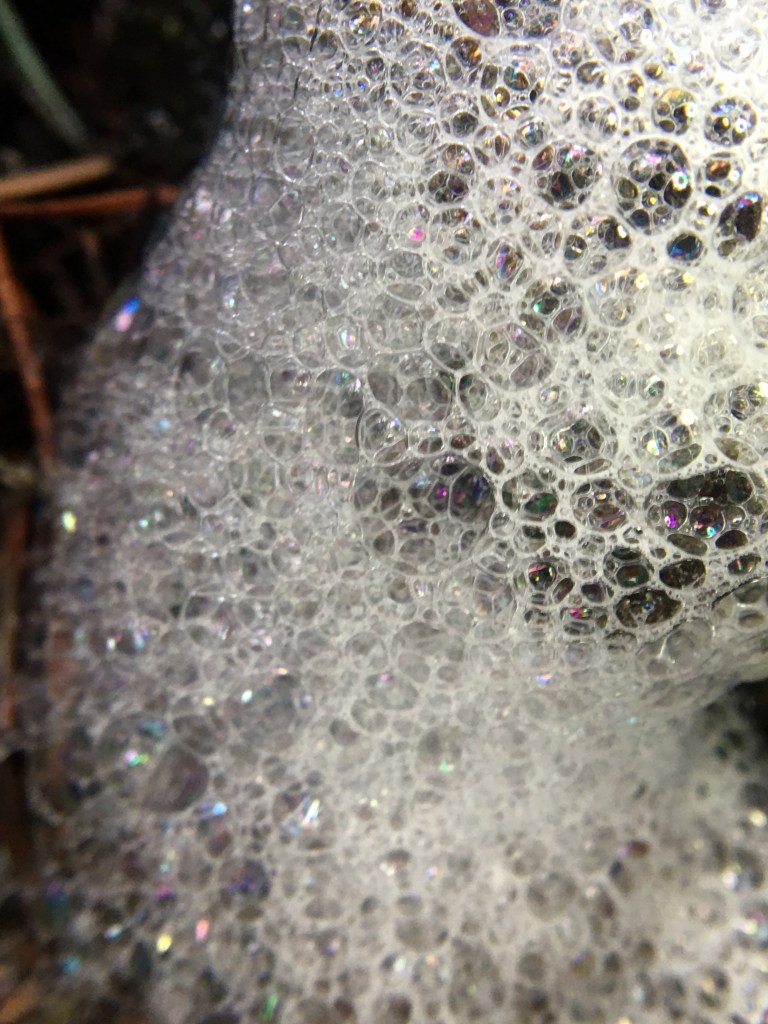
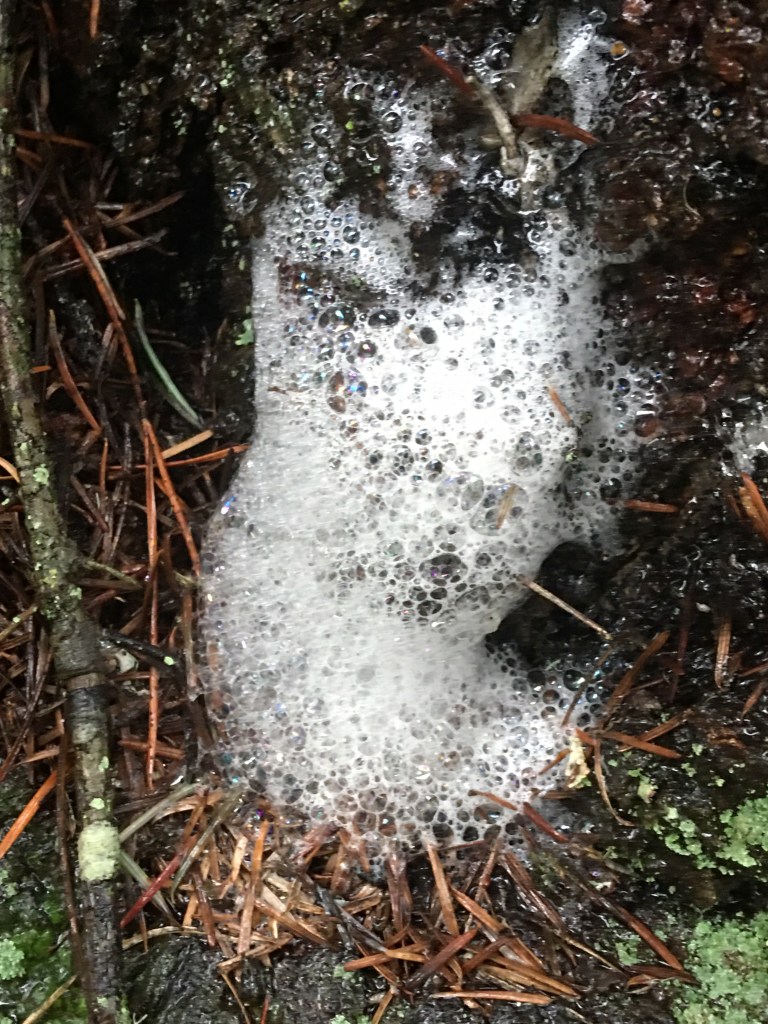
I knew the headline would be catchy! I was indeed flummoxed (or greatly bewildered) when I saw the foam blobs on our Douglas fir trees today after the rain subsided enough for me to walk around outside. We’ve had a DELUGE of rain in the Pacific Northwest this year. Rumor has it, the rain is record-setting!
Back to the giant spit-wad looking blobs of bubbles on those trees…. Here’s what I saw.
Pseudotsuga menziesii Douglas fir trunk with foam blob
I’m an entomologist, so when I saw this I thought, “it sure looks a lot like the foamy froth that spittle bugs make.” However, I quickly discounted this possibility (unless there was some sort of really LARGE undiscovered species hiding out on San Juan Island that is) because it’s way too early in the season for them.
What WOULD we do without Google? Seriously! I typed in a search. My first query was “what do Pacific tree frog eggs look like?” I was skeptical, but since I heard tree frogs around me in the woods and since it is REALLY wet outside, I thought maybe one or two of these frogs got confused and used the tree instead of one of the thousands of water puddles I was trying to avoid stepping in. Nope. Not tree frogs. My next query read like this…”weird, foam mass on Douglas fir tree trunk.” I got a few things, but quickly narrowed the possibility to the sites that had photos that looked like mine.
I discovered these oozing foamy spots are called SLIME FLUX, also known as a condition of the tree called WETWOOD. Sounds bad. Might be.
I’ve not had a chance to read through all of this material. It sure seems like there is a link between harmful bacteria, water, possibly insects, and the resulting foam. but will share it here for you to reference. https://www.fs.fed.us/pnw/pubs/pnw_gtr112.pdf
While scanning this document, the term that popped out at me was “slime-flux insects” on page 8. I’ll have to do some more reading to investigate this. If you beat me to it, please feel free to share your comments. Curious minds want to know!
***Update
I’ve been doing a bit more reading about slime flux and foamy trees this evening (check out this site http://www.wonderofeverydaynature.com/2016/03/26/155/) and found an alternative and possibly more probable cause. While the foam can be caused by bacterial infections, it also is known to form after periods of heavy rain when a chemical reaction of sorts occurs. The rain interacts with soap-like components found in the sap from pine trees (and probably this includes fir trees as well), creating foam similar to what I observed today. It can also form from air pollutants that land on the trees after dry periods and create foam when rain hits the tree bark.
Fi Fi Fo Foam! I learned the best way to tell the difference between friend or foe foam is to take a whiff. Bacterial infections produce a foul-smelling foam that bubbles out as tree tissue is broken down, forming alcohol and carbon dioxide gas. This foam will often attract insects like bees, flies, wasps, and ants.
“Bacteria, commonly found in soil and water, take up residence in young trees or gain entrance to older trees through wounds. The bacteria, including species of Clostridium, Bacillus, Enterobacter, Klebsiella, and Pseudomonas, grow within the tree using the sap as a nutrient source. As the sap is used, oxygen in the heartwood is depleted (creating anaerobic conditions), methane is produced, the pH of the sap is increased (pH 6 in healthy trees to pH 7 to 8 in wetwood), and a high pressure develops in the wood (60 psi in affected trees vs. 5-10 psi in wetwood-free trees). The resulting environment greatly inhibits the growth of fungi that can cause interior rots. The liquid kills grass and other herbaceous plants that it contacts at the base of the tree. The wood of affected trees has greatly reduced value as lumber because of the unsightly discoloration. Affected wood dries much more slowly than wood taken from wetwood-free trees.”


















 Bugging You From San Juan Island