So, this was not without a LOT of frustration on my end – due to lack of practice converting Powerpoint presentations to YouTube. The audio just wouldn’t sync. Finally…figured…it…out. 🤦♀️ Here’s my presentation from this past Sunday’s Garry Oak Symposium at the Grange. Feel free to watch and ask questions if you weren’t able to attend. For anyone interested, I’ve included references and literature at the end. Sorry in advance if there are some audio issues. They are minor and I just decided to go with it. 🙂 I’d like to add a special thanks to April Randall for her amazing artwork. She drew “Garry,” as in Garry the Oak Tree. Enjoy!
Scared of Spiders? Here’s a go-to info-sheet (that I plan to update as time allows) with links to verifiable, research-backed Spider Information/Literature. Let’s end all the misinformation and our arachnophobia. Too often people buy into false reports. Don’t listen to someone’s tall tale of horror. These stories are sensationalized and inaccurate. Know the facts. Dispel the rumors. Spiders are not out to kill you. It’s just not true.
YOU have to do the reading! These are scientifically based, accurate studies with information related to spider bites.
*Bennett RG, Vetter RS. An approach to spider bites. Erroneous attribution of dermonecrotic lesions to brown recluse or hobo spider bites in Canada. Can Fam Physician. 2004 Aug;50:1098-101. PMID: 15455808; PMCID: PMC2214648 https://www.ncbi.nlm.nih.gov/pmc/articles/PMC2214648/pdf/15455808.pdf.
*Melissa M. Gaver-Wainwright, Richard S. Zack, Matthew J. Foradori, Laura Corley Lavine, Misdiagnosis of Spider Bites: Bacterial Associates, Mechanical Pathogen Transfer, and Hemolytic Potential of Venom From the Hobo Spider, Tegenaria agrestis (Araneae: Agelenidae), Journal of Medical Entomology, Volume 48, Issue 2, 1 March 2011, Pages 382–388, https://doi.org/10.1603/ME09224
Brown Recluse Spiders (Loxoceles sp) – NO! I repeat “NO, none, nada!” established populations in our area.
In the attached links below, you will find links to information about the Brown Recluse Spider. Information that comes from a verified, reputable source – from an actual expert. Brown Recluse spiders do not live in the San Juan Islands. Caveat: this is not to say that if you move here from an area where there ARE established populations, one might be found hitching on your moving boxes. It’s possible, BUT – they have not been able to survive and breed here. If you see a large brown spider in your house – especially on the ceiling, it is most likely (99.99%) going to be a Giant House Spider (Eratigena duellica). They are very common and harmless. If you don’t like them, just catch in a cup and take it to a sheltered area outside – preferably another structure where it might have a chance to survive. They won’t hurt you.
Map showing distribution of Brown Recluse spiders (Please note that San Juan County is NOT found on this map) – https://spiders.ucr.edu/spiders-map
Map of Brown Recluse Spider distribution – UC Riverside
Where else can I find reliable information on Spiders?
There are a few sources I’ll list here. The first two are the ones you should look at first. They are valuable resources with information from highly credentialed experts in all things arachnid-related. If you read something written by either Rod Crawford (Seattle Burke Museum curator of the arachnid collection) or by Rick Vetter (UC Riverside Department of Entomology), you can be assured it is correct.
As a local resource, you can also check out the Facebook Bug Group (Bugs of the San Juan Islands). There are several group “experts” with experience identifying spiders. These folks generously volunteer their time and knowledge, so keep that in mind and please refrain if you feel inclined to INSIST they are wrong and there are INDEED Brown Recluse Spiders living in your house in San Juan County. If you have a spider you’d like identified, it helps to have a couple of clear photos to submit. Try and get a shot of the dorsal (top) of the spider, and if you’re able, one of its face – showing eye pattern. You may contact me, Cynthia Brast-Bormann at cynthiabrast@icloud.com to submit live or deceased specimens for identification. I will help you coordinate a drop off point for collection. Please don’t indiscriminately KILL a spider though and ask me to ID it. It will likely make reliable identification more difficult. Just get a cup and a lid with some air holes punched in the top. I appreciate your showing kindness to the helpless creature you’ve caught. I will ID and humanely release.
Bugs of the San Juan Islands Facebook Group – There are at least 4 spider group experts and folks with entomology degrees or experienced backgrounds in the group who are more than qualified to help you. https://m.facebook.com/groups/bugsofthesanjuanislands/about/
Great YouTube information and fun links to watch from one of Bugs of the San Juan Island’s group experts, Arlo Pelegrin (entomologist and arachnologist)
Spiders of the West and their Medical Significance – Arlo Pelegrin at Dept of Health
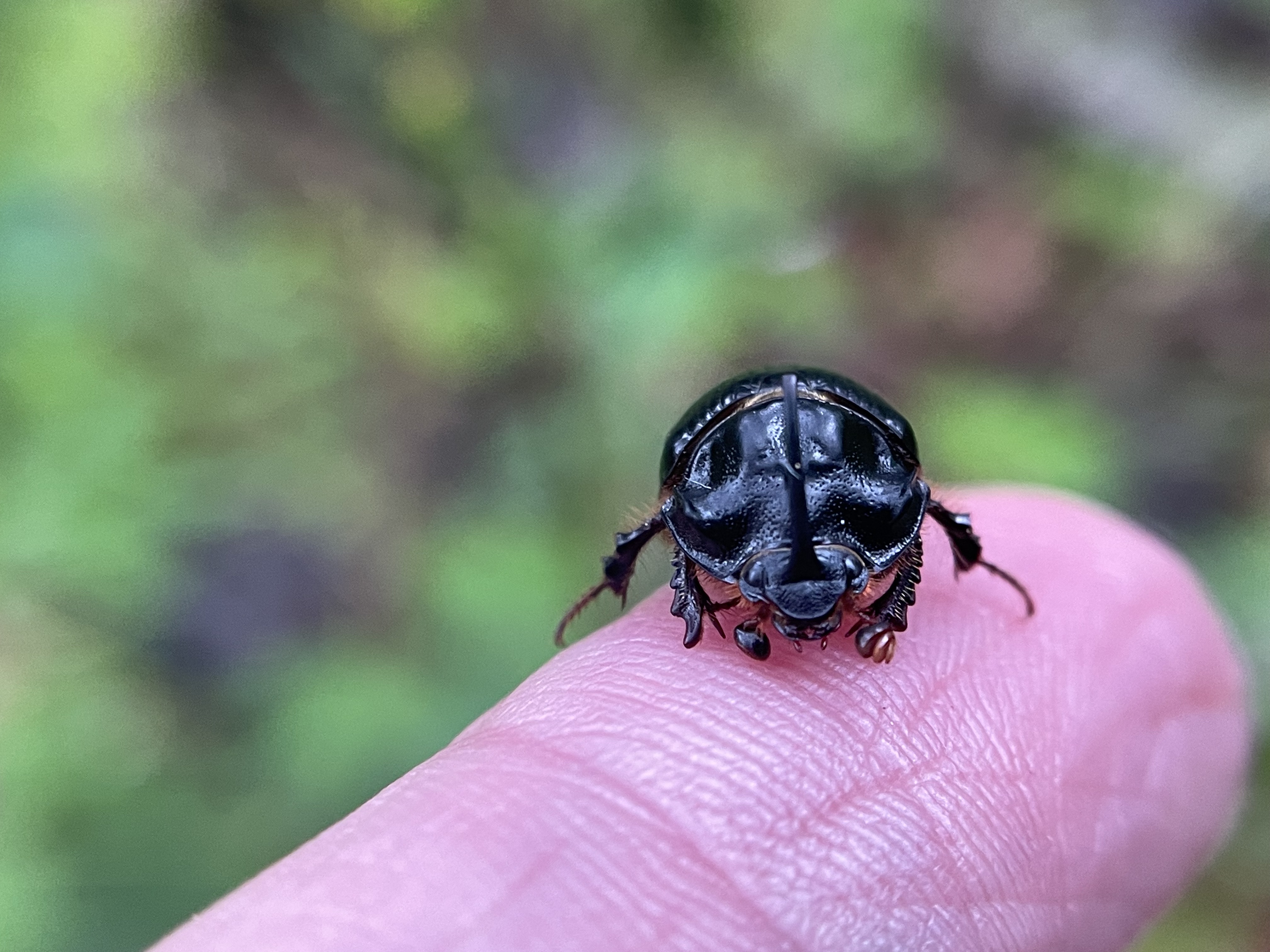
Hello Everyone! Meet my new bug friend, Radar Love ❤️ He must have crashed the wrong party. Radar gone wrong! I found him floating in our pool, in the midst of those raucous “dippers” (the Diplotaxis beetles). Radar Love was so happy I didn’t let him drown, and even happier that I didn’t stick him with a pin and add him to the bug equivalent of a stamp collection. We hung out together for a bit and I took some photos and video to remember him by. Radar Love was released into the forest so he can make more of his kind.
Odonteus obesusOdonteus obesus
Odonteus obesusOdonteus obesus
Odonteus obesus
Location: San Juan Island
ID: Geotruipidae (Odonteus obsesus)
Special thanks to my friend, Michelle Sloan Bos and Tyler Hedlund for ID assistance with this. I was rushing to get ready for my special spider outing. More about that later. For now, enjoy this rare and exciting sighting of a most special little beetle that calls San Juan Island his home.
Ants (Lasius sp.) on Big Leaf Maple Extra-Floral Nectary – May 17, 2022, San Juan Island, WA
When you study insects, or even birds for that matter, you start to understand you have to get to know plants a bit too. It’s all connected.
Plants (including trees and shrubs) provide food and shelter for many different species of animals. Admittedly, I just don’t know a lot about the parts of plants, beyond things like a tree trunk, bark, limbs, branches, leaves, or stems or flowers, nuts, fruit. The obvious parts.
There are some not so obvious parts. Like these extrafloral nectaries. Huh? Sounds weird. Keep reading.
Extrafloral nectaries (EFN’s) are glands occurring on more than 2000 plant species in 64 families. Extrafloral literally means outside of the flower. When we think of nectar, we usually think of little bees and hummingbirds flying around, visiting pretty flowers to sip nectar and in the process, pollinate all of our plants. It’s just that plants are a bit more complex. These glands are located in various places on plants (including trees and shrubs), and may be found on the laminae of leaves, petioles, rachids, bracts, stipules, pedices, fruit, etc. (Mizell, 2019).
These glandular secretions are a fascinating part of how plants attract and sustain a diverse, ecological community, providing sustenance for a multitude of species, including both pests and predators. You can find ants, aphids, beetles (including ladybugs), bees, wasps, and possibly even birds utilizing this excretory faucet to sip what consists of mostly carbohydrate-rich sugar, but also comprised of a wide array of amino acids and other nutrients.
Why are these important? Well, scientists are still trying to fully understand all of the diverse relationships around extra-floral nectaries. It is thought perhaps, beyond attracting organisms to a food source, they play a role in orchestrating a plant’s defense strategy against predators. They also are believed to provide a source of food and/or beneficial nutrients for various organisms during the off-season – when flowering and pollen sources are not available. They may also reduce conflict between ants and other pollinators by partitioning resources (Villamil & Stone, 2019).
Lasius sp. Ants at Extra-floral nectaries on Big Leaf Maple, 05.17.2022, San Juan Island, WA
Ant and aphid hanging out on extrafloral nectaries on Cherry Tree, San Juan Island, 05.17.2022
References
Bentley, B. L. (1977). Extrafloral nectaries and protection by pugnacious bodyguards. Annual Review of Ecology and Systematics, 8(1), 407-427.
Holopainen JK, Blande JD, Sorvari J. Functional Role of Extrafloral Nectar in Boreal Forest Ecosystems under Climate Change. Forests. 2020; 11(1):67. https://doi.org/10.3390/f11010067
Villamil, N., Boege, K., & Stone, G. N. (2019). Testing the Distraction Hypothesis: Do extrafloral nectaries reduce ant-pollinator conflict?. The Journal of ecology, 107(3), 1377–1391. https://doi.org/10.1111/1365-2745.13135
Yesterday I was the lifeguard. And, I had swimmers needing saving!
Hister Beetle (Genus Margarinotus I believe) – April 7, 2022 San Juan Island, WA
Here’s one of the species I used a piece of cardboard to rescue from drowning. This is a beetle in the family Histeridae, also known as a Clown Beetle. I told him no more clowning around without a life jacket. 🤣 Watch as it wrings its hindwings out, rolling them in under the leathery elytra (the outer wings).
I believe this beetle is in the genus Margarinotus. For ID beyond this, I’d need more time and a lot of patience. However, I can tell you I’ve learned some species of Hister beetles are associated with the nests of rodents, birds, and even ants and termites. They are pest predators, meaning they eat other insects at all life stages. They also are especially adept predators of fly eggs. You can often find them in leaf litter, dung, carrion, and under tree bark, or living in those ant mounds where they may be fed by ants, eat the leftovers the ants discard, or in some cases, they eat the ants!
Some other curious tidbits about these beetles include their acting ability. They play dead (Thanatosis) to deter predators. The word Hister is derived from Latin and means “Actor.”
Hister Beetle (I believe Margarinotus sp) – San Juan Island, WA
Wenzel, R. L. (1960). Three new histerid beetles from the Pacific Northwest, with records and synonymies of additional species (Coleoptera: Histeridae). https://www.biodiversitylibrary.org/page/2847194
What adjective would you use to describe a cutworm? Perhaps pest? Something like the evil caterpillar, Mister Mind, one of Captain Marvel’s archenemies in the DC comic strip series?
If you’re a gardener, the name “cutworm” may conjure up an evil worm that wants to eat your vegetables.
If you have a lawn or own a golf course, cutworms may be the gremlins that destroy turf grass. Now personally, I think five year olds should make policy around cutworms because there aren’t many five year olds who actually WANT to eat their veggies. They’ll see reason in defending the cutworm gremlin.
I’m not a golfer, and don’t have a lawn, so I personally don’t care too much if cutworms munch turf grass. Those sites should be classified as biohazard sites right along with nuclear waste if you ask me. They’ve had so many chemicals dumped on them over the years, they can’t be anything but noxious, environmentally toxic sponges.
Seriously, stop for a moment and Google “cutworm.” What pops up? Ads for every sort of pesticide imaginable. There may a be one or two advertised as “Safer” (yep, that’s a brand name), or natural, but they are designed with the same, single, solitary mission. Nuke the cutworm.
How many average American citizens do you think, can really distinguish between one sort of cutworm or another? Did you know the name, cutworm, is used to describe the larval or caterpillar form of a whole grouping of Lepidoptera that fall into the family Noctuidae?
If you’re really into bugs, or you are an entomologist (like me), then you also might know that the family Noctuidae has another name. These so-called cutworms (some are also called army worms) are the OWLET MOTHS. Why do you think? Well, because when they grow up, they look so unbelievably cute – like owls. Also, like this one! I named him Henry!
Henry is the cutest little dude around. His scientific name is Stretchia muricina. I think that name sounds a little bit Italian to me, but he’s not part of the mafia. Actually, Henry looks more like a teeny little lion or maybe even like Orson the Wheely Bird in Sid and Marty Krofft’s late 60’s TV show, HR PufnStuff.
Seymour the Spider and Orson the Wheely Bird – HR Pufnstuf
Whatever YOU see when you look at Henry, you’ve got to agree that he’s cute.
Henry (Stretchia muricina), an Owlet Moth
Henry used to be a cutworm. People are trying to kill him!
Henry isn’t a horrible garden pest though. When Henry was a caterpillar, he was more interested in eating a bit of your native currants. Sure, we all love to look at the beautiful flowers on our currants in the springtime, but he didn’t eat the flowers. He just ate a few leaves. There aren’t many cutworms like Henry. Just a few. They aren’t the same as the massive hoards of army worms that show up in the grass, or the cutworms that want to enjoy your newly sprouted veggies.
It’s pretty tough for a regular person to positively ID a caterpillar, so Henry recommends resisting the urge to grab that powder, spray, or torch. Don’t judge all cutworms to be evil. There are some tools you can take advantage of to help you sort caterpillars. Take a look at these links below and embrace diversity in the world. Caterpillars have feelings too!
Calscape.org https://calscape.org – Lists plants and invertebrates associated with plants. While some may be out of our region, many do overlap. Extremely useful. I wish WSU had one of these sites!
Check out the rest of Henry’s adorable photos here. I found him last night hanging out on our deck. He was afraid of me at first and actually played dead (the entomological term for that is Thanatosis, so you can impress your family and friends). Once Henry figured out I had no intent to harm, he decided to pose and show off a bit. After his photoshoot, Henry went back to his spot on the wood siding.
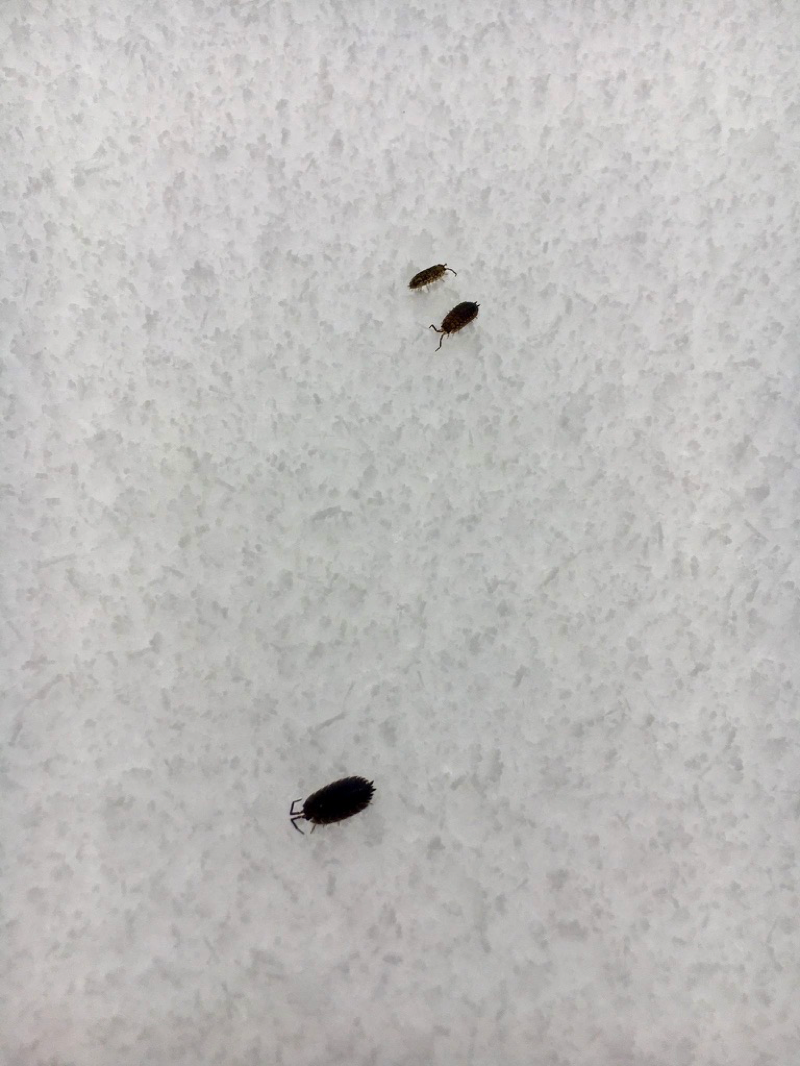
Jason Shields sent in this photo and granted permission to share. Taken on a snowy hike near Wescott Bay, San Juan Island, WA 2/13 or 2/14 2021.
The bugs in the snow in this photo are isopods, commonly known as woodlice. Jason sent the photo to me after finding them on top of the snow, scattered about, alive, but moving slowly. He asked if I might know why they were out in such cold weather like this. At the time, I could only speculate, but did some reading and came up with a possibility that could answer this curiosity.
The literature I sourced suggests that isopods like these can be infected with a helminth parasite capable of altering behavior. Several published scientific papers specifically investigated the Acanthocephalan parasite (Plagiorhynchus cylindraceus), also known as the Spiny or Thorny-head worm parasitizing isopods. For the curious, the name Ancanthcephalan comes from Greek akantha, and kephale; head, referring to the rows of hooks or spines encircling the head of the worm.
In this relationship, the acanthocephalan parasitic worm (P. cylindraceus) is what is referred to as an indirect or two-host parasite, meaning it uses two animals to complete its developmental life cycle. It is also an endoparasite, developing internally in an animal (as opposed to ectoparasite – developing on the outside of the animal).
The isopod is the initial host in this parasitic cycle. In feeding on terrestrial detritus, the acanthocephalan parasite’s eggs are ingested. The eggs exist in the environment after being excreted in the feces of songbirds, especially the American Robin (Turdus migratorius), and European Starling (Sturnus vulgaris).
Within hours of ingestion by the isopod, P.cylindraceus eggs hatch into larvae. These tiny larvae with spines soon mature into a form called a cystacanth, burrowing through the intestinal cavity of the isopod where they lodge into the body cavity, remaining attached to the intestine by a stalk. This site of attachment is important in that the worms lack their own digestive system and must gain nutrients via the host’s dietary intake. Over approximately 60-65 days, the cystocanths continue to grow and develop sexual organs. At the end of this period they are now mature enough to infest the next host (a bird).
While the exact mechanism remains unknown, the worms alter the behavior of the isopod making it “suicidal” or more susceptible to becoming prey and eaten by a bird. It is suspected that biochemical cues are responsible for inducing these behavioral changes.
Scientists have recorded infected individuals of these isopods leaving sheltered leaf litter where they are concealed, and moving into open areas where they are more visible to predators and more likely to be eaten. Inside the bird host, the worm resides in the small intestine, where it continues to grow, often becoming as long as 15 mm. At the end of development in the bird host, reproductively mature, fertilized female worms produce eggs that are excreted in the bird’s feces, repeating the cycle.
Are the isopods Jason found in the snow parasitized? Possibly. It may remain a mystery, but an intriguing one indeed.
References
Amato, José F. R., Amato, Suzana B., Araujo, Paula B., & Quadros, Aline F. (2003). First report of pigmentation dystrophy in terrestrial isopods, Atlantoscia floridana (van Name) (Isopoda, Oniscidea), induced by larval acanthocephalans. Revista Brasileira de Zoologia, 20(4), 711-716. https://dx.doi.org/10.1590/S0101-81752003000400026
Nickol, B., and G. E. Dappen (1982). Armadillidum vulgare (Isopoda) as an intermediate host of Plagiorhynchus cylindraceus (Acanthocephala) and isopod response to infection. Journal of Parasitology 68(4) 570-575. https://www.jstor.org/stable/328091
I first spotted this beauty on October 1, 2021 while I was taking a walk along our road on San Juan Island. There was a cluster of sun loving mullein (Verbascum thapsus) mixed with one or two thistles (probably Canada thistle) growing along the road. The glistening silk threads woven between them drew me over to investigate. There were several Cross Orb Weavers sharing the space here, but one of these was not like the other. The spider that caught my attention was quite a bit darker than the others. Describing it as brown just doesn’t do it justice. Brown sounds much too plain. She was a lovely brunette amongst a few redheads!
Since I often enjoy walking on our road on sunny days, I started looking for her when I passed her home – the Mullein “apartments.” It wasn’t just the spiders enjoying the sunny housing complex, but these units housed a few other species as well. I found some Stilt Bugs (Neoneides sp.) and some Pentatomidae hiding in the fuzzy star shaped trichomes (little hairs) of the Mullein leaves.
Now that autumn has ushered in falling leaves, falling temperatures, and a good bit of rain, I thought of my friend Louisa, the Orb Weaver out in the cold. Had she managed to find a sheltered spot to survive the recent storms? Several times over the past two weeks I’ve looked for her, but she was just gone. Since the lifespan for this species is only a year or less, I suspected she’d reached her end with our last dip in temperatures, gusty winds, and precipitation. I held out a tiny bit of hope though. Just a bit!
Today (November 6, 2021), my husband and I walked our road. It was sprinkling and the precipitation was cold. When we got down to the point on the road to turn around, shortening our walk to just the point where the old cabin used to be, I asked him to wait one second while I looked one more time at that patch of Mullein and the drying stand of thistles.
As I bent down to look closely, I saw a single strand of silk. Examining the attachment and following closely, it led me to Louisa. She was tucked under the dried nodding inflorescence of the thistle. Once a purply-pink sugar treat for pollinators, the now nodding blooms have been repurposed into a thatch roof to keep this little spider dry.
I’ve thought about relocating her so the county doesn’t mow her when they scalp the roadside vegetation. It is bound to happen at some point. For now, I’m going to leave her be, and just keep a close eye on her. Maybe I’ll make a sign! Be Nice to Spiders. ❤️ Louisa lives here!
Fun Fact! Did you know that 25% of the diet of Orb Weaver spiderlings is pollen? Check it out. Article linked in my list of sources below.
Araneus diadematus (Cross Orb Weaver) October 1, 2021 – San Juan Island, WA
Araneus diadematus (Cross Orb Weaver) October 1, 2021 – San Juan Island, WA
Araneus diadematus (Cross Orb Weaver) October 1, 2021 – San Juan Island, WA
Araneus diadematus (Cross Orb Weaver) October 13, 2021 – San Juan Island, WAAraneus diadematus (Cross Orb Weaver) October 16, 2021 – San Juan Island, WA
This is “Louisa,” the Land Bank Orb Weaver Spider. She lives on a Mullein plant alongside the road. I’ve been watching her since October 1, 2021. Hoping she will not become a casualty of San Juan County’s pre-winter roadside mowing. She’s also an expecting mom!
This is “Louisa,” the Land Bank Orb Weaver Spider. She lives on a Mullein plant alongside the road. I’ve been watching her since October 1, 2021. Hoping she will not become a casualty of San Juan County’s pre-winter roadside mowing. She’s also an expecting mom!
Araneus diadematus (Cross Orb Weaver) November 6, 2021 – San Juan Island, WAAraneus diadematus (Cross Orb Weaver) November 6, 2021 – San Juan Island, WAAraneus diadematus (Cross Orb Weaver) November 6, 2021 – San Juan Island, WA
Gucker, Corey L. 2008. Verbascum thapsus. In: Fire Effects Information System, [Online]. U.S. Department of Agriculture, Forest Service, Rocky Mountain Research Station, Fire Sciences Laboratory (Producer). Available: https://www.fs.fed.us/database/feis/plants/forb/vertha/all.html [2021, November 6].
Horton DR, Lewis TM (2003) Numbers and types of arthropods overwintering on common mullein, Verbacsum thapsus L. (Scrophulariacae), in a central Washington fruit-growing region. Journal of the Entomology Society of British Columbia 100, 79–87.
Oxford, Geoff & Gillespie, Rosemary. (1998). Evolution and ecology of spider coloration. Annual review of entomology. 43. 619-43. 10.1146/annurev.ento.43.1.619.
The social media giant we all have become overly dependent on in recent years, had a big, giant F-A-I-L today. The entire site was down. I couldn’t share bug photos or look to see what crazy or amazing things my friends had been up to. I also couldn’t watch the fabulous video of the frog and bearded dragon that I’ve been replaying over, and over, and over because it’s so DARN cute! You can find it on Tik Tok if you can’t find it on Facebook.
In the void, I resorted to the fail safe backup. It’s called E-mail. I really feel old because I actually remember how we communicated before the advent of cyberspace – handwriting letters that you put a stamp on and eventually were delivered by USPS.
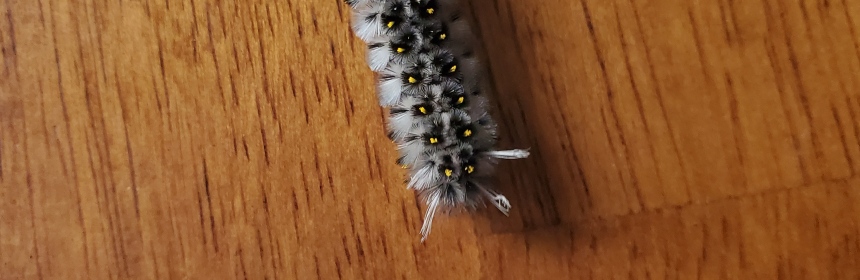
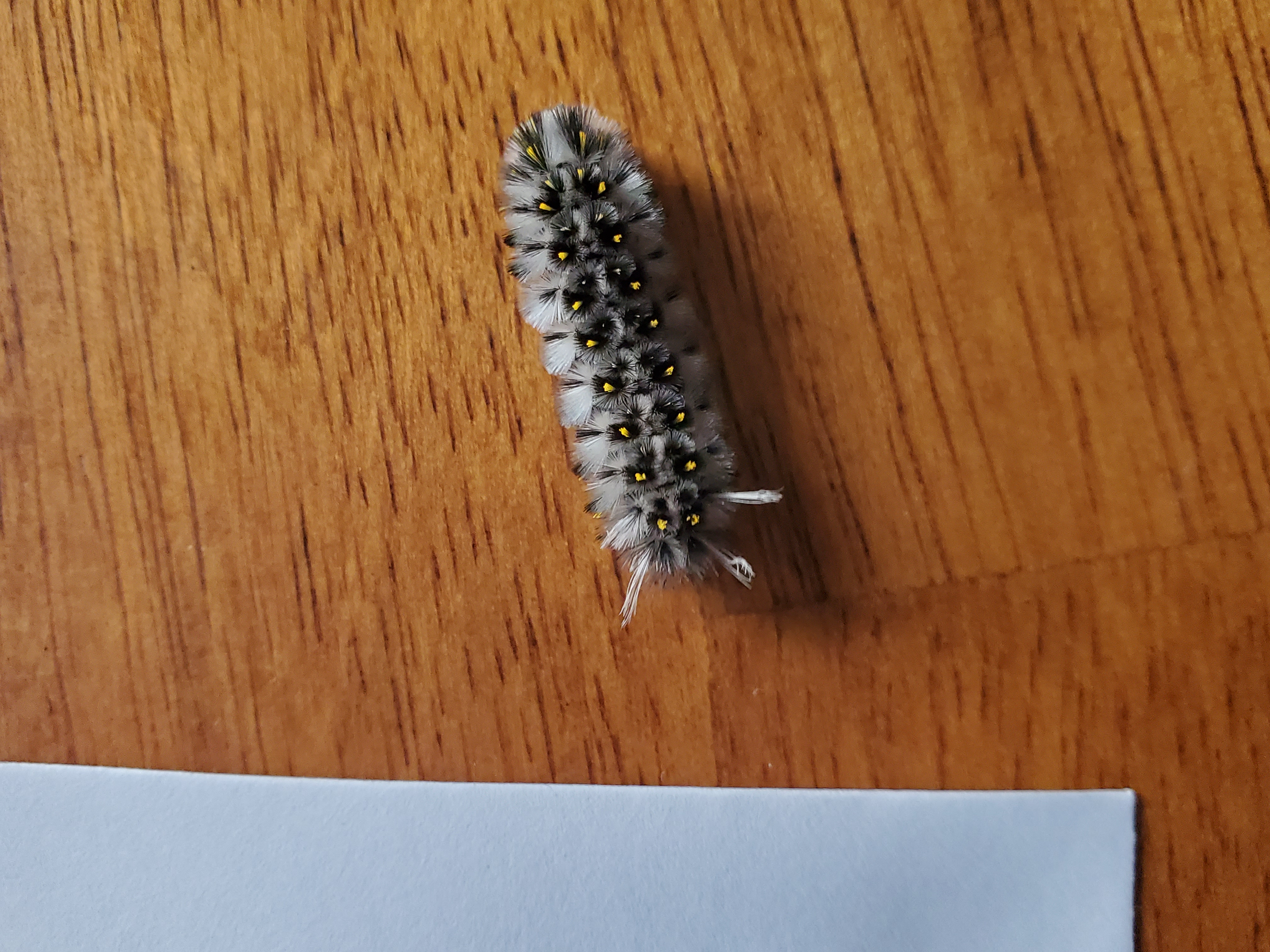
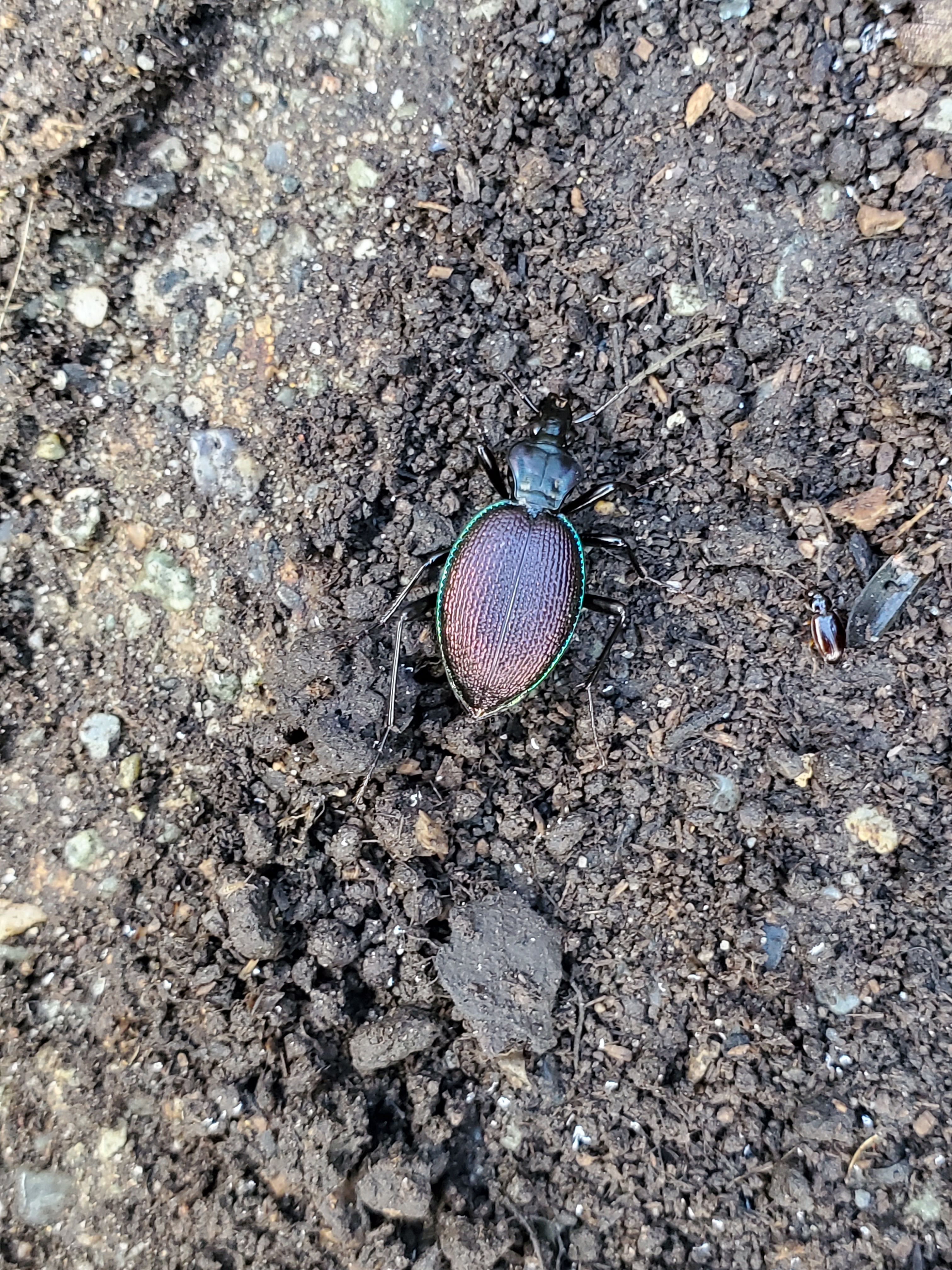
So, in my email, I actually had received two nice bug pictures I want to share with you. Victoria Compton (who is running for Friday Harbor Port Commissioner btw) sent these to me. The first, a caterpillar, is going to turn into my favorite moth, Lophocampa roseata or the Rosy Amelia Moth. The 2nd, is a ground beetle in the family Carabidae (Scaphinotus marginatus) – also sometimes called the Margined Snail-eating Carabid Beetle.
Happy Bug Viewing! Thanks for checking these out and thanks for sending the photos Victoria! You have my vote. 😉
Yesterday I was literally in bed most of the day recovering from a precautionary step to prevent severe illness. I felt like I had been in a bad auto accident, but that’s got to be better than actually having and/or dying from a virus, right? Well, I used the time to read. Mostly I read spider behavior stuff. Believe me, some of these things are pretty interesting! Spider sex for instance. Who knew! I found this somewhat sensational spider story. This spider doesn’t live in the San Juans, but it’s so weird, I just have to share!
DID YOU KNOW there is such thing as a Eunuch spider? (Tidarren sisyphoides), one of the Theridiidae or Tangle Web Spiders, AMPUTATES one of its own pedipalps (the male sex organs). The species name (Tidarren sisyphoides) is a combination translation from Gosiute-Greek meaning ‘small male’. Male spiders of this species are very tiny (1mm) in comparison to females ( only 1% the size of the female).
According to R.J. Adams (2014) and Ramos et al (2004), Tidarren sisyphoides male spiders are born with, and develop two palps, just like other spiders, but at the penulitimate (next to last) molt (shedding of the exoskeleton as part of growth/development), the male spider amputates one of these palps ON PURPOSE!
The amputation process isn’t done by chewing or anything of that sort. The tiny spider wraps it in a silk scaffold, then dismembers the palp by twisting or moving around in circles until it breaks off. The remaining palp is quite large in proportion to the 1mm sized body of this tiny spider, making up 10% of the total body mass.
Why would the spider amputate one of its palps? Well, turns out that males with one palp can move around and chase females much faster with only one palp. It is supposed to give these guys an evolutionary reproductive advantage. Males only mate once, so the reproductive drive is stronger than the drive to preserve one’s palp! Once he’s inserted that single palp, he will die within minutes, still attached to the female. Hmmm, getting laid might not be so lucky depending on how you look at it.
After mating, the female will extricate the palp from her epigynum (the female reproductive receptacle). While some other species of spiders are known to eat the male after mating, this species does not. She will merely discard the body.
Interesed in reading more? Check out these links, and read my blog about spider sex too!
Adams, R. J., & Manolis, T. D. (2014). Field Guide to the Spiders of California and the Pacific Coast States (1st ed.). University of California Press. http://www.jstor.org/stable/10.1525/j.ctt5hjhpb
Kuntner, M., Agnarsson, I. and Li, D. (2015), The eunuch phenomenon: adaptive evolution of genital emasculation in sexually dimorphic spiders. Biol Rev, 90: 279-296. https://doi.org/10.1111/brv.12109
Ramos,M., Irschick, D. J., and Christenson, T.E. 2004. Overcoming an evolutionary conflict: Removal of a reproductive organ greatly increases locomotor performance. Proceedings of the National Academy of Sciences 101 (14) 4883-4887; DOI: 10.1073/pnas.0400324101 https://www.pnas.org/content/101/14/4883










 Bugging You From San Juan Island