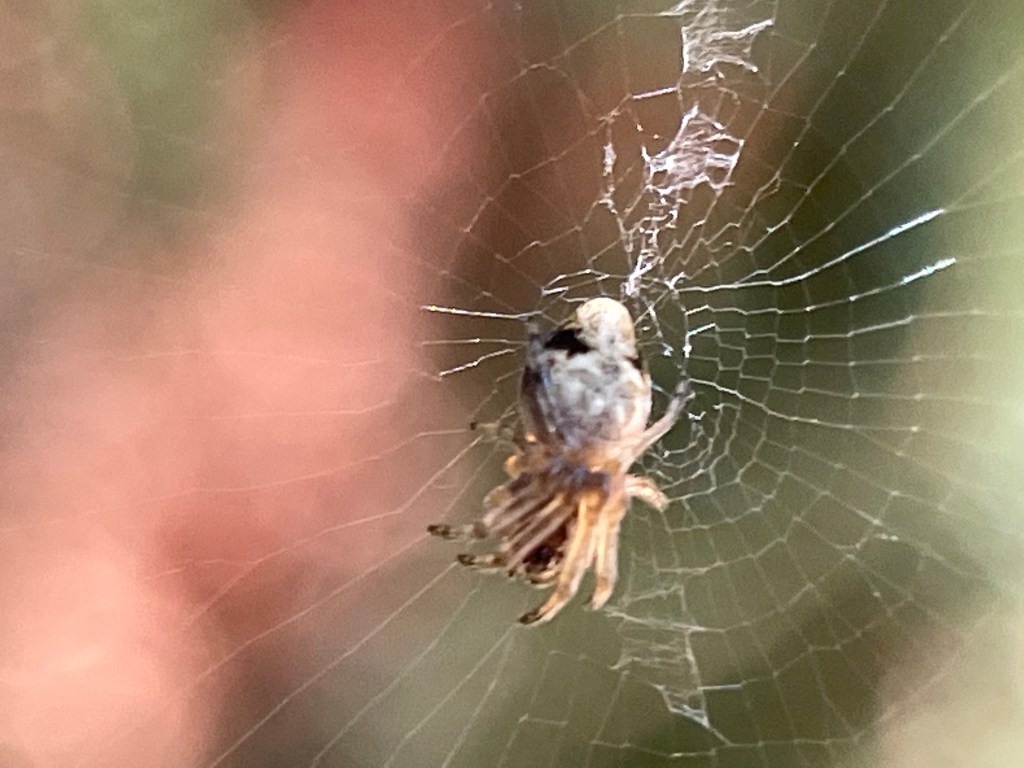
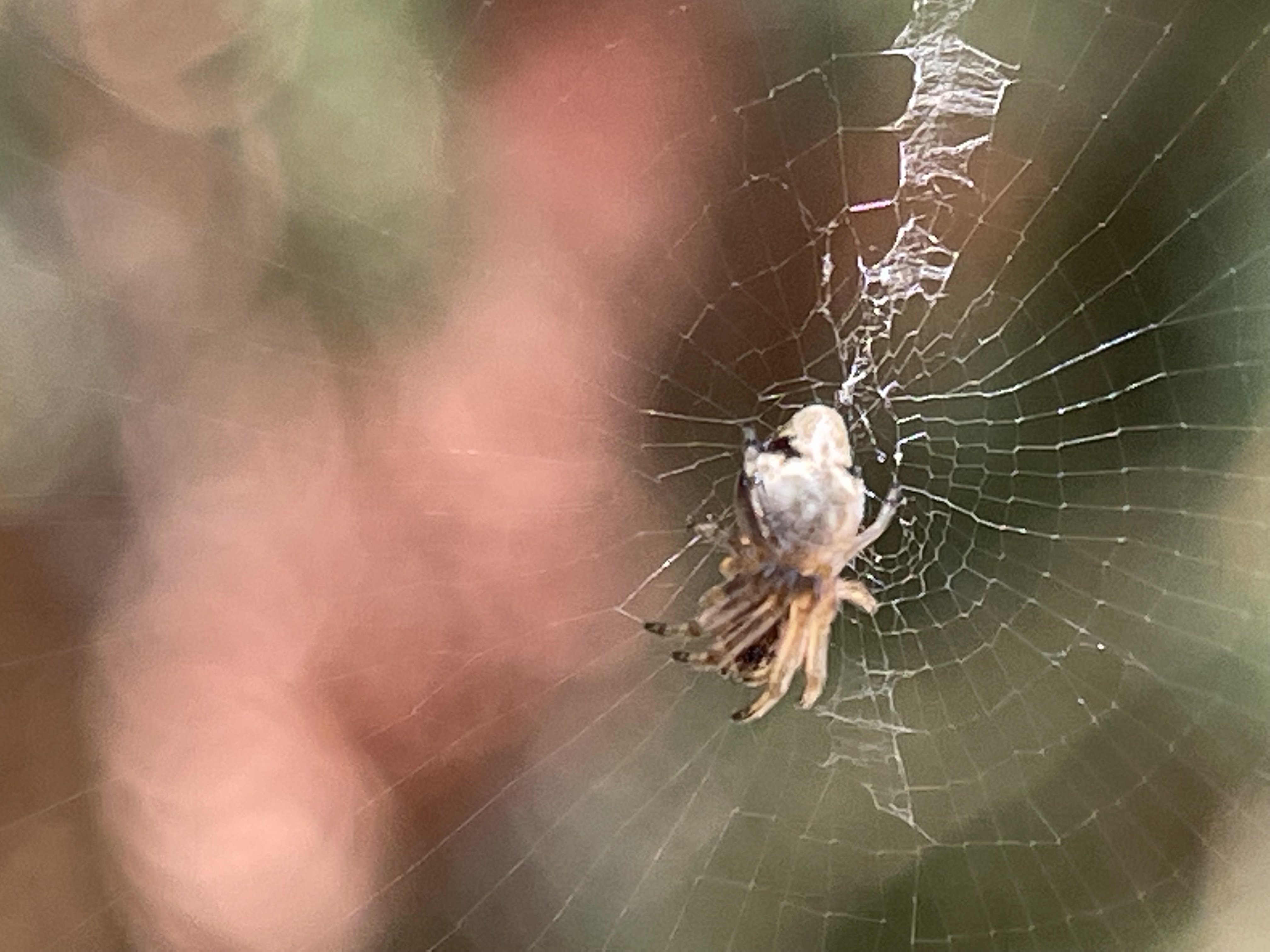
Trashline Orb Weaver (Cyclosa sp.) San Juan Island, WA 09.06.2021
I am very nearly blind when I try to see things up close, so it truly surprises me how I SEE things like the tiny “laundry” line of dead bugs this little orb weaver had strewn along a filmy thread between the boughs of our fir tree. At first, I thought it was just debris, stuck to the remnant of a spider thread, long abandoned. Upon closer inspection, I saw more threads and then my attention focused on the center, where I was able to discern what looked like teeny legs curled up around a body.
Trashline Orb Weaver
I used my clip on macro lens to get a better look. Indeed, there was a tiny spider in the center. I thought it was dead. That’s EXACTLY what the spider was hoping I’d think, and then I’d move on and the spider could enjoy the morning sun, and maybe a tiny bug for breakfast too.
Trashline Orb Weaver
Cyclosa sp. Trashline Orb Weaver 09.07.2021
Trashline Orb Weaver (Cyclosa sp.) San Juan Island, WA 09.07.2021
Trashline Orb Weaver
I had a hard time getting decent photos. Even with the macro lens, focusing was tough. The wind would blow at just the WRONG second and I’d have to start all over again. I couldn’t find my tripod, but finally got a decent pole to help me balance, and went out to take photos at different times over a period of 2 days. I even went out last night and took a picture.
Awake or Sleeping? Trashline Orb Weaver (Cyclosa sp.) at night. San Juan Island 09.07.2021
It was fairly easy to identify the spider to Genus (Cyclosa), but species ???? . After going through the literature I had, I narrowed it to 2 possibilities, but reached out to Rod Crawford for help. Rod is the curator of arachnids at Seattle’s Burke Museum and this is what he says,
“Yes, it’s a Cyclosa. This time of year all Cyclosa are juvenile, and I for one cannot distinguish between our 2 species (C. conica, C. turbinata) as juveniles. However, C. conica is more common.”
So, my little spider with a laundry line of bugs is either Cyclosa conica or Cyclosa turbinata.
Why exactly do they string the debris along their web lines? Well, again, this debris is usually made up of dead bugs and other tiny bits of debris attached to the silk line. Typically, the spider is positioned somewhere in the middle, using the debris as camouflage against predators. Often, the female spiders’ egg sacks are attached to this “laundry line” too. I think laundry line sounds better than trash line, but I don’t think I get to rename the spider.
There are five species of Cyclosa spiders in North America, north of Mexico. I believe we only have the two mentioned by Rod here. I’m going back out to check on my new friend after I finish my post. Enjoy the day and remember to Be Nice to Spiders!
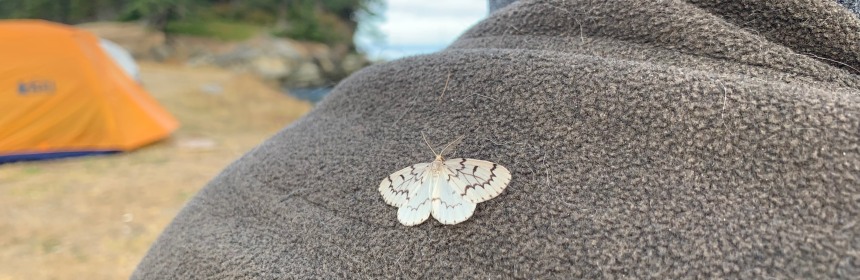
Yesterday, August 29, 2021, I received an email from C. Croll requesting ID of a moth photographed by T. Ormenyi. Their query read,
“I live on Orcas and kayak quite a bit. Today I was paddling from Patos Island back home, and there were thousands of moths in the air. They were heading from south to north. We first saw them on Patos but then all the way home. Some had fallen onto the water on the crossing. ”
And,
“I had not witnessed so many moths all traveling together before. Seemed like a migration of some sort? When they first arrived I thought there were cottonwood seeds floating on the breeze, took a second to realize that it was moths. The air was full of them for almost an hour. “
These moths sighted by Calvin and Tessa are the Phantom Hemlock Loopers, (Nepytia phantasmaria). They are in the family Geometridae. This species ranges from southern BC to California. There is one generation produced per year and larvae feed on conifers, including Western Hemlock, Douglas-fir, Grand Fir, Amabilis Fir, Sitka Spruce, and Western Red cedar (Bugguide.net).
Adults typically emerge in fall (September and October), so seeing them now is a bit earlier than when I’ve typically collected specimens at my porch light on San Juan Island. Last year, I photographed my first specimen of the season on Sept. 7, 2020. As these moths are nocturnally active, Calvin and Tessa’s report of of them traveling en-masse like this during daylight was intriguing. I was curious to know more.
William H. Hendrix III’s thesis titled Migration and behavioral studies of two adult noctuid (Lepidoptera: Noctuidae) species plus feeding observations of some moths common to Iowa (1990), cites (Johnson, 1969), stating these migration events are part of the “oogenesis flight syndrome” stage where the newly emerged adult insects move en-masse before reproduction and egg laying takes place. Hendrix (1990) also provides some theories as to WHY these moths migrate in the first place. Several theories have attempted to explain this, but he concludes, “Migration, consequently, occurs primarily in young adults and its chief function is to allow escape from unfavorable habitats and allow colonization of a broad range of environments” (Hendrix, 1990).
After reading about this particular species, I believe the migration witnessed yesterday could be attributed to either 1) the sudden weather change we experienced overnight in the islands, or 2) the lack of suitable habitat for reproduction because of the drought we are experiencing. I’m guessing the drought may have more to do with this and we will see more evidence as other species struggle to survive the coming environmental shifts associated with global warming.
Thanks to Calvin and Tessa for sending in their observations!
Edwards, D.. (2011). Activity rhythms of Lepidopterous defoliators. II. Halisidota argentata Pack. (Arctiidae) and Nepytia phantasmaria Strkr. (Geometridae). Canadian Journal of Zoology. 42. 939-958. 10.1139/z64-093.
Hendrix, William Hurston III, “Migration and behavioral studies of two adult noctuid (Lepidoptera: Noctuidae) species plus feeding observations of some moths common to Iowa ” (1990). Retrospective Theses and Dissertations. 9373. https://lib.dr.iastate.edu/rtd/9373 https://lib.dr.iastate.edu/cgi/viewcontent.cgi?article=10372&context=rtd
Johnson, C. G. 1969. Lepidoptera: Long-distance displacement. In MigrationandDispersalofInsectsbyFlight. Methuen&Co.,Ltd., London. 763 pp.
June 29,2021. So happy we’re not broiling today. Since many of us will be eager to enjoy the outdoors the rest of the week, I’m sharing something I’ll describe as an “insect-related public health announcement.” Please find some humor and some good advice in my post.
While we are lucky we live here and not in the south where bugs are much more likely to bite and transmit all sorts of icky things (like Dengue, West Nile, Yellow Fever, EEEV, and a long laundry list of others), we still get various bites and stings that cause reactions.
If you’re like me, your skin may over-react (large, localized reactions), or worse if you’re extremely allergic or even anaphylactic.
After living here almost 12 years, I’ve become pretty familiar with the bugs, including the biting and stinging ones. Every year, when the grass is tall, I’ve gotten these extremely irritating, itchy bites that look a lot like the chigger bites I used to get in the south. They are angry-red, and the itching can last for WEEKS!
Well, a little over a week ago, I was sitting outside in our freshly mowed “yard” which is really a field of miscellaneous native and non-native grasses. We have 3 different colors of lawn chairs – royal blue, white, and brown. I love the blue, so I plopped down to relax and watch my bearded dragon while we both enjoyed some sun. I made a couple of mistakes here, but also solved a mystery.
Fierce Dragon
First mistake. I wore my new shorts. Yep. After this much time, you’d think I would finally learn. Wearing shorts in the San Juans is like coating yourself with sugar water and sitting down next to a nest of yellow jackets. You’re advertising you’re open for dining.
Second mistake. The chair. Yep. That blue chair is a bug magnet. If you’ve been following my posts, you’ll notice I’ve photographed a few bugs on that blue chair. I should have picked the brown chair…or at least worn long pants.
Blue chair
I felt the bite when it happened. My desire to figure out what critter has caused me a multi-annual summer season of itchy aggravation that compels me to cover up with long pants to prevent future bites, and hide the leprosy-looking splotches, was finally realized when I found I had the teeny culprit between my fingers. I ran into the house to stick it under the microscope and found…it was SQUISHED beyond determination. Sigh!
But wait! I was able to rule out a few potential offenders. It was definitely NOT a spider. Come on! Spiders get blamed for more things than they deserve. Most spiders are innocent. It was not a mosquito, no-see-um, flea, tick, bee, wasp, and, I’ll repeat again – NOT a spider!
The thing about being an entomologist is you are 100% oriented to try to identify bugs. I’m ALWAYS looking at bugs. They are fascinating to me. Especially the ones that have super powers or weird behaviors and even the ones that bite. So, I sat down and became OBSESSED with trying to figure out what I squished.
My breakthrough came in going back outside. I took my cellphone and the little macro-lens that attaches to the camera since it helps me see tiny things that age makes impossible to see. My eyes failed at about age 50. If you’re younger than me, SEE what you have to look forward to! 👀
I scanned the chair for any salt-grain sized objects and THERE it was! I made a short video clip and then took a still image from my video. A thrips.
Thrips on a blue chairstill image – thrips on a blue chair
Thrips are tiny (1-2mm). Their name is also interesting. It’s the same for singular and plural. One thrips, two thrips! Sounds like Dr. Seuss should have written a story about these. I will forever remember thrips because when I was in Florida for my graduate school exit exams, I had to answer questions in front of my committee chair and a few other profs. One of the questions I got was about what insect order these were in. I went completely BLANK.
It is one of those moments where you want to slink down into your chair, slide under the table, and crawl away in shame. Even worse, the comment made by one of the committee members. He hinted, “but your committee chair made his career studying these!” OMG, I wanted to die. Nothing prompted my memory. I would have been utterly humiliated except for the fact that when they were trying to set up the computer to Skype in my co-committee chair who was in South Africa, they couldn’t get the technology to work and guess who fixed it? Yep. ME. I think that may have saved me that day.
Also, it WAS the only question I missed. And, in case you’re wondering, THRIPS are in the insect order THYSANOPTERA.
Back to thrips. They bite. I found quite a few records of folks being bitten by these TEENY, TINY bugs. Check my list of references when you’re done reading. If you can’t access these online and want to read more, shoot me an email and I’ll figure out how to get you a copy.
This review was pretty interesting. They actually found reports of bites by thrips dating back to 1883. One article I found is actually titled, “Night of the Living Thrips: An Unusual Outbreak of Thysanoptera Dermatitis.” That one is about an outbreak of skin eruptions at the Marine Corps Training Area Bellows in Oahu, Hawaii. The photos I saw made me itchy just looking at them.
The itching is intense! My bite had the exact features described in the literature I found, down to the presentation of the classic “anaemic halo” or white ring around the bite. Irritation and itching is attributed to the thrips injecting you with saliva when they bite.
More about thrips. They have a variety of niches in ecosystems, typically as plant eaters (phytophagous), fungi eaters (fungivorous), and eaters of other invertebrates (predacious). I should add, occasional biters of vertebrates!
Most thrips species have two pair of wings and can fly. Some are known agricultural pests. Sometimes they swarm and people notice them then, but typically, when they bite a human, it’s a case of mistaken ID. That means, a mosquito gets blamed.
from wikipedia
It’s an easy mistake to make. Thrips actually have mouthparts somewhat similar to mosquitoes. They have piercing sucking mouthparts with a single mandibular stylet and two opposable and interlocking maxillary stylets. That mandibular stylet is the hole puncher! More about how that all works in Childers et al. 2005. If you remember nothing else, just remember that adult and larval thrips can bite.
Another thing I found out in my obsessive reading. Thrips like BLUE. They like white too and have been reported getting on laundry hung outdoors to dry, then biting people when they bring that sun-dried, fresh shirt (or underwear) indoors and put it on. The blue chair is a thrips magnet. I’ve resorted to rinsing it off with the hose and wiping it dry before I sit down on it.
This most recent bite I had resulted in this baseball-sized diameter welt. It also had the white halo ring.
Thrips bite with white halo ring
I ended up calling the after hours line at my doctor’s office to get an antibiotic prescription because it was the weekend and the bite sure looked to be getting infected. I took Benadryl. The call-a-nurse at my insurance company said if you’re ever having a bad reaction to chew Benadryl tablets. It gets into your system faster. I already knew this, but liquid Benadryl also works fast. The itching was miserable given the heat, but I also took a bath in hot water with a lot of iodized salt. I didn’t take the antibiotic because the salt seemed to stave off infection.
My bite is healing, but I ended up with another on my other thigh. The halo ring around this one is fainter, but still visible.
I didn’t see that bite happen, but I know it wasn’t a mosquito because I saw a mosquito bite my ankle when I was outside watering and even though I felt it, I didn’t get any mark or subsequent itching at all. Mosquitoes here don’t have the same effect on me as the mosquitoes in the south had.
Take away message here. Don’t blame the spiders next time you get a weird bite. Especially if it’s summer and you’ve been outdoors. Take a shower before getting into bed and if your pets go outside and come indoors to sleep with you and lie around on furniture, just be aware it may not be fleas biting you, but thrips. Also…avoid blue. Blue is one color that bugs in general seem to like, so unless you’re into entomology and WANT to attract bugs, wear another color. The way it’s looking to me is that gray and beige may be the only safe choices.
Oh…and before I go, the person who coined the term “delusory parasitosis…” Bah to you! Lucky for the poor farmer fellow I read about who complained of being bitten by an “invisible” bug. He’d been diagnosed with delusional parasitosis, but in his persistent presentation to his dermatologist, finally had the culprit of his irritation identified as a grain thrips.
Remember that while you might hope to have that bite diagnosed at your doctor’s office, medical professionals may not have the additional expertise in identifying what bug bit you. They’re there to treat symptoms, but in some cases, it’s important to know what bit you. So, if you feel a bite, look for a culprit and collect it if you can. In some situations, with tiny things, I’ve used scotch tape. A plastic baggie or small cup or jar with a lid works too. Collecting that specimen also means you’re less likely to walk out with “delusional” written in your file!
Further Reading
Carness, J.M., J.C. Winchester, M.J. Oras, and N.S. Arora. 2016. Night of the living thrips. Cutis. 97:13
Leigheb, G., R. Tiberio, G. Filosa, L. Bugatti, and G. Ciattaglia. 2005. Thysanoptera dermatitis. European Academy of Dermatology and Venereology. 19:722-724 DOE: 10.1111/j.1468-3083.2005.01243.x
*Author’s note – While this post attributes pest status to thrips, please know that although thrips can occasionally bite humans and animals, there are thousands of species. Not all of them are biters. Many are actually beneficial and pollinate plants. Lots become food for other organisms, including spiders (which are mostly friendly)! Pesticides are completely unnecessary and often do more harm than good.
This fly was in my yard last week. San Juan Island, WA. 06.19.2021. It’s taken me about a week to get around to ID, but I believe this to be Eupeodes fumipennis (the Western Aphideater, a syrphid fly that happens to be a bee mimic.
In case you are wondering about that name. The Western Aphideater does actually eat aphids in the larval stage. To see what a syrphid fly larva looks like in action, check out my blog post with more video footage here –https://buggingyoufromsanjuanisland.com/…/honeysuckle…/ – also viewable in the photo below. While I have not been able to identify the species name of the syrphid fly larva in that post, you can definitely see where the Western Aphideater fly might get its name.
This amazing little creature is a Tiger Fly in the genus Coenosia, and I believe C. tigrina. Photographed on May 30, 2021 with prey that appears to be a spittlebug nymph.
This particular tiger fly is a European native, introduced to North America in the 1800’s. It is now found throughout the northeastern and western United States and adjacent Canada.
Tiger flies, also sometimes known as hunter or killer flies, are indeed fantastic predators of other pest insects, including Drosophila sp. flies. Even the larval stage of this fly is predatory on other organisms. Because of their success in hunting, they are often used as biological control of pests in greenhouses.
I found another “new-to-me” bug on the island the other afternoon. This fly was a surprise. It is really small at about 3mm, with big red eyes, and clear wings with a little black dot on each one . Guess what? It’s a SWD! That’s the abbreviated form of Spotted-Wing-Drosophila or Drosophila suzukii (also sometimes called the Vinegar Fly). I’m attaching an info. sheet here for you to reference http://entnemdept.ufl.edu/creatures/fruit/flies/drosophila_suzukii.htm
It’s amazing how quickly the SWD fly can reproduce. I’m curious as to whether they’ve been seen out and about by other folks on San Juan. We have an apple orchard, but honestly, I didn’t check the fruit this year for pests and I wouldn’t use spray anyway because I love our birds. We’ve had lots of chickadees, nuthatches, and juncos in our trees, as well as gorgeous round orb weaver spiders in the garden and around the house, so I’m banking on them keeping these (and other) insects categorized as pests in check.
Drosophila suzukii – Spotted Wing Drosophila or (SWD)
My husband said this title was far to risque’ but I’m going with it anyway. I would tell you to “get your mind out of the gutter,” but this is a SPIDER sex story. Sex education is not a bad thing and it’s good to know how it all works, right?
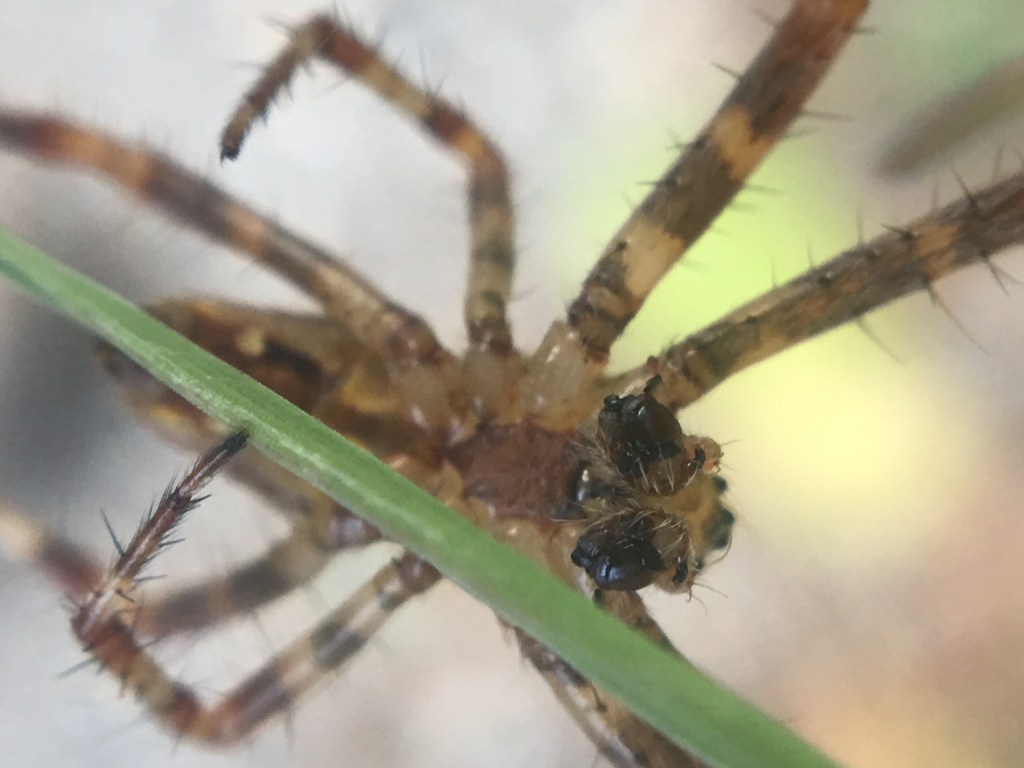
So male spiders have these fuzzy, enlarged “paws” that sort of hang down in front of their face. People who study spiders call them palps. They are sort of like a 5th pair of legs, but used by the spider to manipulate food and “smell” things. These palps are also where the sex organs are housed in adult male. The hairs on the palps have chemoreceptors that help the fellas follow the pheromone trails of SHE spiders. This is the mating season for one of our commonly seen spiders in the San Juans…the Giant House Spider (Eratigena duellica) who happens to be harmless, just horny.
How do spiders DO it? Well, an adult male spider will weave a small silken sheet called a sperm web. He deposits a drop of semen on the sheet and then dips the tips of his palps into the semen, drawing it up into what is called the emboli. The emboli act like a syringe, drawing the fluid up to be held in the palp for transfer to a SHE spider. With his palps “charged and loaded,” he gleefully wanders off to woo all the ladies.
Some of these male spiders really go all out to impress a gal. They will drum (with their palps), dance, and display all sorts of postures to show how great they are. They better do EVERYTHING they can to impress her too since SHE might eat them if it’s not good enough. Watch a jumping spider perform his quirky courtship ritual here –
Saturday, September 19, 2020. San Juan Island, WA – Caterpillar rescue!
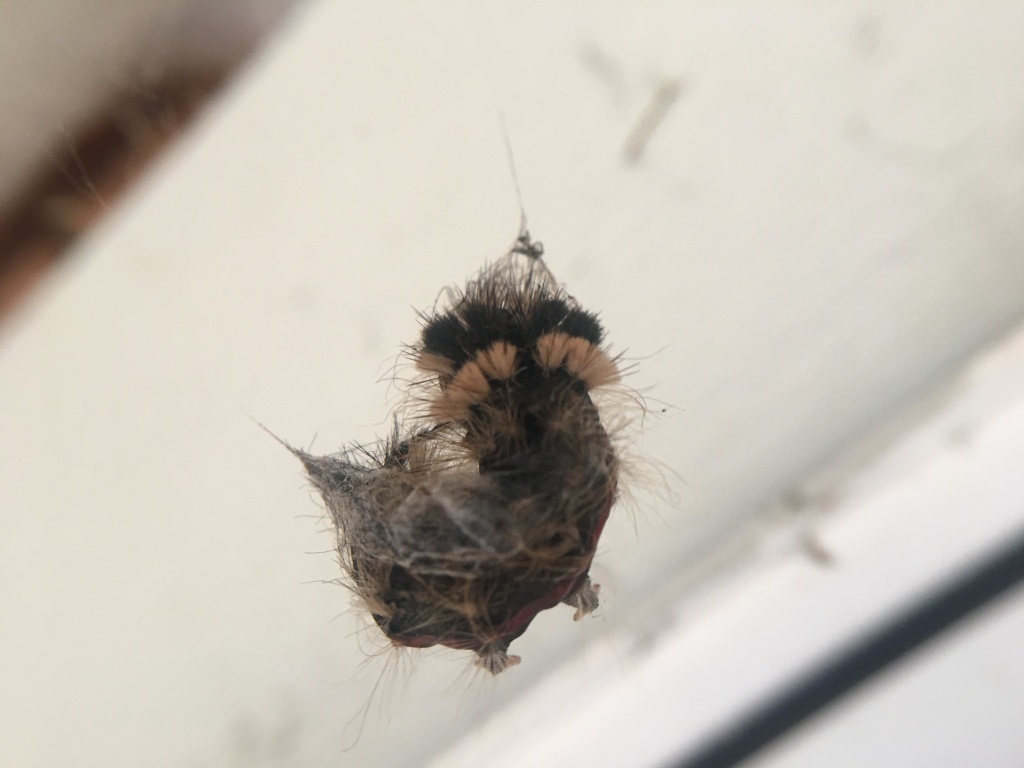
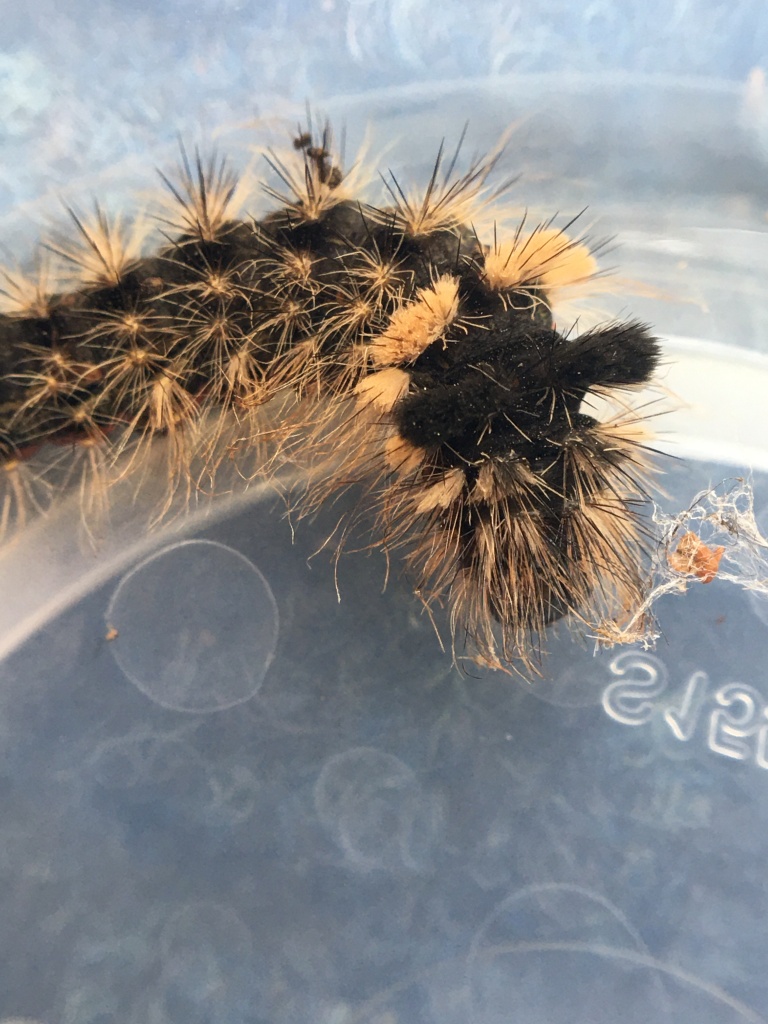
Acronita impleta – Yellow-haired Dagger Moth caterpillar. San Juan Island, WA 09.19.2020
I found one of these several years ago (September 20, 2017 to be exact), so I recognized it immediately when I saw it squirming in the spider webbing along the house this morning. My husband said I should just leave it alone. “Nature is ugly sometimes and you can’t interfere.” Well, when it was still there four hours later, suspended mid air, and still squirming, my tendency to SAVE things kicked in. The spider living above that web was actually dead. I’m not feeling very guilty about stealing food from a dead spider.
Acronita impleta – Yellow-haired Dagger Moth caterpillar. San Juan Island, WA 09.19.2020
Acronita impleta – Yellow-haired Dagger Moth caterpillar. San Juan Island, WA 09.19.2020
I got a cup and gently pulled at the web and began the process of freeing this caterpillar. It took finding my reading glasses and getting some fine-pointed tools to gently ply away the sticky bonds and clean the strands off the caterpillar hairs.
Acronita impleta – Yellow-haired Dagger Moth caterpillar. San Juan Island, WA 09.19.2020
Yellow-haired Dagger Moth (Acronita impleta)
I think it looks pretty good! I even picked it some dinner and we’ll see if I can keep it healthy through pupation and adulthood.
Yesterday my husband was outside working on our deck (without much help from me). The weekend projects can be overwhelming, especially when I’m so easily distracted every time I find a BUG. This one was perfect for my post today!
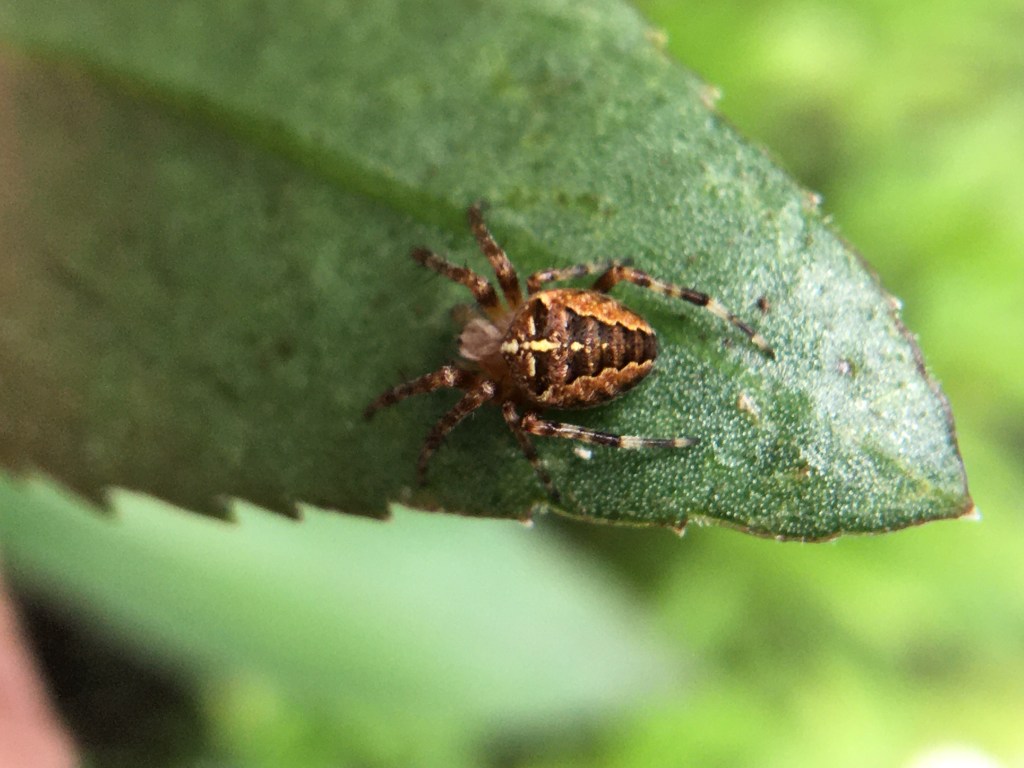
First off, it’s a SHE spider! This fall beauty is a female Cross Orb Weaver, Araneus diadematus. She was hanging out on the side of the house, just under the eave. I had to carefully climb a ladder to get a photo, but it was completely worth the risk.
Female Cross Orb Weaver, Araneus diadematus.
Female Cross Orb Weaver, Araneus diadematus.
Female Cross Orb Weaver, Araneus diadematus – San Juan Island, WA 09.07.2020Female Cross Orb Weaver, Araneus diadematus 09.07.2020
Orb Weavers are in the family Araneidae. These are some of the most beautiful and commonly seen spiders in our area. They weave the classic and typically vertical, orb-shaped web that we often see in our gardens.
March 29, 2013, Photo by Cynthia Brast-Bormann
While Araneus diadematus is not a native species and was introduced from Western and Northern Europe, it has become naturalized here and ranges across North America now. Bugguide.net gives the North American (including Canada) range for A. diadematus as the following localities – “diadematus – BC, WA, OR, MI, OH, PA, ON, NY, QC, RI, MA, NS, NL.”
Male and female specimens have different morphology (size, shape). Female body length can be from 6-20mm and they are fuller and more rounded. Male body length varies from 6-13mm and they are more narrowed in body shape.
Male A. diadematus
Male A. diadematus
Male A. diematus
Male A. diematus
Male A. diematus
Male A. diadematus
Typically, even though they are around in spring, we don’t notice them until later in the fall (like now). Females will be waiting on their web for a wandering male to find them. Males are not usually seen on webs since they are often on the move to find “Miss Right.”
The female A. diadematus will lay her last clutch of eggs in fall before dying, usually timed with our first frost. The eggs will overwinter. The eggs will hatch in springtime when temperatures warm, releasing hundreds of baby spiderlings!
June 13, 2013 – San Juan Island “Orb-Weaver Spiderlings”
I found this interesting poem online about Orb Weavers that I’ll leave you with today. Thanks for stopping by!
Araneus diadematus
Our cradle empty, we shall climb
To a high place, to catch the wind
And fly, strewing gossamer as we go,
Singly, flowing without will, to land
Wherever.
We shall know, by the compass
Blotched in white upon our backs,
Where to spin the spokes, and how
To spire the wheel; with one leg, feel
The trembling.
Approach too fast, and we shall quake,
And blur the whorl with shaking
From the underside, the compass
Pointing down, our legs the eight points
Taking.
At night we eat the orb, conserve
The silk, to spin again by morning,
Indelicately, cramming all
Into open mouths, every spoke
Consuming.
We spin the globes of nurture
After mating, span them so,
With loving claws, adore the
Minor worlds we make, compass
Turning.
Entwined in silk, their spinnerets
Are forming, massed bundles
Of eyes, and legs, and fangs
Entangling. Each of us
Expiring.
Source material. Veronica Godines, Araneus diadematus, http://animaldiversity.ummz.umich.edu. Theodore H. Savory, The Spiders and Allied Orders of the British Isles, London, 1945, pp. 130–131. The common “Garden Spider” has a characteristic “cross” on its back, and is the archetypal orb-weaver. Immatures, already orphans by the time they emerge, go out to seek their fortunes by abseiling more or less at random on air-currents, attached to an anchor point by nothing but a thread of gossamer.
Today, I’m going to introduce you to Rod Crawford in my post. Rod is the curator and spider expert (GENIUS) at the Burke Museum in Seattle. He is the go-to guy for anything you would possibly want to know about spiders.
One thing I really like about Rod are his efforts to debunk some of the most common myths about spiders. For instance, putting that spider you find in your house outdoors is good for the spider and where it belongs. Nope. Nope. Nope,….and one more big ole’ NOPE! Take a look here to read what Rod says about where some spiders live (including indoors), and why tossing them outdoors is not a good idea.


















 Bugging You From San Juan Island