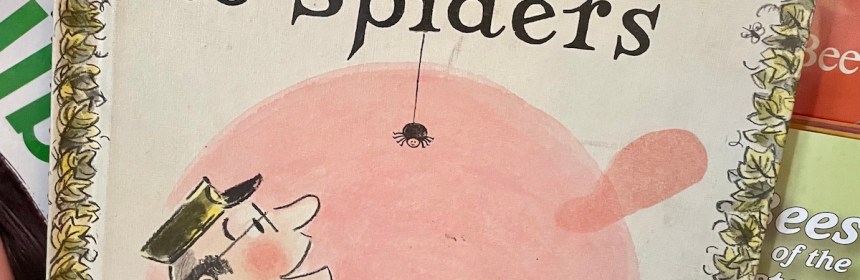
When I was a little girl, my mom read me this book, “Be Nice to Spiders.” We read it together many, many times! It was probably one of my earliest introductions to the wonder of ecological systems and definitely played a role in the development of my love for animals and nature.
My mom didn’t have the opportunity for a college education, and was a young mom at 23. She did however, grow up in the mountains of North Carolina, loved nature, and she had a “story” for everything! It made learning about leaves, bugs, rocks, and animals of all kinds really fun.
I was extremely lucky to have a mom like that and to be exposed to so many science opportunities, even though I didn’t really see it as science at the time. As a parent myself, and someone with a background in education, I can’t express enough to other parents out there how important it is to connect your children with nature…in a kind way! Help them to see living things with wonder and respect for all life. Especially spiders!
Here’s a YouTube read aloud of Be Nice to Spiders. There were several, but I just liked this woman for some reason. I’m sure the San Juan Island library has a copy of the book too, and if not, there’s always Griffin Bay Books, Serendipity, Abebooks, and Amazon where you can find a copy for your bookshelf.
There could be a few reasons you’re finding that spider in your sink or bathtub or shower!
Reason #1 – Lots of spiders are nocturnal, so while we’re sleeping they’re stealthily crossing the ceiling overhead. Sometimes one may bungee down to check things out below. If that happens to be over the tub, it’s possible the poor little (or BIG) spider just got stuck, unable to scale the walls of a slippery surface.
Same thing with the kitchen sink. A spider scurries across the counter too fast, one of those 8 legs slips or maybe a knee buckles (yes, spiders have knees), and the next thing that spider is facing is our equivalent of falling down into a deep well.
He…or SHE, needs someone to throw in a lifeline to get back out.
Reason #2 – Sometimes…yes, sometimes spiders end up in your tub or shower or sink because deep in the cracks or seals around the shower door or down in the drain, you have these teeny little spider snacks squirming around. That’s right! You might not see them, but even if your shower is squeaky clean, you probably have drain fly larvae living in your pipes.
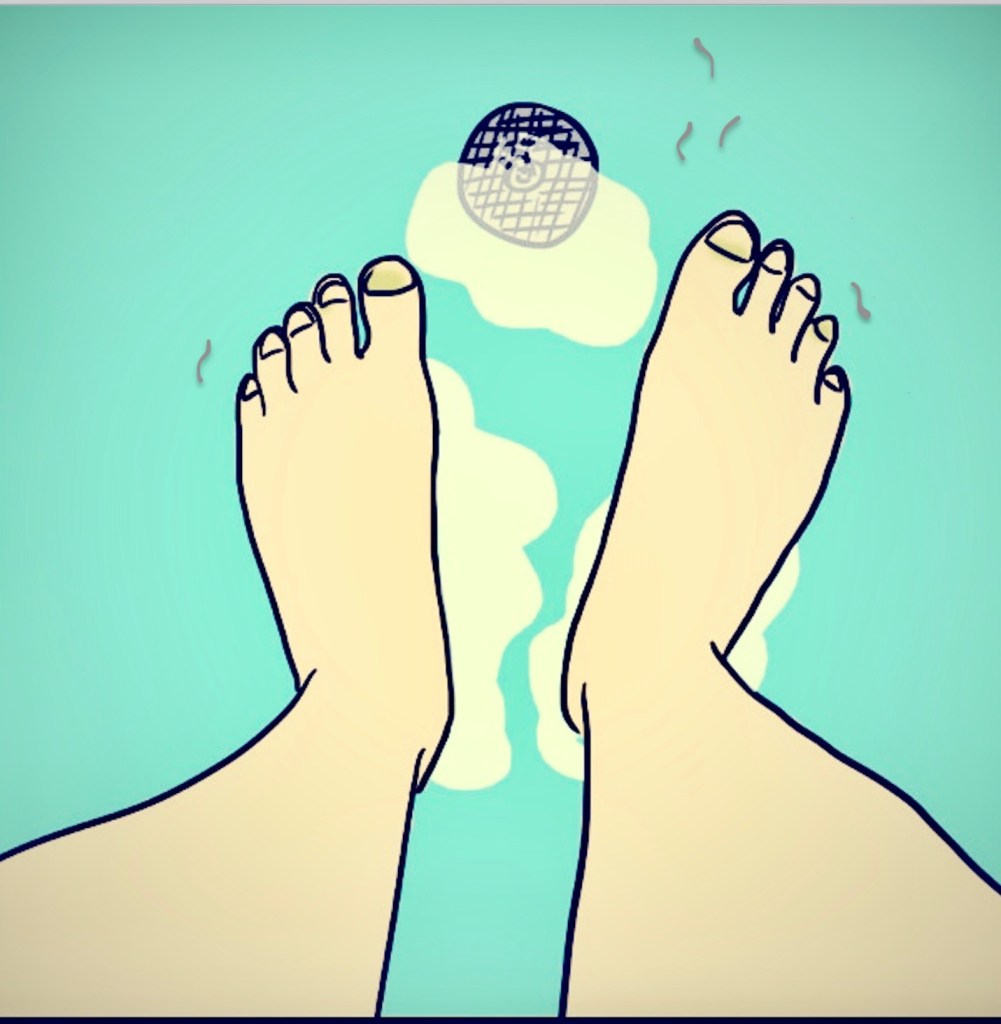
Yikes! I got into our shower one morning and there were these teeny little wiggly worms down at my feet. When I poked around the rubber strip that prevents water from leaking out the shower door, there were MORE!
To help you visualize this, I’ll try and get creative. I’m not a very good drawer, so I scribbled in the wriggling larvae to enhance this image I found online. In my mind, I pictured the woman in the movie Psycho, screaming at the top of her lungs since the scientific name for drainflies is Pscho-di-dae!
The adults aren’t scary looking at all though. They’re called Moth Flies and they are sort of cute…and fuzzy-wuzzy! The larvae, also called sewer flies, actually are beneficial and help purify water, so I am viewing them now as an important part of an ecosystem while trying to get over being creeped out by them around my feet.
I also am much more welcoming to my house spiders now that I know they are working hard to save me from DRAIN FLIES!
Reason #3 – Did you know that spiders drink water? Yes…sometimes spiders end up in the sink, bathtub, or shower because spiders get thirsty! I actually had a little spider I found in my home that was in a declining way and Rod Crawford (also known as the Spider Whisperer) at the Burke Museum messaged me about how to give it a drink. Here’s what he said, “For future reference, the way to give a spider a drink is to rest the mouth area (under the front of the “head”) directly in a drop of water.” I must confess that now I’m so sensitive to spiders needing water that whenever I get one out of the bathtub, I’ve put a moistened cotton ball on the floor nearby so it won’t die of thirst!
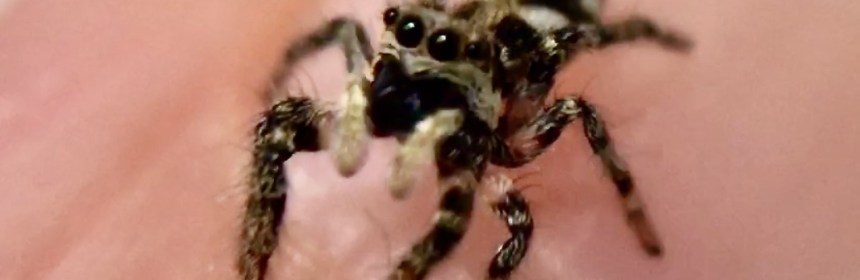
Please be my friend! (Salticus scenicus), a little jumper ❤️
Spider Sleuthing Day 3 – Classifying Spiders. The (VERY) Beginner Basics. Spider classification (for North America) consists basically of two different groups. These are the infraorders: Araneomorphae (the “true” spiders) and Mygalomorphae (the tarantulas and trapdoor spiders).
What are “true” spiders? Why those are the ones that aren’t Mygalomorphs! What??? I confess, I’m having to read up on this as I type this post. I DID, however, disclose that I am an entomologist and not an arachnologist in my DAY 2 post, and I can count to 6 (if you read my earlier post, you’ll get my joke), and that is high enough to tell you that these groups are partially differentiated by the number of book lungs a spider has.
Book lungs are the main respiratory organ in arachnids. Mygalomorphs have 4 book lungs and Araneomorphs have only 2. See, we got to SIX! 😁
The other difference between these two spider groups has to do with how they chew. Well, sort of. A more scientific description would be to say the directionality of movement of their chelicerae.
Yep. Let’s just make it easy today and say, Mygalomorph’s mouthparts move in a parallel direction (move your first two fingers towards each other like you’re making air quotes) and Araneomorph’s mouthparts are oriented in an opposing way (touch your forefinger to your thumb in a pincer-like way). For more about this, you’re welcome to delve into the deep world of spider systematics here – https://www.jstor.org/stable/2097274?seq=1#metadata_info_tab_contents
Sorting spiders involves numerous other factors including morphological differences such as eye arrangement, hairs, body shape, number of claws and even what type of web they make or whether they make a web at all!
As to webs, well that’s going to be a post of its own. There are ALL sorts of webs and knowing their names and being able to identify them will be a tool for figuring out what sort of spider you may have.
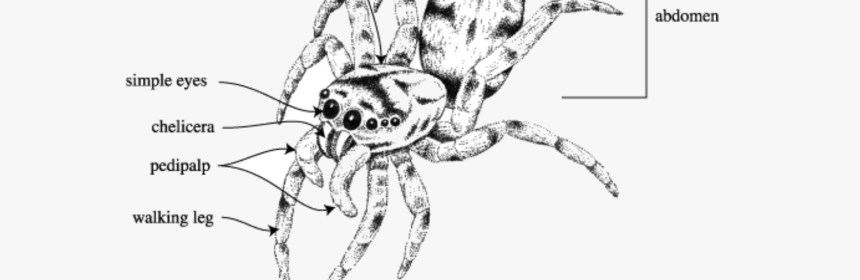
I have run out of time for my post today, but I will leave you with a few links to check out so you can learn more of the basic morphology that all spiders share: 8 legs, head or (cephalothorax region), abdomen…Oh, and the cutie on my finger is one of my house spider friends. This little one is a jumping spider (Salticus scenicus), named Skipper.
***Hint to remembering the Mygalomorphs – *The majority of species in the Mygalomorphae are tarantulas, in the family Theraphosidae (in French, a tarantula is called a ‘mygale’
Sleuthing Spiders Day TWO! It’s all about the NAME.
Did you know I name the spiders in my house? I also can recognize some of the cuties that are repeat offenders. Repeat offenders? Oh yes! These are the ones who I find in my kitchen or bathroom sink on a regular basis.
I even have some that end up in the shower or bathtub. The toilet you ask? Well, we keep our toilet lids down so they don’t accidentally fall in and drown. Also, keeping that toilet lid down (especially when you flush) prevents weird germy bacteria and viruses from spewing out into the air where you might breathe it back in! That’s another topic entirely though. Tomorrow, I’ll cover why spiders end up in bathrooms in the first place, so stay tuned!
Are any of these spiders in my house going to bite me? Doubtful. And, even if they did, most likely all that would happen is NOTHING! At most, I might feel a small pinch like I did when the one hanging out in my bath towel bit me.
I knew it was a spider because I was patting myself dry, felt it bite my leg, then watched it drop to the floor. Sadly, I was the one inflicting pain and had mortally wounded the poor creature. All I suffered was a tiny raised red mark on my skin that went away in less than 20 minutes.
Was I worried about the bite? First off, I’m no spider expert because entomologists study INSECTS and spiders are ARACHNIDS. It’s all about legs (and math). Entomologists can’t count beyond 6 and Arachnologists can count to 8. Bad joke, right? I wasn’t worried because most spiders (and I’m referring to the ones that are found in the San Juan Islands) are harmless (or you can use the scientific description of “medically insignificant” to impress your friends)!
Learning to correctly identify some of these spiders will put your fears to rest. We’ll go through some of the ones commonly found in homes, especially at this time of year. We will learn to identify a black widow and where they might be found. Also, we’ll be learning about widow look-a-likes that you might not want to squish in your home because they chase the real widows away!
But today! Today, we are going to NAME that spider in our house. I found a list of very cool spider names online (check out either of these links if you need ideas – https://animalhype.com/arachnids/spider-names/ and https://petpress.net/pet-spider-names/ My favorites were Zorro, Otto, Blossom, Skreech, Jinx, Twitch, Tinkerbelle, and get this…SPINDRA!
I named my spider Tinkerbelle! I think Tinkerbelle is a SHE spider. Tinkerbelle is giant house spider hanging out in my bathroom this week. Her scientific name is Eratigena duellica.
Giant House Spider (Eratigena duellica)Giant House Spider (Eratigena duellica)Shelf-like spider webs in bathroom
I looked around the ceiling of the bathroom and can see little shelf-like webs where some of those super irritating fruit flies are landing. I’ve resisted my OCD urges to clean the webs away and actually appreciating the natural pest control that is free of toxic chemicals.
If you want to become FEAR-Less of Giant House Spiders, and we’ll be seeing LOTS of them through the upcoming fall months, someone I know put together an awesome YouTube video about them. You can check out Arlo’s video here –
Today is officially the first day of September Spider Sleuthing in the San Juans. I’m excited about seeing those “spidee” photos and learning together about some of the very cool things that spiders do. We’re also going to conquer any FEARS of spiders and to start off, I’m going to post a link so you can discover Lucas the Spider. If you don’t know about Lucas, he is the cutest spider in the world, AND he wants to be your friend. *Kid and Adult Friendly!
A neighbor sent me this video footage late last night. She asks, “Why are all the black and yellow bumble bees on the ground dying?” This occurred locally at an island lavender farm where the bumble bees are LOVED and no one is applying any pesticides. In the video you can certainly see the bees she refers to. Why only those?
The dying bees are the lovely Yellow-Faced bumble bees, Bombus vosnesenskii. I personally appreciate these because not only are they avid tomato pollinators, but they have such adorably chubby and fuzzy bodies with a yellow face and a yellow band around their little black bottom.
Bombus vosnesenskii, Yellow-faced Bumble Bee
Bumble bees are cavity nesters. Many will select an empty mouse burrow in the ground to create their nest. The fertilized queen overwinters and begins her colony in late March or early April, foraging for herself and the eggs she laid that would soon hatch into larvae needing to be fed.
Bumble bee nest on San Juan Island, WA 2010
In order to obtain nutrients necessary for survival, bumble bee foragers can travel long distances (up to 11 miles), especially here as our growing season ends in summer. Right now, they are visiting the lavender in bloom.
These poor bees are most likely victims of pesticide. The fact that all of them are the same species, at the same location, indicates to me that someone applied pesticide at their nest site, likely a property owner within foraging distance of the worker bees visiting the lavender farm. The workers dispersed from the nest to try to do what they are programmed to do (forage for food), but simply succumbed to the toxic residues that some fearful homeowner applied.
“I can’t have bees in my yard!” “I’m allergic.” “I have pets.” “I hate insects.” “It could be murder hornets.”
Do you want to have food?
If you, as a homeowner, continue spraying your yard every time you see a bee and can’t learn to live with them, you are going to be the end of all of us. Bumble bees are some of our most important agricultural pollinators. More important than honey bees!
The dying bees in this video are native bees. “Native” means they are adapted to this environment. They have the ability to survive here better than European honey bees (Apis mellifera) which are not native. Honey bees were transported to North America by Europeans who brought sheep, cattle, swine, and other domesticated species to this continent.
Back to the over-sensationalized “murder hornets.” This term makes me angry! 😡 The media hype is much like the hype over the mantids that are going to eat our hummingbirds ! Just because it is printed in the paper doesn’t mean it is the whole truth or entirely accurate. The primary reason the Asian Giant Hornet (Vespa mandarinia) is of concern is their ability to kill European honey bees (Apis mellifera), an agricultural commodity. To read some of the news stories, you’d think we were dealing with Africanized Bees…remember those?
It is possible Vespa mandarinia will not survive here. They aren’t native. They will be susceptible to parasites, and viral, bacterial, and fungal diseases (not unlike the same problems our non-native European honey bees face) potentially making it difficult for populations to establish themselves. We could also, as many Asians do, learn to eat them. Yes, do read the publication about them in my references section!
Please put that can of pesticide away. Don’t spray. If you are truly afraid of bees, then educate yourself about how to live alongside them. First off, don’t wear shades of blue or black colors when you’re near an area that has bees. Bumble bees and honey bees are attracted to these colors. Avoid wearing fragrances. Wash your clothing in unscented detergent and avoid using those noxious, heavily scented dryer sheets. Finally, if you do see an insect that you believe is the Asian Giant Hornet, take a photo or collect the specimen if it is already dead and contact WSU following these guidelines.
In Washington State only, people should report potential sightings of the AGH through the Washington State Department of Agriculture’s website. Outside of Washington, contact your state apiary inspector. If it is safe to do so, take a photo or collect a dead specimen of the pest to help experts identify the insect.
In the meantime, please don’t fall victim to media hype and do your best not to murder innocent bumble bees!
John M. Mola, Neal M. Williams. (2019) A review of methods for the study of bumble bee movement. Apidologie 56.
Jha, Shalene, and Claire Kremen. (2019) Resource diversity and landscape-level homogeneity drive native bee foraging. Proceedings of the National Academy of Sciences of the United States of America vol. 110,2: 555-8. doi:10.1073/pnas.1208682110
Sujaya Rao, George Hoffman, Julie Kirby & Danielle Horne (2019) Remarkable long-distance returns to a forage patch by artificially displaced wild bumble bees (Hymenoptera: Apidae), Journal of Apicultural Research, 58:4, 522-530, DOI: 10.1080/00218839.2019.1584962
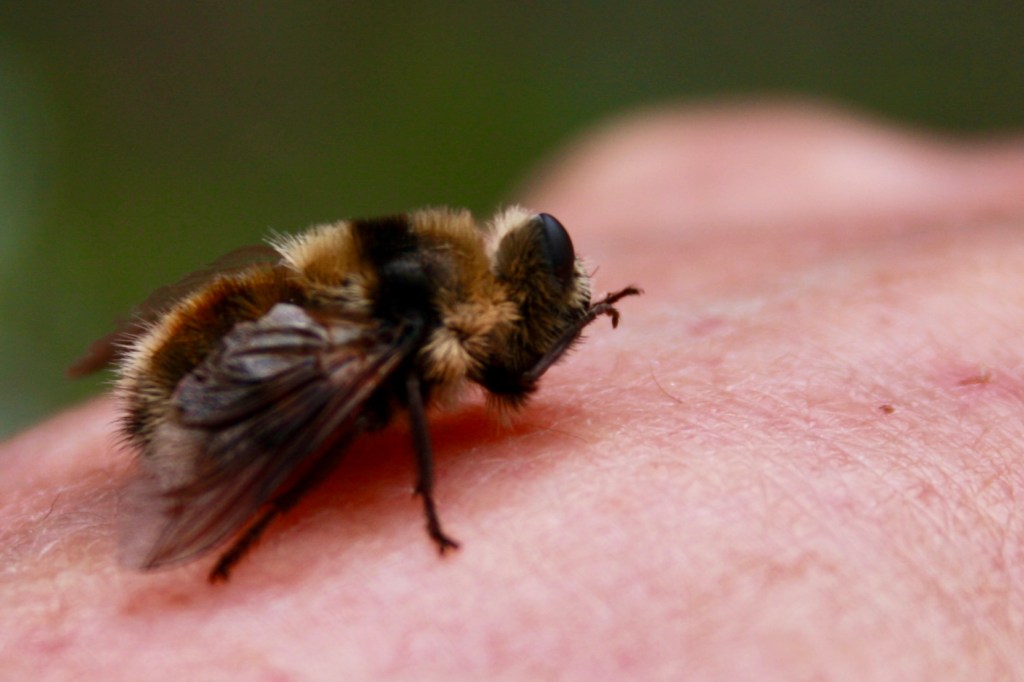
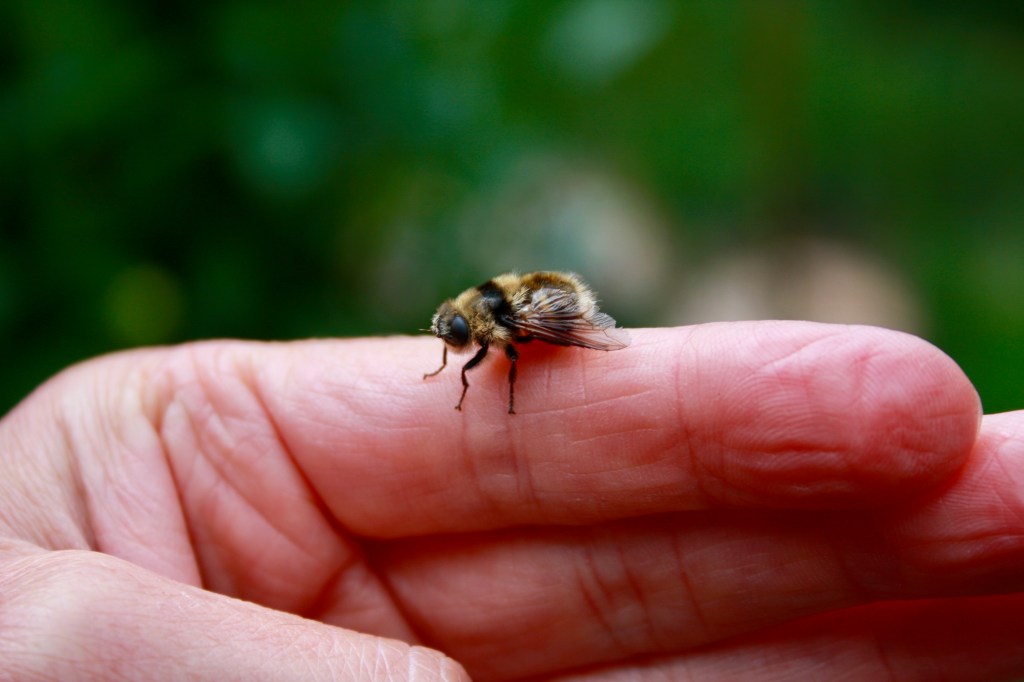
I made a video of one of my favorite insects you will see here in the San Juan Islands. This is a bumble bee mimic, but it’s not a bee at all. It’s a fly. Not only is it not your ordinary fly, it’s a fly with a very interesting life cycle that requires a host. This particular host relationship has evolved between the fly and our local black-tailed deer. It’s not feeding on the deer because these adult flies don’t even have mouthparts to eat. Their sole mission is to reproduce and they need an incubator for their “babies.” If you see a deer and notice it coughing, watch the video to find out why. **Edit *** Update to post… I misspoke in the video and state that the fly oviposits onto the deer which is incorrect. The eggs actually hatch inside the fly body and the fly larviposits onto the deer muzzle. Either way it’s got to be pretty terrifying to the deer! 🦌
Cephenemyia apicata 07.07.2020 video by Cynthia Brast-BormannCephenemyia apicata 07.07.2020 photo by Cynthia Brast-BormannCephenemyia apicata San Juan Island, WA 07.07.2020 Photo by Cynthia Brast-BormannCephenemyia apicata San Juan Island, WA 07.07.2020 Photo by Cynthia Brast-Bormann
Cephenemyia apicata
San Juan Island, WA
07.07.2020
Photo by Cynthia Brast-Bormann
Cephenemyia apicata
San Juan Island, WA
07.07.2020
Photo by Cynthia Brast-Bormann
Cephenemyia apicata
San Juan Island, WA
07.07.2020
Photo by Cynthia Brast-Bormann
Cephenemyia apicata
San Juan Island, WA
07.07.2020
Photo by Cynthia Brast-Bormann
Cephenemyia apicata
San Juan Island, WA
07.07.2020
Photo by Cynthia Brast-Bormann
Cephenemyia apicata
San Juan Island, WA
07.07.2020
Photo by Cynthia Brast-Bormann
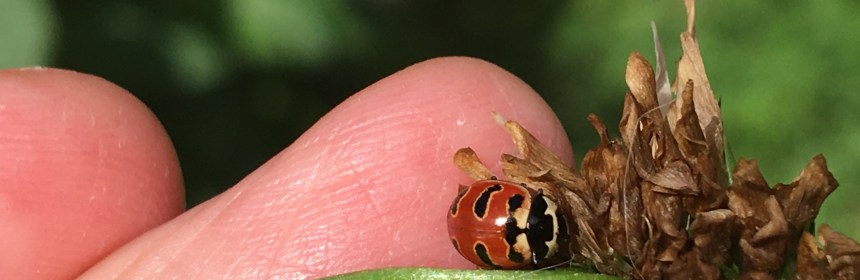
I found my first Three Banded Lady Beetle (Coccinella trifasciata subversa) this morning in the patch of clover in front of my home. At least I believe it is the subspecies ‘subversa’ according to the information I found online and referencing the distribution map. While I did not find much information about this particular species pertaining to life in the Pacific Northwest, I did find that according to the Lost Ladybug Project, this species (Coccinella trifasciata) is considered a species of greatest conservation need in the state of New York.
Coccinella trifasciata subversa on clover Photo by Cynthia Brast-Bormann San Juan Island, WA 07.06.2020Distribution map of Coccinella trifasciata subversa
So, because I’m interested in Lady Beetles and conservation, I submitted my photos today to the Lost Ladybug Project. They’re keeping records of sightings and I believe it’s important to collect and share data that help us understand more about the lives all of all the amazing critters we share the planet with.
If you see a Lady Beetle you are interested in knowing more about, take a look at the Lost Ladybug Project here – http://www.lostladybug.org/index.php
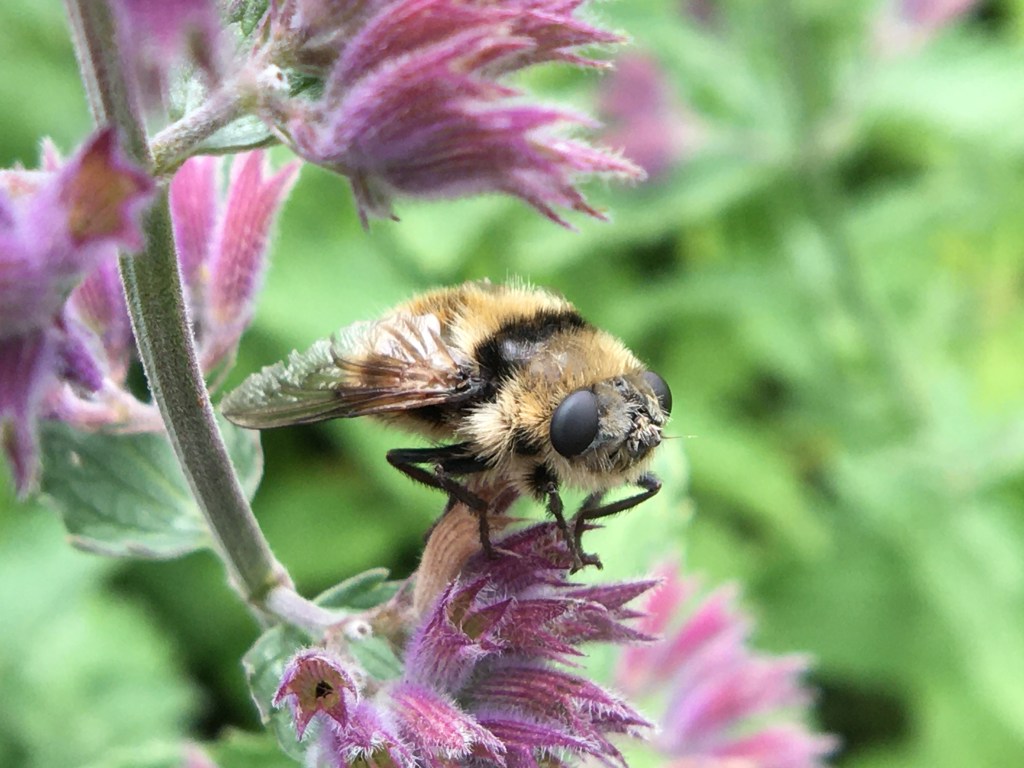
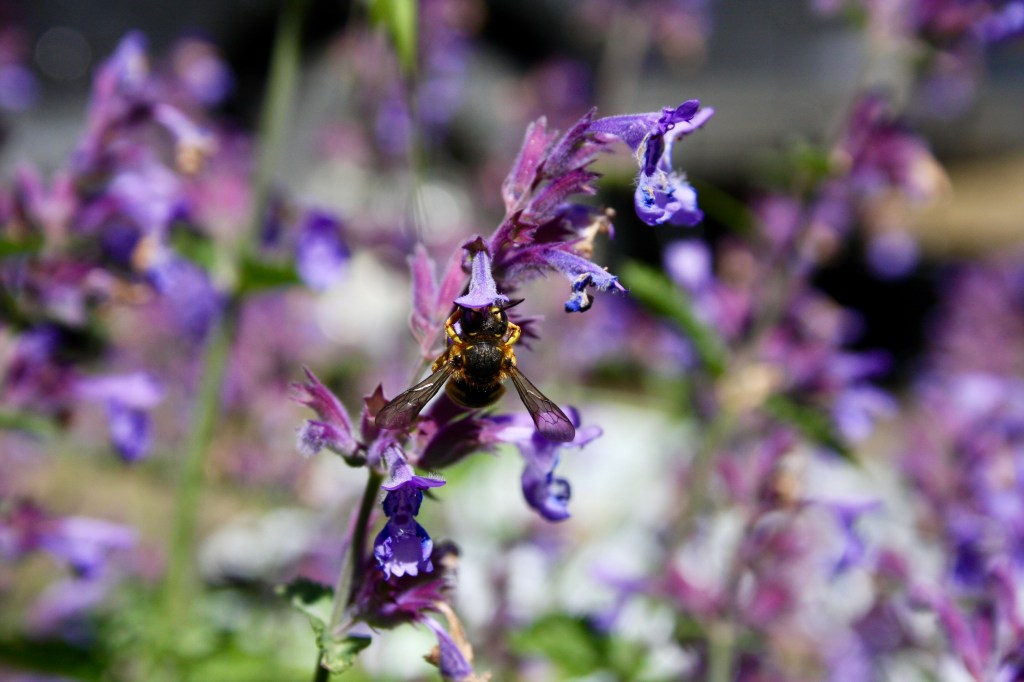
Meet Woolly Wool Carder. Woolly gets a bad rep because Woolly LOOKS like a Yellowjacket Wasp. All Woolly wants to do is find that patch of Lambswool in your garden or flower bed and take enough to make a nice cozy bed for its babies.
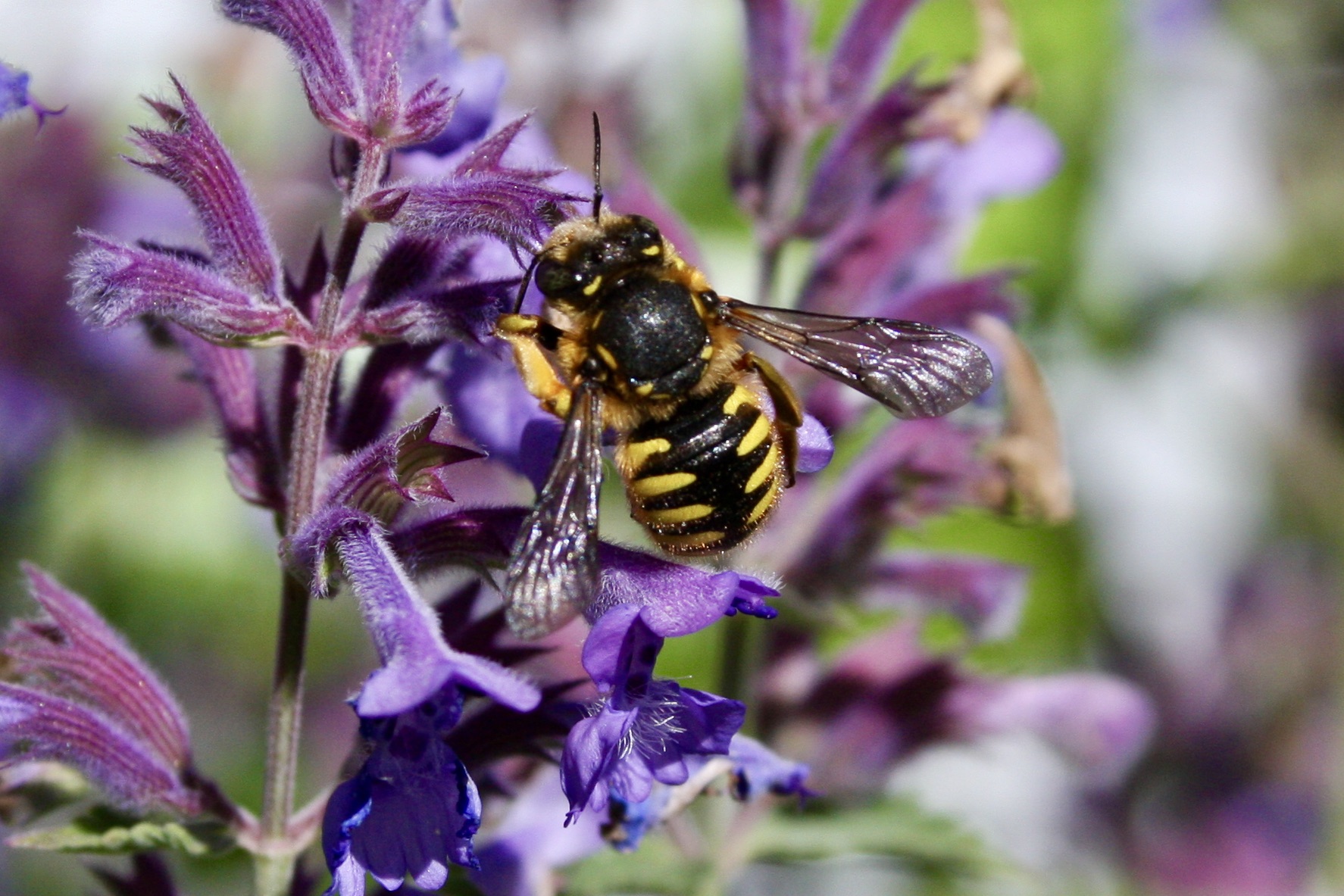
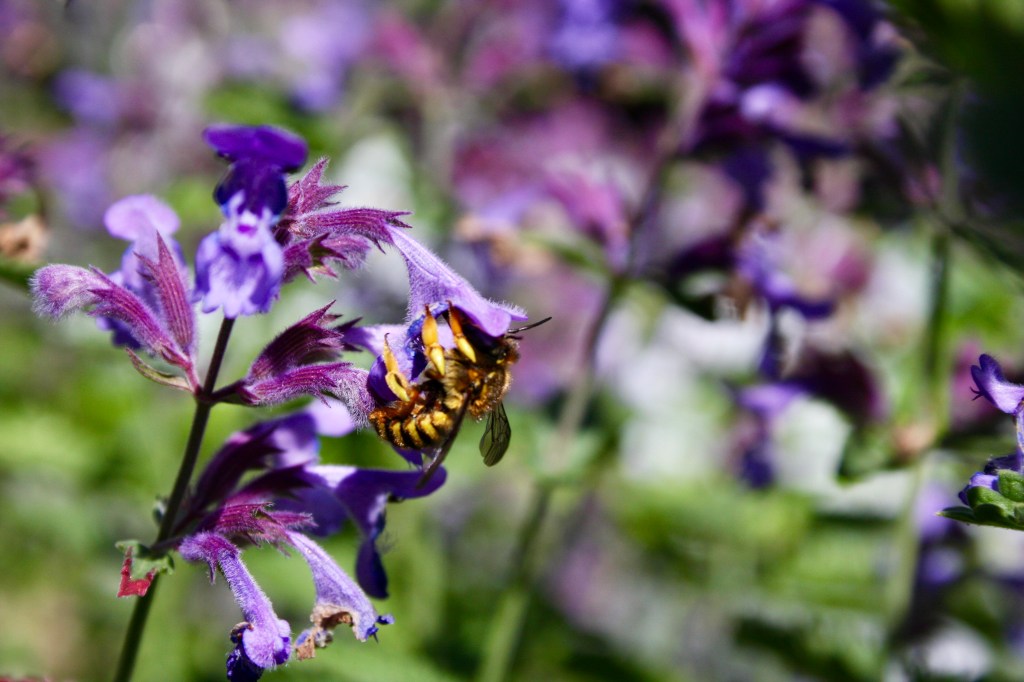
Wool Carder Bee (Anthidium manicatum) on Nepeta spp. (Catmint)
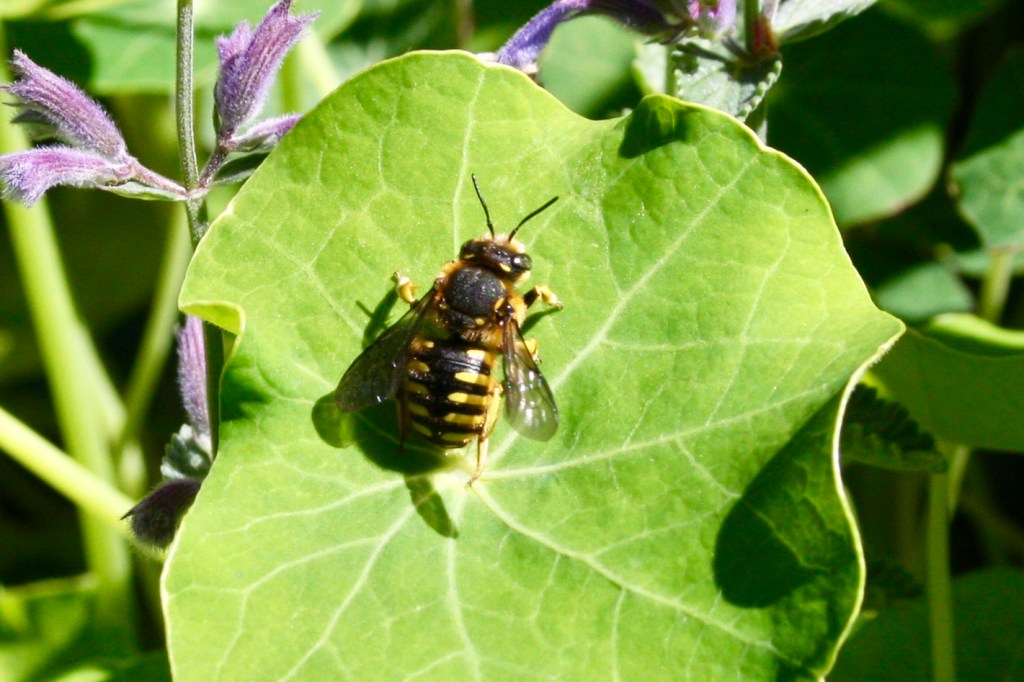
The European Wool Carder Bee (Anthidium manicatum) at first glance, looks like a somewhat chubby Yellowjacket. While these stouter and hairy-bodied bees mimic the barbed stingers everyone wants to avoid, they aren’t going to harm you at all. They don’t even have stingers, though the males do have some spines at the end of their abdomen they can use defensively against other flying insects that might be perceived as a threat to their food source or territory.
Wool Carders are smaller than most Yellowjackets. They are about the size of honey bees or between 11 and 17 mm. They are very brightly colored with yellow and black markings, but again, the distinguishing features to differentiate them from Yellowjackets are 1) they’re hairy and 2) they’re stout!
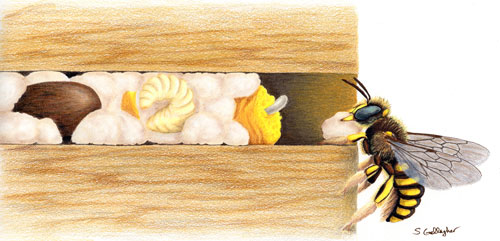
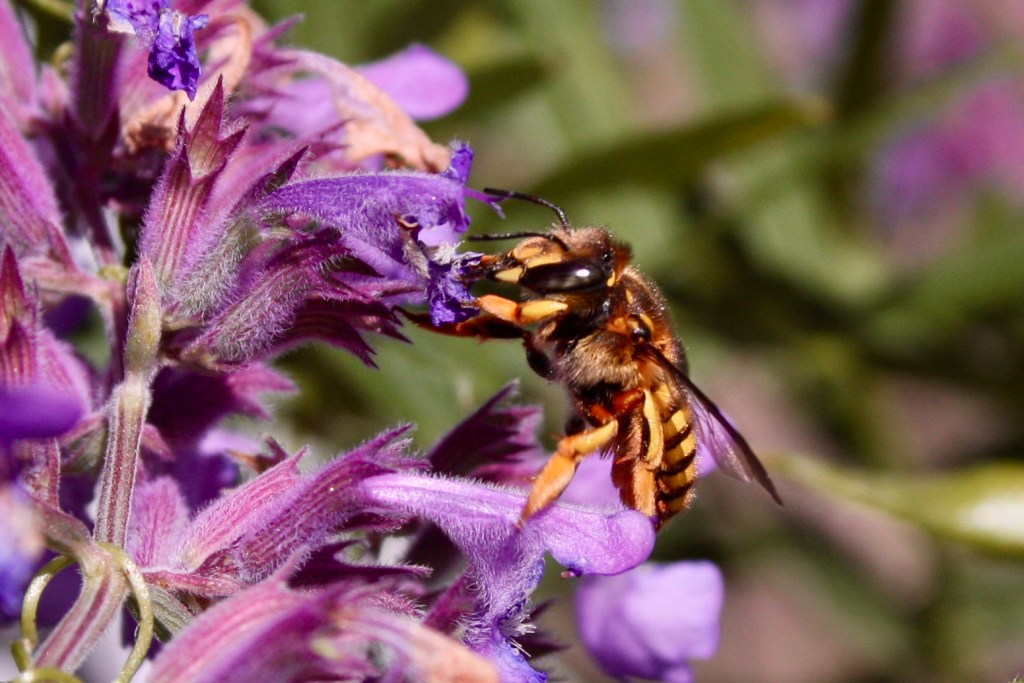
Other than sipping nectar from flowers, these solitary, cavity nesters are all about finding wool to make a cozy bed for their babies. Actually, aside from the uhm…deed, the female is the one doing all the provisioning for a nest. She will card “wool,” using her mandibles to scrape bits of trichomes (or hairs) from lambs ears or other fuzzy plants (especially those in the mint family) to make a cushioned bed on which to lay her egg. Each egg is provisioned with enough nectar and pollen to supply the developing larva with nutrients to reach pupation.
Wool Carder Bee nest – Illustration by Samantha Gallagher, University of Florida
Anthidium manicatum European Wool Carder Bee 06.28.2020
Anthidium manicatum European Wool Carder Bee 06.28.2020
Anthidium manicatum European Wool Carder Bee 06.28.2020
Anthidium manicatum European Wool Carder Bee 06.28.2020
Anthidium manicatum European Wool Carder bee on Nepeta 06.28.2020
Anthidium manicatum European Wool Carder Bee 06.28.2020
Anthidium manicatum European Wool Carder Bee 06.28.2020
The European Wool Carder Bee is native to Europe, Northern Africa, and Western Asia, but has become cosmopolitan in distribution. While non-native, it has become widely adapted to various habitats in North America. These bees are not dangerous to humans or pets. They are effective pollinators, but sometimes outcompete native bees for resources.
Menacing Murder Hornets are making headlines everywhere these days and giving many of our beneficial wasps a bad rap. Before you grab that can of bug spray, follow along for the next week or two while I profile the good guys and give you tips on how to ID the ones you’ll see on the San Juan Islands.
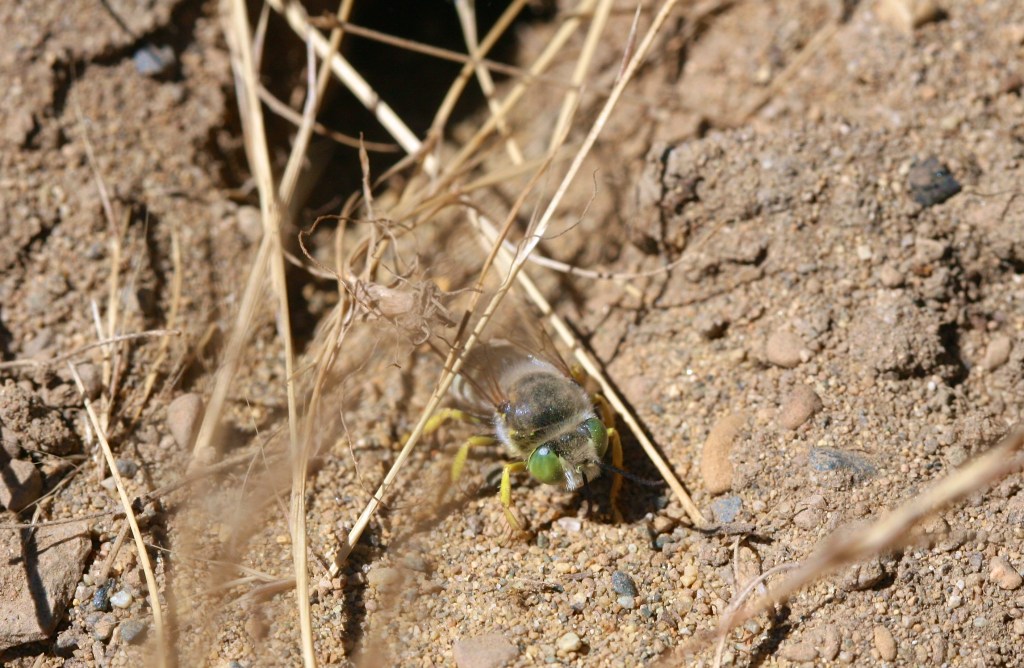
Wasp #1 – The Western Sand Wasp (Bembix americana)
Bembix americana – Western Sand Wasp – San Juan Island, WA
On San Juan Island, if you’re out along the beach bluffs on the west side or anywhere at American Camp, Eagle Cove, or Jackson’s Beach and the nearby quarry, you may notice them hovering and darting about above the sand or spots of bare earth. Western Sand Wasps are solitary digger wasps in the family Crabronidae. Males and females emerge simultaneously and their entire adult life is to sip nectar from flowers, mate, and reproduce.
After mating, it is the female who will provision her nest. She scours the sand and nearby areas, hunting insects and arachnids to supply her developing offspring in underground burrows. She will oviposit one egg in a single burrow, leaving it with a zombied insect, continuing until all her eggs are laid. But her work is not over. She must continue to check and feed each of her larvae in their individual burrows after the eggs hatch, making sure that they do not starve as they develop. Fast fact…a single larva can eat more than 20 flies before it pupates!
So she digs…and digs…and digs! These wasps are able to dig so fast, they can disappear under the sand in a matter of seconds.
video by Cynthia Brast-Bormann, San Juan Island, WA
Human or Pet Risk factor – LOW
Unless you are walking barefoot in the sand and mange to step on one of these, you are highly unlikely to be stung. Wear foot coverings and enjoy your hike or picnic. They’re not going to murder you!














 Bugging You From San Juan Island