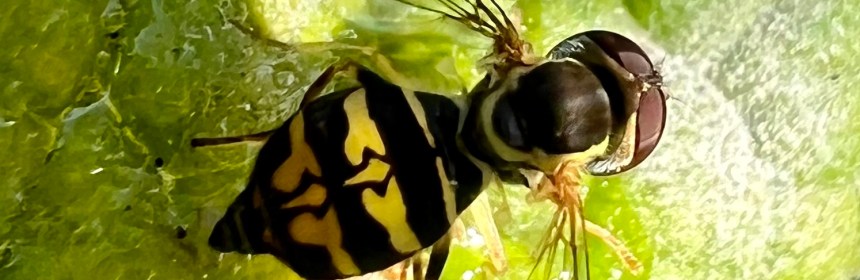
Western Calligrapher (Toxomerus occidentalis)
I sat outside today in the sunshine, forced convalescence if you will, exhausted and achey after getting my Covid Omicron Variant booster vaccine yesterday at the San Juan County Fairgrounds. My outdoor time was unfortunately cut short because we have been inundated with construction development noise. I’m fairly certain I will be forever challenged to have an amiable relationship with our newest neighbors. In part, because they sited their VACATION home, right in front of our view. Mind you, they could have moved over 100 feet and we would not have to look across the top of our driveway at their newly constructed 2nd home. It has definitely impacted us. We’ve lost a lot of our privacy out here in the woods. It was never my desire to have close neighbors. I am a bit of a recluse….which is what the new neighbor said about his wife, yet, it begs me to ask again, WHY DID YOU BUILD YOUR HOUSE RIGHT ON TOP OF US?
Oh, and the jackhammering! That noise is enough to make a person homicidal. We had an entire summer of jackhammering from the former owners of that property. Really, truly, that property should never have been zoned for development. Not any development. It’s partly (half) wetland, and the other half is bedrock. Imagine the task of trying to excavate enough to bury your septic lines down the hill when you have solid bedrock! Also, our house is on that same shelf of bedrock, so the hammering shakes the walls and vibrates the floors of our home in the process of all this construction. The development on this lot has gone on for multiple years. I’m really tired of the disruption.
I digress. Sorry, I just had to vent. San Juan Island would be a much friendlier place for wildlife and bugs and such if we didn’t allow anyone to build a 2nd, or 3rd home here. We are outgrowing our space and it isn’t pretty.
Here’s my bug of the day. This beauty is a Western Calligrapher Fly (Toxomerus occidentalis). I was mesmerized watching it rest on the mint leaf. The patterning on the dorsal side of the abdomen reminds me of some sort of totem design.
The adults of this fly species are pollinators. They lay eggs on plants near aphids and when larvae emerge they are predatory on the aphids. It is believed that late instar larvae overwinter, pupation takes place in the soil cavities in the spring and adults emerge later in summer. The name for this group of flies comes from Greek toxon ‘bow’ + meron ‘thigh’ (refers to the bow-shaped hind femur). You can see the curve in the first photo below, circled in red. Something else interesting pertaining to the adult coloration I found on bugguide.net: “Colors vary with overall temperature during pupation: if it was hot, the yellow/orange increases and the background becomes lighter, but if it was cold, the dark/black increases and the yellow/orange becomes darker like the background.”
Enjoy the last few days of sunshine and embrace our native pollinators. We are heading into the dark part of the year. For those of us who live here year round, you know what to expect. Lots and lots of rain.
Thanks for reading!





 Bugging You From San Juan Island