I picked up these acorns (Quercus sp.) when I visited my folks recently in Texas. They have several oak trees on their property and there was an abundance of acorns all over the ground this year, so I brought a few home with me in a ziplock bag. I like acorns. My mom used to draw little faces on them and I had acorn “people” to play with when I was a child.
Acorn “person”
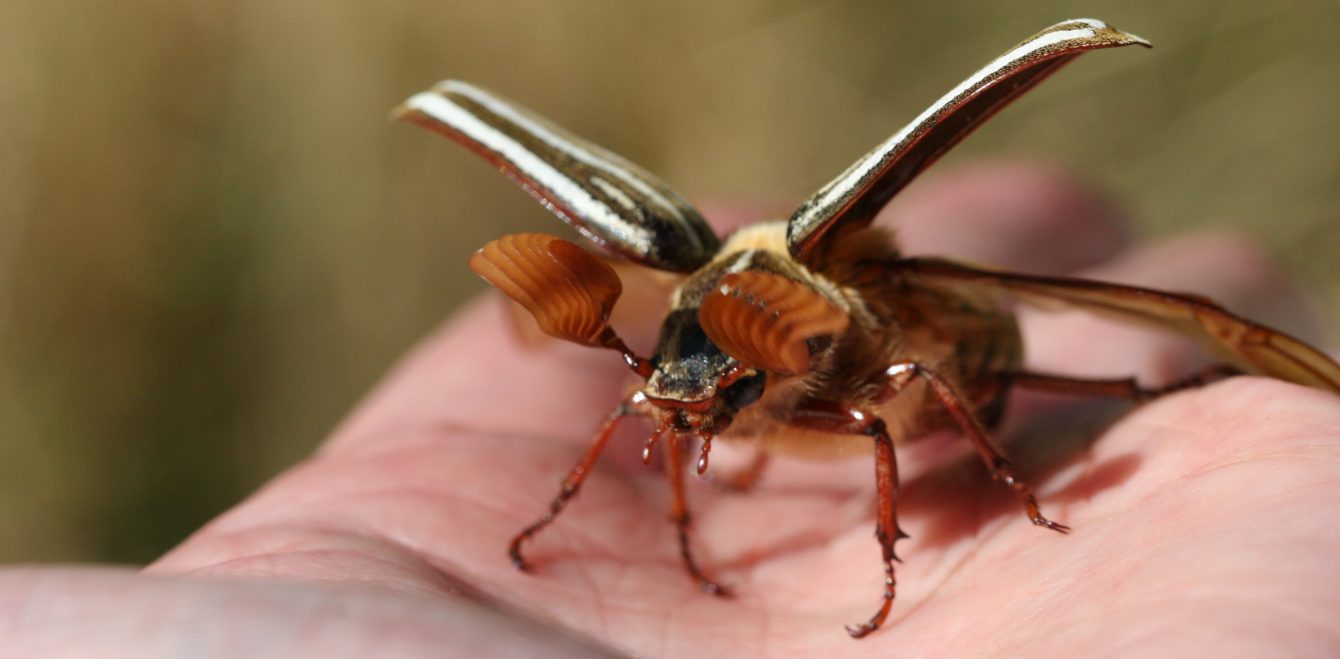
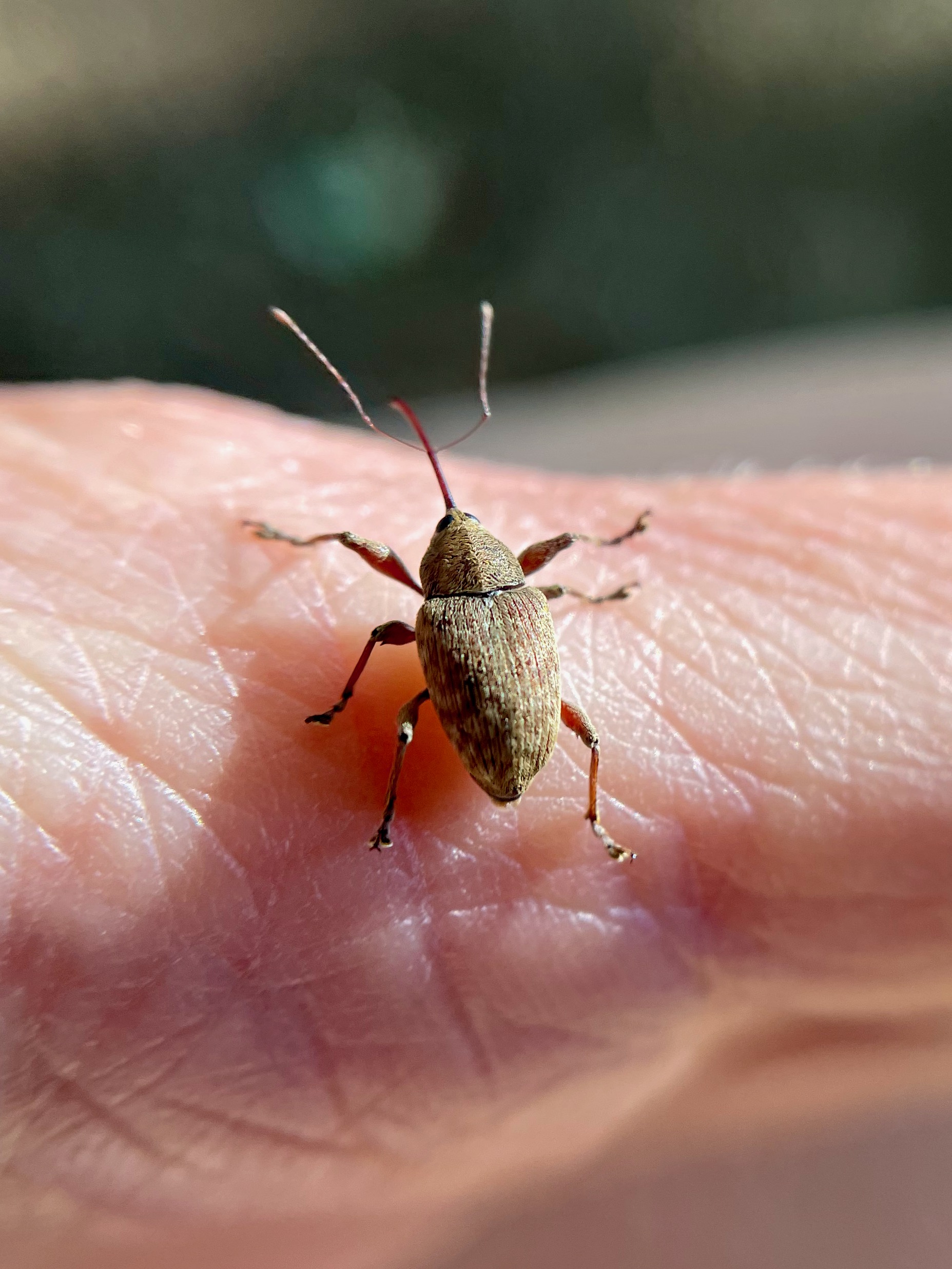
I also found a very cool bug under one of those oak trees while I was there. This strange looking creature is one of the Nut and Acorn Weevils (Curculio sp). It has an extremely long snout. When you find out how this weevil uses it to DRILL, you may be amazed. The adult female weevil will use this drill on her very long snout to make a hole in those acorns!
Nut and Acorn Weevil (Curculio sp).Nut and Acorn Weevil (Curculio sp).Nut and Acorn Weevil (Curculio sp).
Keep reading. It really is amazing.
A female weevil will make a hole in the acorn so she can put her eggs inside it!
Hole drilled by Nut and Acorn Weevil
Because I like word games, I thought I’d point out to you that rearranging the letters in the word weevil will make the words “we live?” Well, those eggs hatch into baby weevils who LIVE in a little house that is an acorn (and sometimes in other nuts too). Some folks call them grubs or worms. They are actually the larvae of the adult weevil mom who selected the acorn for her nursery.
If you are assessing this situation from an agricultural perspective (say that nut is a pecan), invested in harvesting a profitable crop, you might be feeling very worried. Sometimes the worry may indeed be justified, but in many cases, like with these acorns, the tree has evolved a strategy to deal with occasional waves of weevils and other insects we consider pests. In actuality, they are just utilizing the resources of the tree like we do when WE (the humans) eat the nut or fruit.
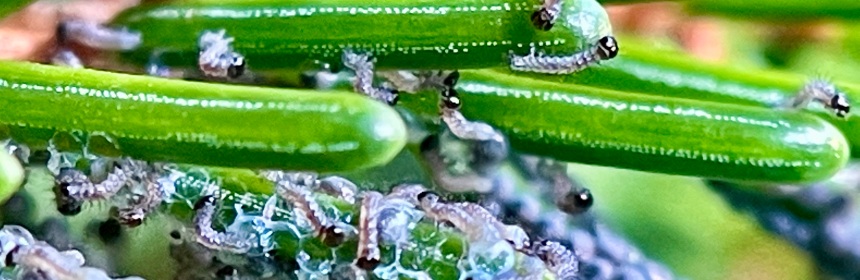
Larvae of Nut and Acorn Weevil (Curculio sp).
I’m going to name the trees’ strategy of dealing with this bug FEAR NO WEEVIL. However, the actual scientific moniker for this strategy (and it applies to other pests and adverse weather stressors as well) is MASTING. The word mast has been used since way back in the Middle Ages to refer to the acorns and seeds of forest trees that drop and accumulate on the ground. It comes from Old English, mæst. Essentially, masting is an ecological term referring to the highly variable and often synchronized periodic cycles of fruiting/seeding in the reproductive processes of trees (both forest and fruit trees).
How is it a strategy for circumventing the deleterious affects of pests? Well, the idea is that in some years, bumper crops of nuts and seeds are produced in order to satiate the predators, so some are left to germinate and continue new generations. In this particular case, you could think of it as the oak trees sacrificing some of their offspring to the weevil gods. When there are more acorns than there are adult female weevils, some of those acorns will escape the weevil drill and makeover into little bug nurseries.
In reality, this relationship is much more complicated. In some cases, acorns parasitized by only a few weevil larvae will germinate, while those acorns with many larvae will not. The trees’ bumper crops of seeds and nuts will also cycle with years of low production, where resources are scarce for the weevil (and other organisms). Nature is incredibly dynamic though. Studies show some species of weevils have adapted a counter mechanism to circumvent the trees’ strategy of masting. It’s called prolonged diapause. This means these weevils are able to sleep longer (more than one year) as they develop in order to synchronize adult emergence with years when the trees’ seed/nut production is high.
If you are interested in reading more about the history and MYSTERY of masting, I encourage you to delve into the literature I’ve listed in the references below. It’s quite fascinating – especially going back in history to the link between masting and pannage. Way more than I can cover here. Check it out.
Higaki M (2016) Prolonged diapause and seed predation by the acorn weevil, Curculio robustus, in relation to masting of the deciduous oak Quercus acutissima. Entomol Exp Appl 159:338–346. https://doi.org/10.1111/eea.12444
Koenig WD. 2021 A brief history of masting research. Phil. Trans. R. Soc. B 376: 20200423. https://doi.org/10.1098/rstb.2020.0423 Koenig, W. D., & Knops, J. M. H. (2005). The Mystery of Masting in Trees: Some trees reproduce synchronously over large areas, with widespread ecological effects, but how and why? American Scientist, 93(4), 340–347. http://www.jstor.org/stable/27858609
I first spotted this beauty on October 1, 2021 while I was taking a walk along our road on San Juan Island. There was a cluster of sun loving mullein (Verbascum thapsus) mixed with one or two thistles (probably Canada thistle) growing along the road. The glistening silk threads woven between them drew me over to investigate. There were several Cross Orb Weavers sharing the space here, but one of these was not like the other. The spider that caught my attention was quite a bit darker than the others. Describing it as brown just doesn’t do it justice. Brown sounds much too plain. She was a lovely brunette amongst a few redheads!
Since I often enjoy walking on our road on sunny days, I started looking for her when I passed her home – the Mullein “apartments.” It wasn’t just the spiders enjoying the sunny housing complex, but these units housed a few other species as well. I found some Stilt Bugs (Neoneides sp.) and some Pentatomidae hiding in the fuzzy star shaped trichomes (little hairs) of the Mullein leaves.
Now that autumn has ushered in falling leaves, falling temperatures, and a good bit of rain, I thought of my friend Louisa, the Orb Weaver out in the cold. Had she managed to find a sheltered spot to survive the recent storms? Several times over the past two weeks I’ve looked for her, but she was just gone. Since the lifespan for this species is only a year or less, I suspected she’d reached her end with our last dip in temperatures, gusty winds, and precipitation. I held out a tiny bit of hope though. Just a bit!
Today (November 6, 2021), my husband and I walked our road. It was sprinkling and the precipitation was cold. When we got down to the point on the road to turn around, shortening our walk to just the point where the old cabin used to be, I asked him to wait one second while I looked one more time at that patch of Mullein and the drying stand of thistles.
As I bent down to look closely, I saw a single strand of silk. Examining the attachment and following closely, it led me to Louisa. She was tucked under the dried nodding inflorescence of the thistle. Once a purply-pink sugar treat for pollinators, the now nodding blooms have been repurposed into a thatch roof to keep this little spider dry.
I’ve thought about relocating her so the county doesn’t mow her when they scalp the roadside vegetation. It is bound to happen at some point. For now, I’m going to leave her be, and just keep a close eye on her. Maybe I’ll make a sign! Be Nice to Spiders. ❤️ Louisa lives here!
Fun Fact! Did you know that 25% of the diet of Orb Weaver spiderlings is pollen? Check it out. Article linked in my list of sources below.
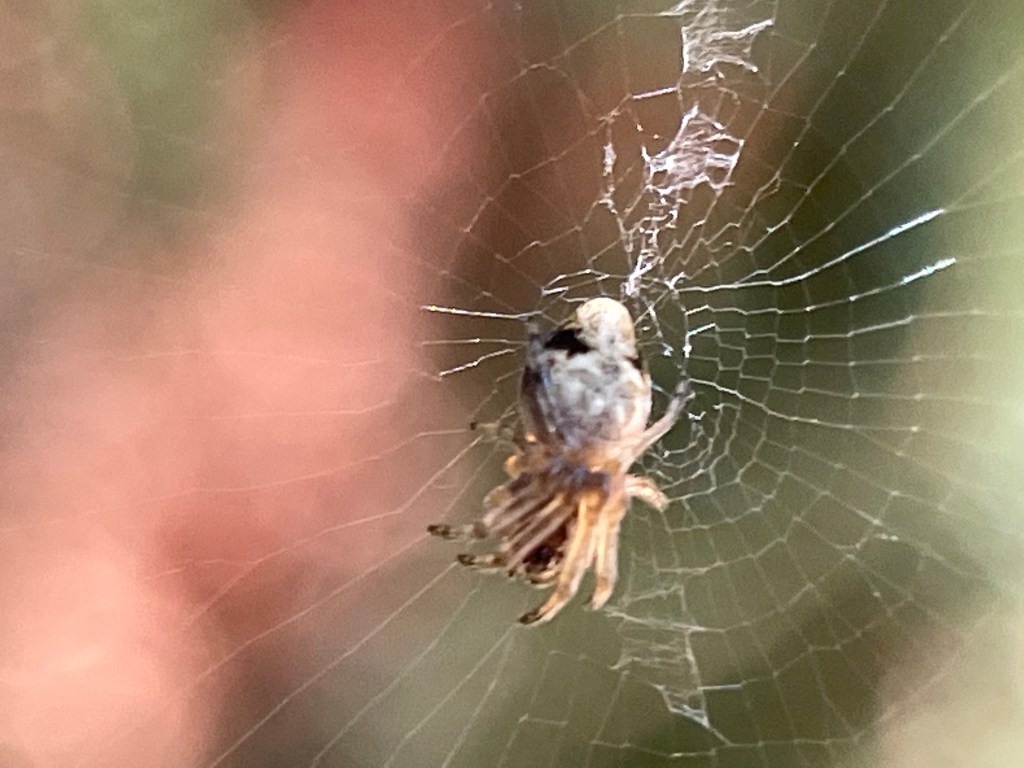
Araneus diadematus (Cross Orb Weaver) October 1, 2021 – San Juan Island, WA
Araneus diadematus (Cross Orb Weaver) October 1, 2021 – San Juan Island, WA
Araneus diadematus (Cross Orb Weaver) October 1, 2021 – San Juan Island, WA
Araneus diadematus (Cross Orb Weaver) October 13, 2021 – San Juan Island, WAAraneus diadematus (Cross Orb Weaver) October 16, 2021 – San Juan Island, WA
This is “Louisa,” the Land Bank Orb Weaver Spider. She lives on a Mullein plant alongside the road. I’ve been watching her since October 1, 2021. Hoping she will not become a casualty of San Juan County’s pre-winter roadside mowing. She’s also an expecting mom!
This is “Louisa,” the Land Bank Orb Weaver Spider. She lives on a Mullein plant alongside the road. I’ve been watching her since October 1, 2021. Hoping she will not become a casualty of San Juan County’s pre-winter roadside mowing. She’s also an expecting mom!
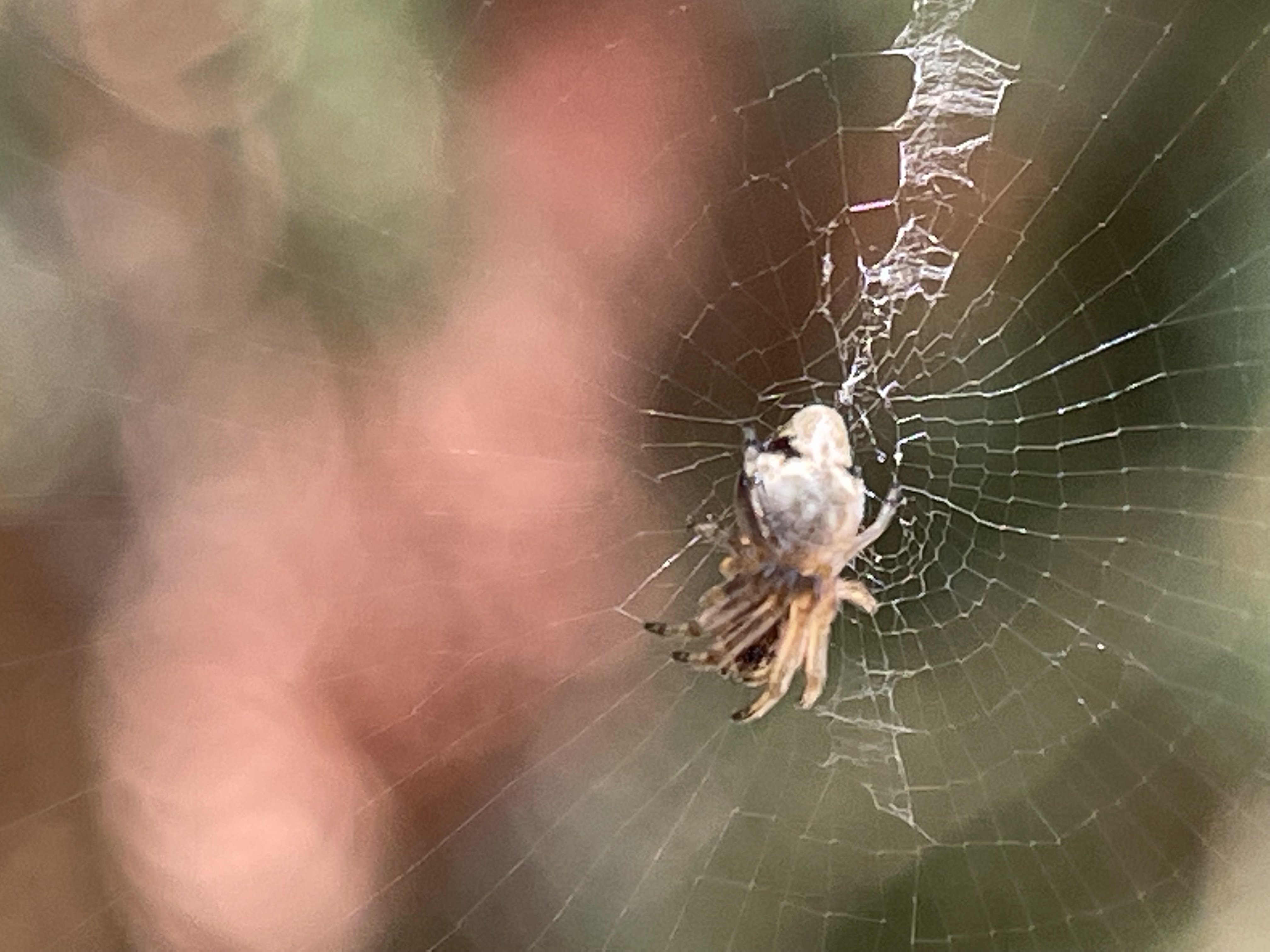
Araneus diadematus (Cross Orb Weaver) November 6, 2021 – San Juan Island, WAAraneus diadematus (Cross Orb Weaver) November 6, 2021 – San Juan Island, WAAraneus diadematus (Cross Orb Weaver) November 6, 2021 – San Juan Island, WA
Gucker, Corey L. 2008. Verbascum thapsus. In: Fire Effects Information System, [Online]. U.S. Department of Agriculture, Forest Service, Rocky Mountain Research Station, Fire Sciences Laboratory (Producer). Available: https://www.fs.fed.us/database/feis/plants/forb/vertha/all.html [2021, November 6].
Horton DR, Lewis TM (2003) Numbers and types of arthropods overwintering on common mullein, Verbacsum thapsus L. (Scrophulariacae), in a central Washington fruit-growing region. Journal of the Entomology Society of British Columbia 100, 79–87.
Oxford, Geoff & Gillespie, Rosemary. (1998). Evolution and ecology of spider coloration. Annual review of entomology. 43. 619-43. 10.1146/annurev.ento.43.1.619.
The headline, “Spider Bites Woman’s Lip“ popped out in my news feed yesterday. As an entomologist, these bizarre reports are click bait for me. I bit. As I read through the linked piece, my first thought was, “Yes!” Someone was definitely hallucinating!”
My other knee jerk conclusion is we have doctors who have absolutely no diagnostic skills whatsoever. In reconsidering, he may not be the one at fault though, or at least not entirely. In fact, it would be interesting to hear the physician’s side of this story. Did he definitively state it was a Brown Recluse Bite? Or, did he suggest it “might be?” Are the patient and the Newsweek reporter the ones guilty of the hyperbole here?
It’s got to be fantastic to be featured in Newsweek, right? Please note my sarcasm! The media is a huge problem when it comes to sensationalizing stories and egging on the screaming fear folks have around spiders. You’re welcome to take a look at this story yourself, but please come back because I’m gonna tell you what’s wrong with it!
First off, there is NO spider. No one collected a spider. No one brought a spider to the doctor to ID. Even if there had been an actual spider, since when have physicians become expert taxonomists and actually have the skills to identify arachnids or insects. Strangely, the story reports the woman didn’t even think much about the bite when it happened. Her words. Not mine. I really wonder about this mystery “spider.”
Secondly, the bite occurred, I presume, when she was paddling her kayak through a waterway. Brown Recluse spiders don’t make webs in the air, and certainly not over the water like that. Of course, I suppose it is possible for a spider to have been in the kayak, crawled up her legs and torso, and then crawled all the way up to her face where it bit her on the lip. You’d think she would have seen it. Also, Brown Recluse spiders like to live with other Brown Recluse spiders, so it’s difficult to imagine not finding a spider somewhere in the kayak to bring to the doctor.
Third. Lots of things can cause spider bite-looking lesions. I’m surprised the doctor declared it a Brown Recluse bite. There is no test to diagnose that someone has been bitten by a Brown Recluse. Again, no spider was brought in, so why was this deemed a spider bite when it could have been numerous other things? For instance, UC Riverside’s Department of Entomology webpage about Brown Recluse Spiders states,
“The following can cause lesions similar to the lesion from a bite of a Brown Recluse spider …mites, bedbugs, a secondary Staphylococcus or Streptococcus bacterial infection and “Three different tick-inflicted maladies have been misdiagnosed as brown recluse bite: Lyme disease, Rocky Mountain Spotted Fever and the bite of the soft tick, Ornithodoros coriaceus. “
What about her hallucinations? My first thought was she has had an outbreak of a herpes lesion and could have developed herpes simplex encephalitis. Please DO look this up! I did. It’s one of the side effects of getting a nasty cold sore. https://rarediseases.org/rare-diseases/encephalitis-herpes-simplex/
Now, I’m not a doctor. I didn’t take this woman’s medical history. I’m just pointing out some OTHER possibilities. Possibilities that are actually much more likely than the sensationalized over-reaching claim it was a Brown Recluse spider. Hmmmm… Hysteria and hyperbole. I hope she recovers, and I hope she will be able to kayak again soon. I just wish there was a way to stop the inevitable slaughter of innocent spiders that will ensue. It’s a shame.
***Note*** We do NOT have Brown Recluse Spiders in the San Juan Islands. Please take a look at the attached distribution map and show it to anyone who tries to convince you otherwise. https://spiders.ucr.edu/spiders-map
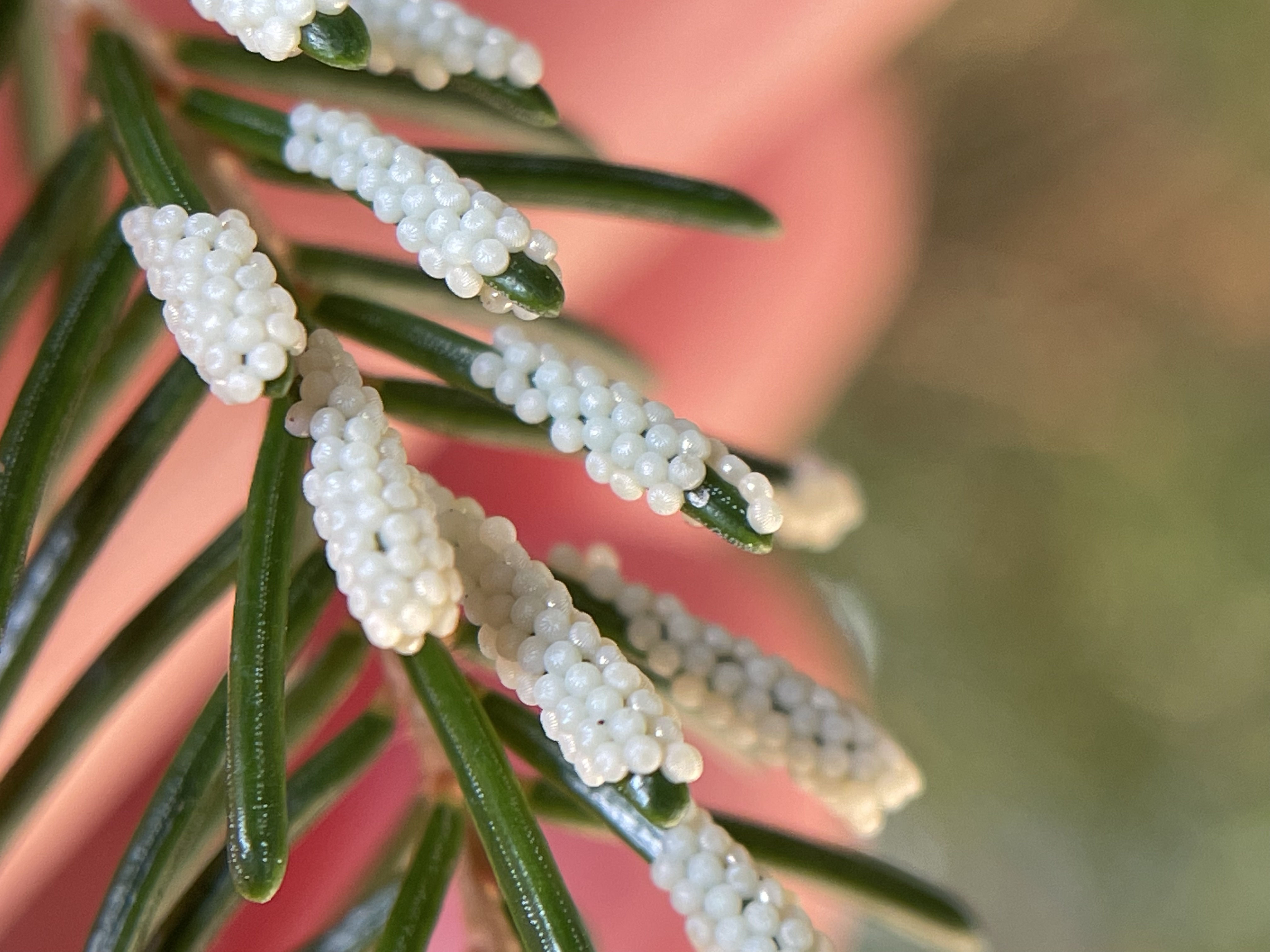
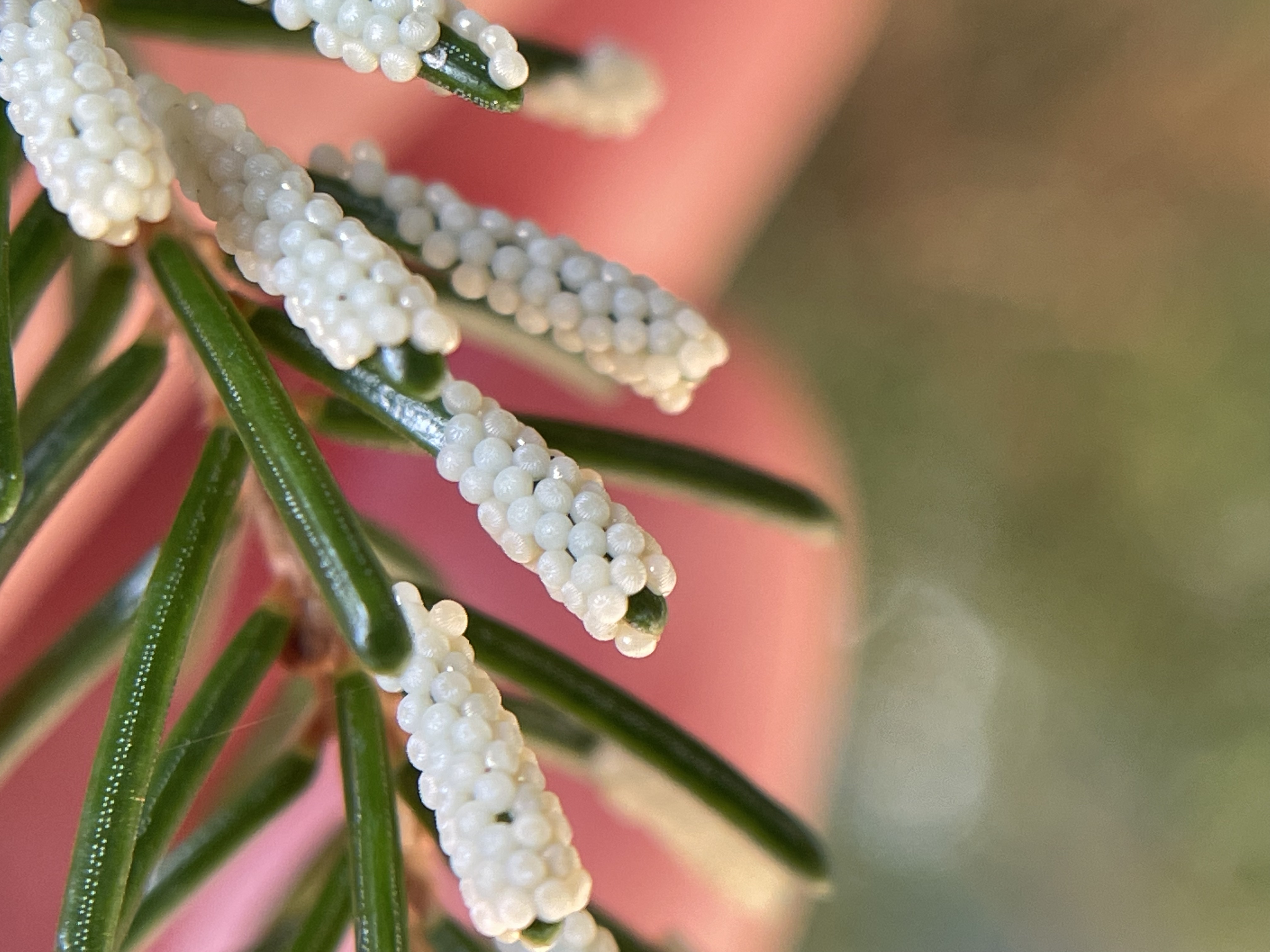
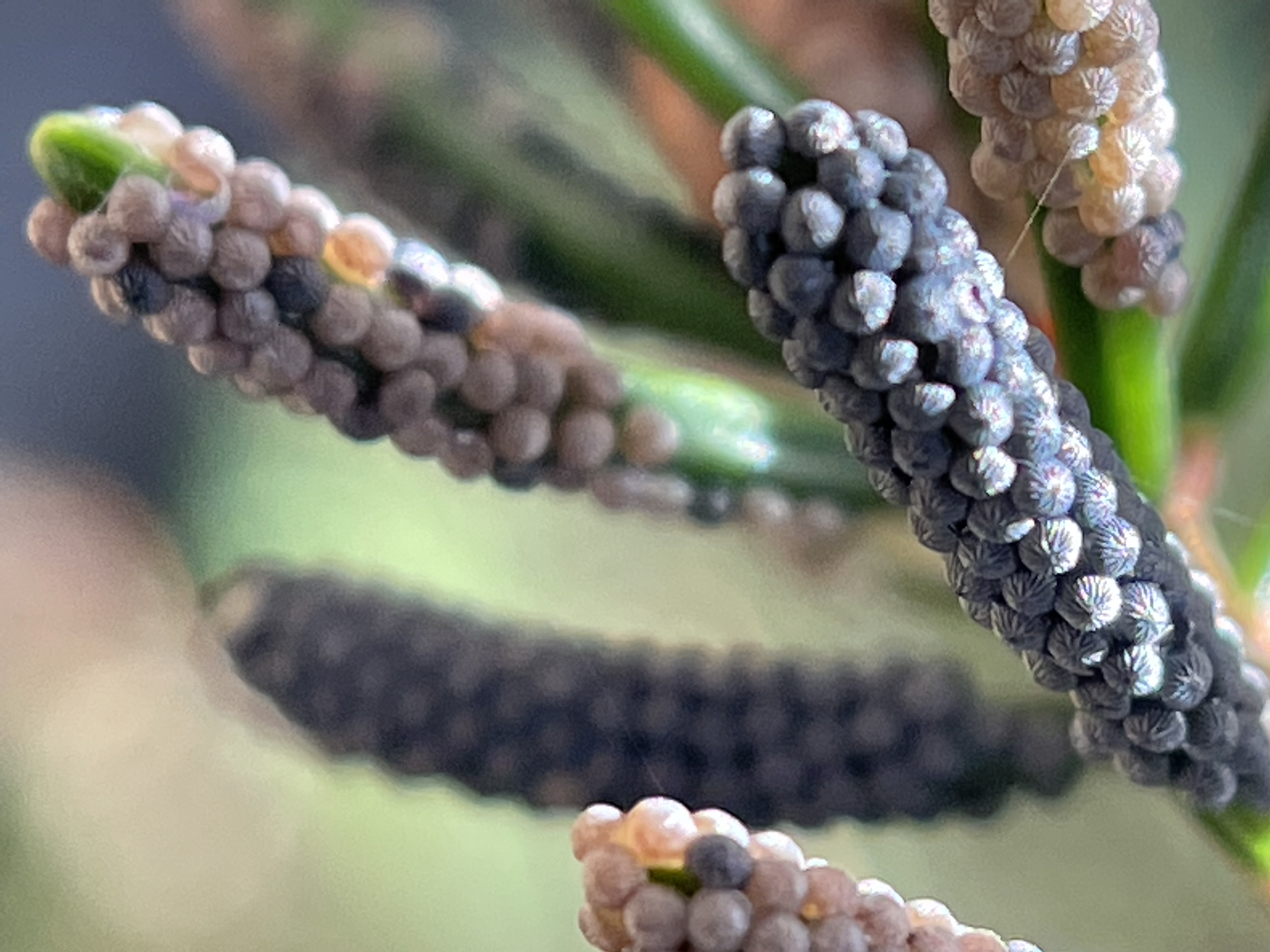
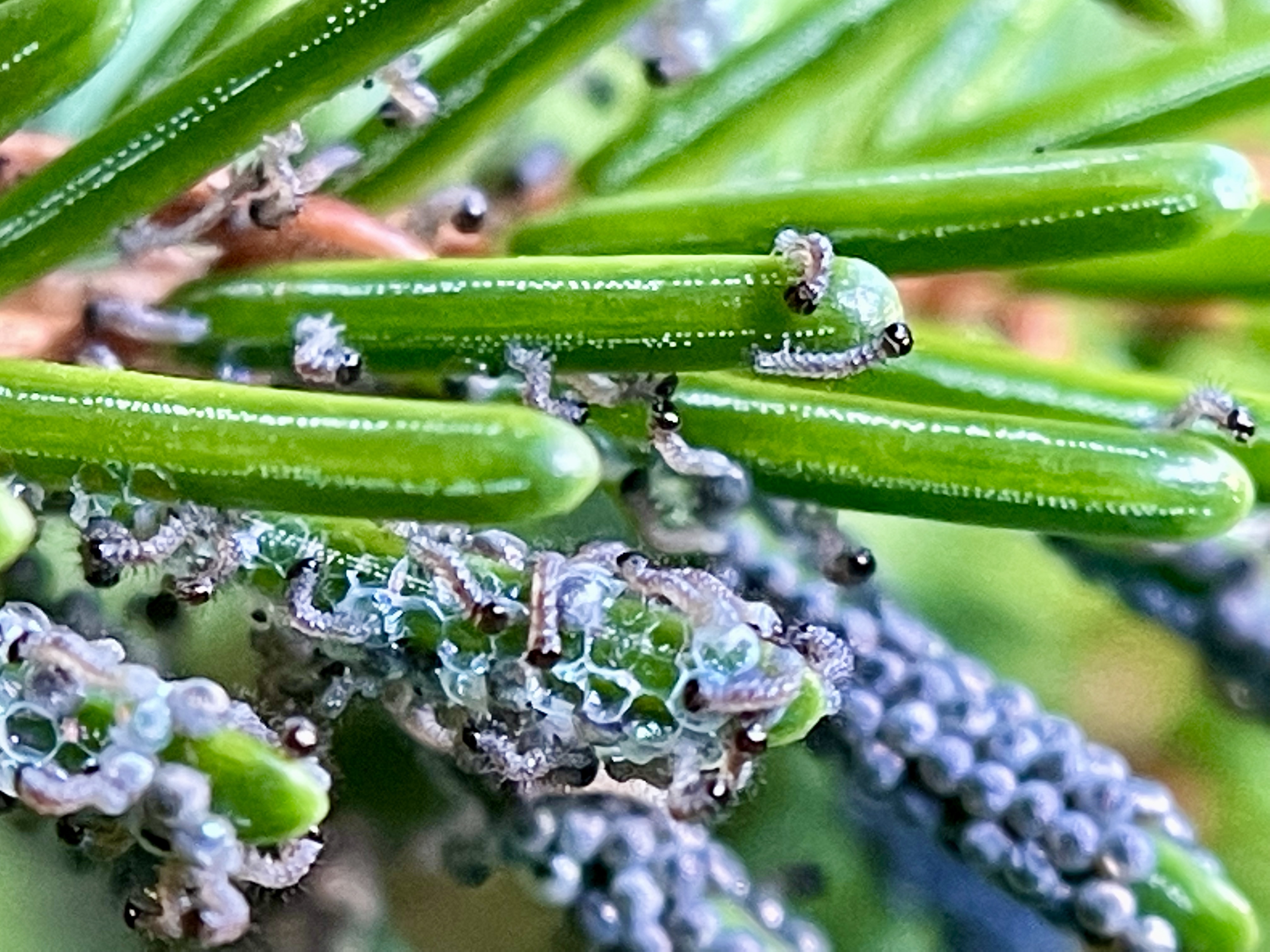
Editing here to update identification. These are Noctua pronuba or Yellow Underwing moth eggs. They will hatch, caterpillars will drop to the ground on tiny threads of silk and feed through the winter on mostly weedy vegetation like Dock, Dandelions, Plantains, and Hawkweed, but will also sometimes feed on turf grasses and winter vegetables.
Well, I was wrong in my theory about these possibly being Nepytia phantasmaria orPhantom Hemlock Loopereggs, so my next steps will be to review all my moth photos from early September to try and thread out any other possibilities. That may take some time. Initial observation (date eggs laid) was Sept. 12, 2021. Today is Oct. 7, 2021. They are indeed pretty tiny and if you look closely, you can see the caterpillar body rolled up in the eggs that haven’t hatched. The tree is a Caucasian Fir (Abies nordmanniana).
eggs on Caucasian Fir, San Juan Island, WA 09.12.2021eggs on Caucasian Fir, San Juan Island, WA 09.12.2021Eggs darkening – September 18, 2021 San Juan Island They hatched! Oct. 7, 2021
Mystery moth eggs hatch – October 7, 2021
Thanks for reading! Stay tuned for further updates. I’ll do my best to figure out an ID for these. 🙂
Last month I held my 2nd annual virtual event, “September Spider Sleuthing in the San Juans.” Little did I know it would turn out to be so popular. Even the Journal of the San Juan Islands interviewed me. One of the questions asked was, “What led me to create the event in the first place?” Let me answer that for you.
Well, I happen to be an entomologist (someone who studies insects), but after living here for twelve years, I’ve come to LOVE the diversity of spiders that share our islands. I want to help others understand how important spiders are in our ecosystem and dispel some of the unfortunate and undeserved myths associated with our eight-legged friends.
This week, the spider sleuthing continues, albeit informally. I received some emails about spiders, and actually had two folks drop off spiders at my husband’s office in little cups for me to take a look at. “What ARE these?” inquiring minds wanted to know.
One was a suspected Black Widow that turned out to be a look-a-like False Widow (Steatoda grossa). While instinctively protective of the little sack of clustered eggs laid in a matrix of messy web in the plastic cup, I could sense she was alarmed. I was able to remove the lid and take a few photos without disturbing her too much. For now, she remains in the plastic cup. I may relocate her and her egg sack to our greenhouse tomorrow. Steatoda grossa spiders are not medically significant to humans. She’s a friend. Her presence helps keep the actual black widow spiders from colonizing our homes.
Steatoda grossa spider with egg sackSteatoda grossa spider with egg sackSteatoda grossa spider with egg sackSteatoda grossa ventral view
The other cup held two spiders. All I knew ahead of picking them up was they were presumed deceased. One of those two spiders moved ever so slightly when I opened the lid. Where there is movement, there is LIFE! I was mesmerized with this spider, a Woodlouse hunter (Dysdera crocata). After photographing this beauty, I set it free in our stack of cut wood that doubles as a fence along the edge of our property. It will find plenty of isopods in the forest floor and the wood will double as a nice winter home with all its nooks and crevices. Woodlouse hunters are also harmless to humans. Consider them friendly!
Woodlouse Hunter (Dysdera crocata)
Dysdera crocata
The last poor little soul was unfortunately frozen after it was collected. Yes, I opened the lid knowing this, but imagining movement, and hoping that maybe it hadn’t been frozen long enough to kill it. I don’t personally enjoy killing bugs. They’re much more interesting to me alive. I took the post mortem photos, but I’d have preferred being able to resurrect it.
Callobius severus
This sweet little dude is a Hackelmesh Weaver. His scientific name is Callobius severus. He’s harmless (a friend). He was only trying to find a mate. Male spiders often wander this time of year in search of a female. Look at those little palps! Those are the organs the male spider uses to transfer sperm to the female. They looks like little paws…or maybe tiny furry boxing gloves. I’m sorry this fella didn’t find a friend. May he R.I.P.
The social media giant we all have become overly dependent on in recent years, had a big, giant F-A-I-L today. The entire site was down. I couldn’t share bug photos or look to see what crazy or amazing things my friends had been up to. I also couldn’t watch the fabulous video of the frog and bearded dragon that I’ve been replaying over, and over, and over because it’s so DARN cute! You can find it on Tik Tok if you can’t find it on Facebook.
In the void, I resorted to the fail safe backup. It’s called E-mail. I really feel old because I actually remember how we communicated before the advent of cyberspace – handwriting letters that you put a stamp on and eventually were delivered by USPS.
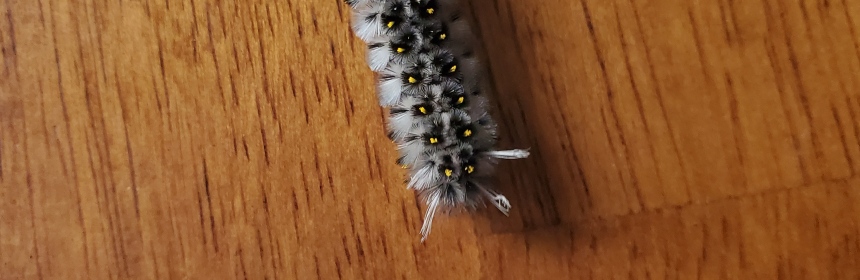
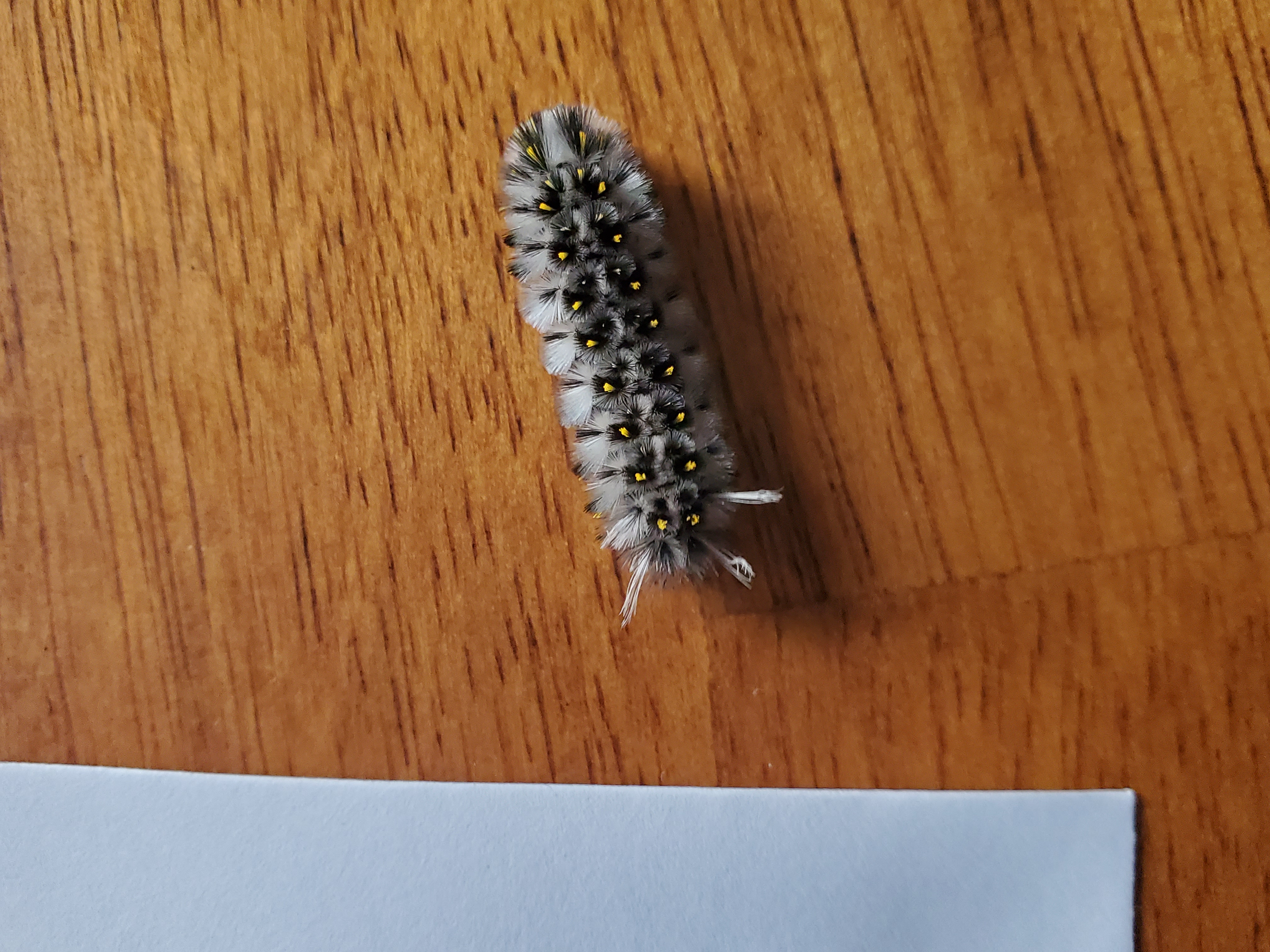
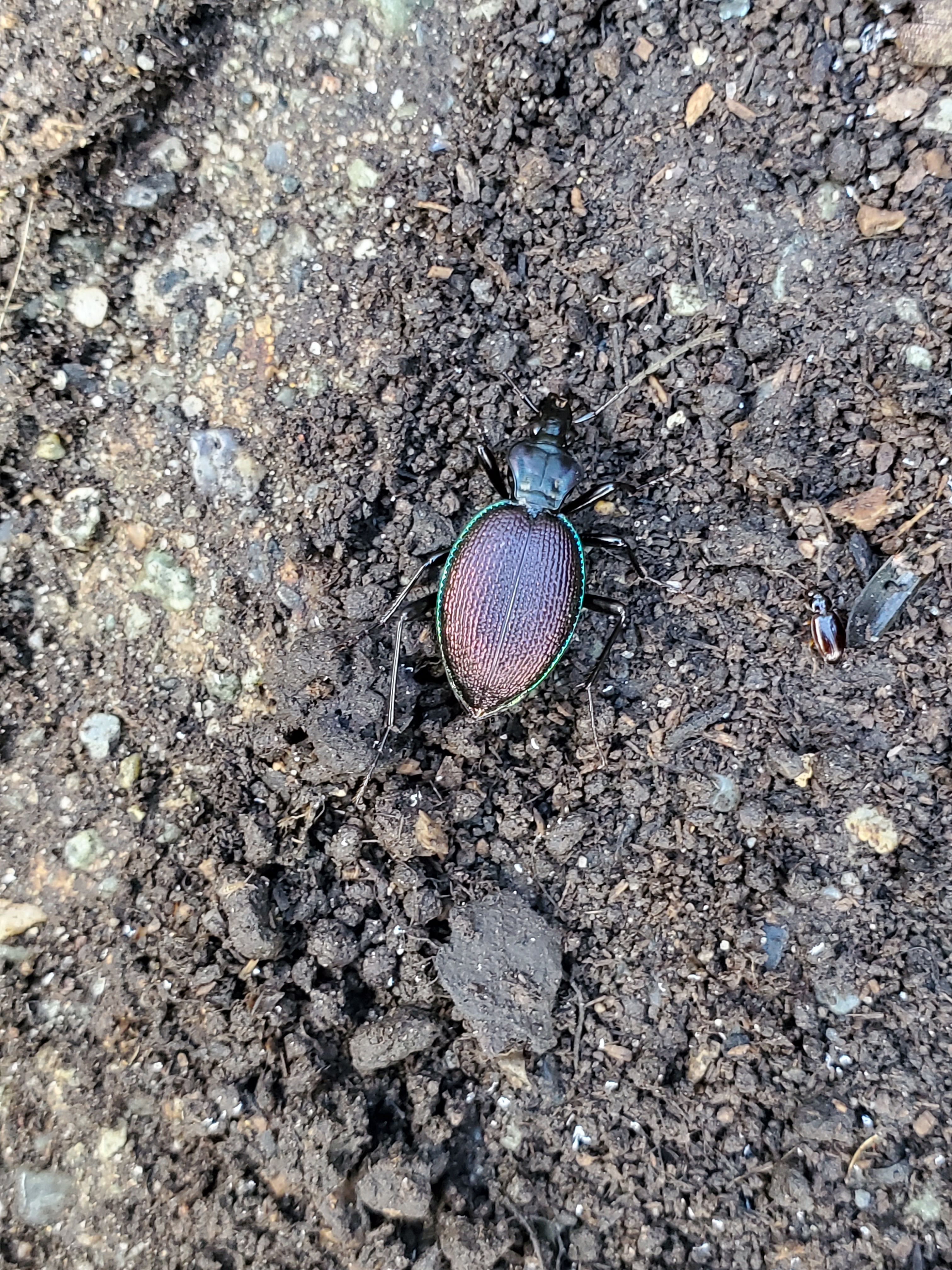
So, in my email, I actually had received two nice bug pictures I want to share with you. Victoria Compton (who is running for Friday Harbor Port Commissioner btw) sent these to me. The first, a caterpillar, is going to turn into my favorite moth, Lophocampa roseata or the Rosy Amelia Moth. The 2nd, is a ground beetle in the family Carabidae (Scaphinotus marginatus) – also sometimes called the Margined Snail-eating Carabid Beetle.
Happy Bug Viewing! Thanks for checking these out and thanks for sending the photos Victoria! You have my vote. 😉
Trashline Orb Weaver (Cyclosa sp.) San Juan Island, WA 09.06.2021
I am very nearly blind when I try to see things up close, so it truly surprises me how I SEE things like the tiny “laundry” line of dead bugs this little orb weaver had strewn along a filmy thread between the boughs of our fir tree. At first, I thought it was just debris, stuck to the remnant of a spider thread, long abandoned. Upon closer inspection, I saw more threads and then my attention focused on the center, where I was able to discern what looked like teeny legs curled up around a body.
Trashline Orb Weaver
I used my clip on macro lens to get a better look. Indeed, there was a tiny spider in the center. I thought it was dead. That’s EXACTLY what the spider was hoping I’d think, and then I’d move on and the spider could enjoy the morning sun, and maybe a tiny bug for breakfast too.
Trashline Orb Weaver
Cyclosa sp. Trashline Orb Weaver 09.07.2021
Trashline Orb Weaver (Cyclosa sp.) San Juan Island, WA 09.07.2021
Trashline Orb Weaver
I had a hard time getting decent photos. Even with the macro lens, focusing was tough. The wind would blow at just the WRONG second and I’d have to start all over again. I couldn’t find my tripod, but finally got a decent pole to help me balance, and went out to take photos at different times over a period of 2 days. I even went out last night and took a picture.
Awake or Sleeping? Trashline Orb Weaver (Cyclosa sp.) at night. San Juan Island 09.07.2021
It was fairly easy to identify the spider to Genus (Cyclosa), but species ???? . After going through the literature I had, I narrowed it to 2 possibilities, but reached out to Rod Crawford for help. Rod is the curator of arachnids at Seattle’s Burke Museum and this is what he says,
“Yes, it’s a Cyclosa. This time of year all Cyclosa are juvenile, and I for one cannot distinguish between our 2 species (C. conica, C. turbinata) as juveniles. However, C. conica is more common.”
So, my little spider with a laundry line of bugs is either Cyclosa conica or Cyclosa turbinata.
Why exactly do they string the debris along their web lines? Well, again, this debris is usually made up of dead bugs and other tiny bits of debris attached to the silk line. Typically, the spider is positioned somewhere in the middle, using the debris as camouflage against predators. Often, the female spiders’ egg sacks are attached to this “laundry line” too. I think laundry line sounds better than trash line, but I don’t think I get to rename the spider.
There are five species of Cyclosa spiders in North America, north of Mexico. I believe we only have the two mentioned by Rod here. I’m going back out to check on my new friend after I finish my post. Enjoy the day and remember to Be Nice to Spiders!
I wanted to share with you photos of two spiders I photographed recently. Location: San Juan Island, WA. Both are in the family Araneidae or what we know as Orb Weavers. The first (orangey one), was observed on a tomato plant July 31, 2021, and the 2nd (brown one) was observed yesterday evening, August 10, 2021, on some sort of wetland grass near my home.
While I knew the orangey one was a Cross Orb Weaver, Araneus diadematus, I wasn’t certain of the brown one’s ID beyond genus Araneus, so I reached out to Seattle Burke Museum’s arachnologist, Rod Crawford to see what he’d say. He responded to my query this afternoon and offered that both are Araneus diadematus spiders. There can be variability in color tint (many of us know the Cross Orb Weaver A. diadematus as pumpkin orange).
Rod continued with, “the ventral view of the brown one shows it is penultimate (still one molt to go). Once they mature they will be more noticeable. Seattle specimens are at this same stage now.” He also offered in terms of color variants among spiders, …”I imagine there is a genetic component to this variation, at least in most cases, but I’ve never looked into the details. I have found situations where spiders living amidst a population explosion of green leafhoppers all tended to be greenish in color, presumably derived from their food.”
It’s all so very interesting, isn’t it! I’m glad we have scientists who are willing to share their knowledge and experience. Thanks to Rod for his help!
Araneus diadematus (San Juan Island 07.31.2021)Araneus diadematus (San Juan Island 07.31.2021)Araneus diadematus (San Juan Island 07.31.2021)Ventral View – penultimate molt – Araneus diadematus (San Juan Island 08.10.2021)Araneus diadematus (San Juan Island 08.10.2021)
June 29,2021. So happy we’re not broiling today. Since many of us will be eager to enjoy the outdoors the rest of the week, I’m sharing something I’ll describe as an “insect-related public health announcement.” Please find some humor and some good advice in my post.
While we are lucky we live here and not in the south where bugs are much more likely to bite and transmit all sorts of icky things (like Dengue, West Nile, Yellow Fever, EEEV, and a long laundry list of others), we still get various bites and stings that cause reactions.
If you’re like me, your skin may over-react (large, localized reactions), or worse if you’re extremely allergic or even anaphylactic.
After living here almost 12 years, I’ve become pretty familiar with the bugs, including the biting and stinging ones. Every year, when the grass is tall, I’ve gotten these extremely irritating, itchy bites that look a lot like the chigger bites I used to get in the south. They are angry-red, and the itching can last for WEEKS!
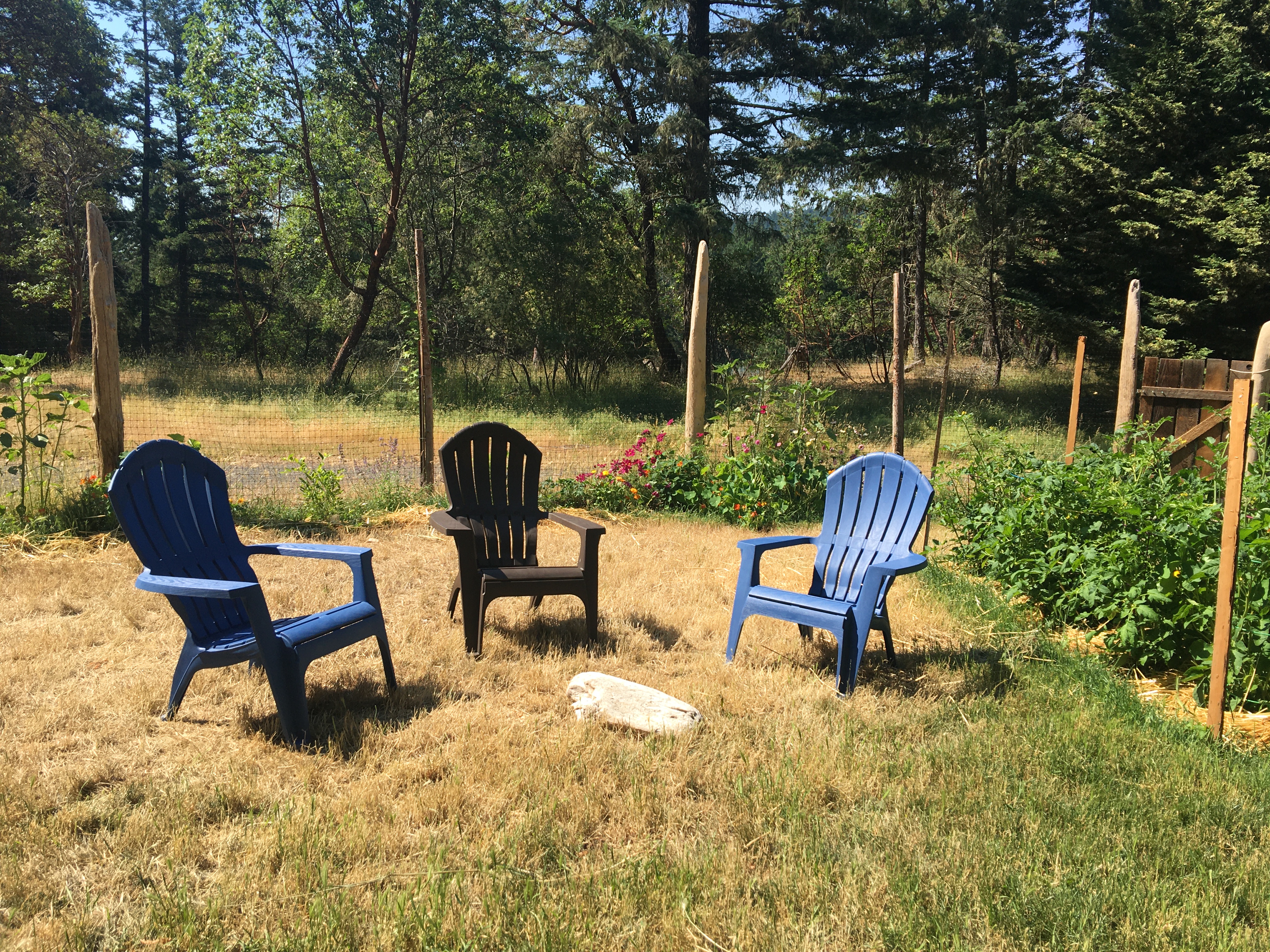
Well, a little over a week ago, I was sitting outside in our freshly mowed “yard” which is really a field of miscellaneous native and non-native grasses. We have 3 different colors of lawn chairs – royal blue, white, and brown. I love the blue, so I plopped down to relax and watch my bearded dragon while we both enjoyed some sun. I made a couple of mistakes here, but also solved a mystery.
Fierce Dragon
First mistake. I wore my new shorts. Yep. After this much time, you’d think I would finally learn. Wearing shorts in the San Juans is like coating yourself with sugar water and sitting down next to a nest of yellow jackets. You’re advertising you’re open for dining.
Second mistake. The chair. Yep. That blue chair is a bug magnet. If you’ve been following my posts, you’ll notice I’ve photographed a few bugs on that blue chair. I should have picked the brown chair…or at least worn long pants.
Blue chair
I felt the bite when it happened. My desire to figure out what critter has caused me a multi-annual summer season of itchy aggravation that compels me to cover up with long pants to prevent future bites, and hide the leprosy-looking splotches, was finally realized when I found I had the teeny culprit between my fingers. I ran into the house to stick it under the microscope and found…it was SQUISHED beyond determination. Sigh!
But wait! I was able to rule out a few potential offenders. It was definitely NOT a spider. Come on! Spiders get blamed for more things than they deserve. Most spiders are innocent. It was not a mosquito, no-see-um, flea, tick, bee, wasp, and, I’ll repeat again – NOT a spider!
The thing about being an entomologist is you are 100% oriented to try to identify bugs. I’m ALWAYS looking at bugs. They are fascinating to me. Especially the ones that have super powers or weird behaviors and even the ones that bite. So, I sat down and became OBSESSED with trying to figure out what I squished.
My breakthrough came in going back outside. I took my cellphone and the little macro-lens that attaches to the camera since it helps me see tiny things that age makes impossible to see. My eyes failed at about age 50. If you’re younger than me, SEE what you have to look forward to! 👀
I scanned the chair for any salt-grain sized objects and THERE it was! I made a short video clip and then took a still image from my video. A thrips.
Thrips on a blue chairstill image – thrips on a blue chair
Thrips are tiny (1-2mm). Their name is also interesting. It’s the same for singular and plural. One thrips, two thrips! Sounds like Dr. Seuss should have written a story about these. I will forever remember thrips because when I was in Florida for my graduate school exit exams, I had to answer questions in front of my committee chair and a few other profs. One of the questions I got was about what insect order these were in. I went completely BLANK.
It is one of those moments where you want to slink down into your chair, slide under the table, and crawl away in shame. Even worse, the comment made by one of the committee members. He hinted, “but your committee chair made his career studying these!” OMG, I wanted to die. Nothing prompted my memory. I would have been utterly humiliated except for the fact that when they were trying to set up the computer to Skype in my co-committee chair who was in South Africa, they couldn’t get the technology to work and guess who fixed it? Yep. ME. I think that may have saved me that day.
Also, it WAS the only question I missed. And, in case you’re wondering, THRIPS are in the insect order THYSANOPTERA.
Back to thrips. They bite. I found quite a few records of folks being bitten by these TEENY, TINY bugs. Check my list of references when you’re done reading. If you can’t access these online and want to read more, shoot me an email and I’ll figure out how to get you a copy.
This review was pretty interesting. They actually found reports of bites by thrips dating back to 1883. One article I found is actually titled, “Night of the Living Thrips: An Unusual Outbreak of Thysanoptera Dermatitis.” That one is about an outbreak of skin eruptions at the Marine Corps Training Area Bellows in Oahu, Hawaii. The photos I saw made me itchy just looking at them.
The itching is intense! My bite had the exact features described in the literature I found, down to the presentation of the classic “anaemic halo” or white ring around the bite. Irritation and itching is attributed to the thrips injecting you with saliva when they bite.
More about thrips. They have a variety of niches in ecosystems, typically as plant eaters (phytophagous), fungi eaters (fungivorous), and eaters of other invertebrates (predacious). I should add, occasional biters of vertebrates!
Most thrips species have two pair of wings and can fly. Some are known agricultural pests. Sometimes they swarm and people notice them then, but typically, when they bite a human, it’s a case of mistaken ID. That means, a mosquito gets blamed.
from wikipedia
It’s an easy mistake to make. Thrips actually have mouthparts somewhat similar to mosquitoes. They have piercing sucking mouthparts with a single mandibular stylet and two opposable and interlocking maxillary stylets. That mandibular stylet is the hole puncher! More about how that all works in Childers et al. 2005. If you remember nothing else, just remember that adult and larval thrips can bite.
Another thing I found out in my obsessive reading. Thrips like BLUE. They like white too and have been reported getting on laundry hung outdoors to dry, then biting people when they bring that sun-dried, fresh shirt (or underwear) indoors and put it on. The blue chair is a thrips magnet. I’ve resorted to rinsing it off with the hose and wiping it dry before I sit down on it.
This most recent bite I had resulted in this baseball-sized diameter welt. It also had the white halo ring.
Thrips bite with white halo ring
I ended up calling the after hours line at my doctor’s office to get an antibiotic prescription because it was the weekend and the bite sure looked to be getting infected. I took Benadryl. The call-a-nurse at my insurance company said if you’re ever having a bad reaction to chew Benadryl tablets. It gets into your system faster. I already knew this, but liquid Benadryl also works fast. The itching was miserable given the heat, but I also took a bath in hot water with a lot of iodized salt. I didn’t take the antibiotic because the salt seemed to stave off infection.
My bite is healing, but I ended up with another on my other thigh. The halo ring around this one is fainter, but still visible.
I didn’t see that bite happen, but I know it wasn’t a mosquito because I saw a mosquito bite my ankle when I was outside watering and even though I felt it, I didn’t get any mark or subsequent itching at all. Mosquitoes here don’t have the same effect on me as the mosquitoes in the south had.
Take away message here. Don’t blame the spiders next time you get a weird bite. Especially if it’s summer and you’ve been outdoors. Take a shower before getting into bed and if your pets go outside and come indoors to sleep with you and lie around on furniture, just be aware it may not be fleas biting you, but thrips. Also…avoid blue. Blue is one color that bugs in general seem to like, so unless you’re into entomology and WANT to attract bugs, wear another color. The way it’s looking to me is that gray and beige may be the only safe choices.
Oh…and before I go, the person who coined the term “delusory parasitosis…” Bah to you! Lucky for the poor farmer fellow I read about who complained of being bitten by an “invisible” bug. He’d been diagnosed with delusional parasitosis, but in his persistent presentation to his dermatologist, finally had the culprit of his irritation identified as a grain thrips.
Remember that while you might hope to have that bite diagnosed at your doctor’s office, medical professionals may not have the additional expertise in identifying what bug bit you. They’re there to treat symptoms, but in some cases, it’s important to know what bit you. So, if you feel a bite, look for a culprit and collect it if you can. In some situations, with tiny things, I’ve used scotch tape. A plastic baggie or small cup or jar with a lid works too. Collecting that specimen also means you’re less likely to walk out with “delusional” written in your file!
Further Reading
Carness, J.M., J.C. Winchester, M.J. Oras, and N.S. Arora. 2016. Night of the living thrips. Cutis. 97:13
Leigheb, G., R. Tiberio, G. Filosa, L. Bugatti, and G. Ciattaglia. 2005. Thysanoptera dermatitis. European Academy of Dermatology and Venereology. 19:722-724 DOE: 10.1111/j.1468-3083.2005.01243.x
*Author’s note – While this post attributes pest status to thrips, please know that although thrips can occasionally bite humans and animals, there are thousands of species. Not all of them are biters. Many are actually beneficial and pollinate plants. Lots become food for other organisms, including spiders (which are mostly friendly)! Pesticides are completely unnecessary and often do more harm than good.
This fly was in my yard last week. San Juan Island, WA. 06.19.2021. It’s taken me about a week to get around to ID, but I believe this to be Eupeodes fumipennis (the Western Aphideater, a syrphid fly that happens to be a bee mimic.
In case you are wondering about that name. The Western Aphideater does actually eat aphids in the larval stage. To see what a syrphid fly larva looks like in action, check out my blog post with more video footage here –https://buggingyoufromsanjuanisland.com/…/honeysuckle…/ – also viewable in the photo below. While I have not been able to identify the species name of the syrphid fly larva in that post, you can definitely see where the Western Aphideater fly might get its name.