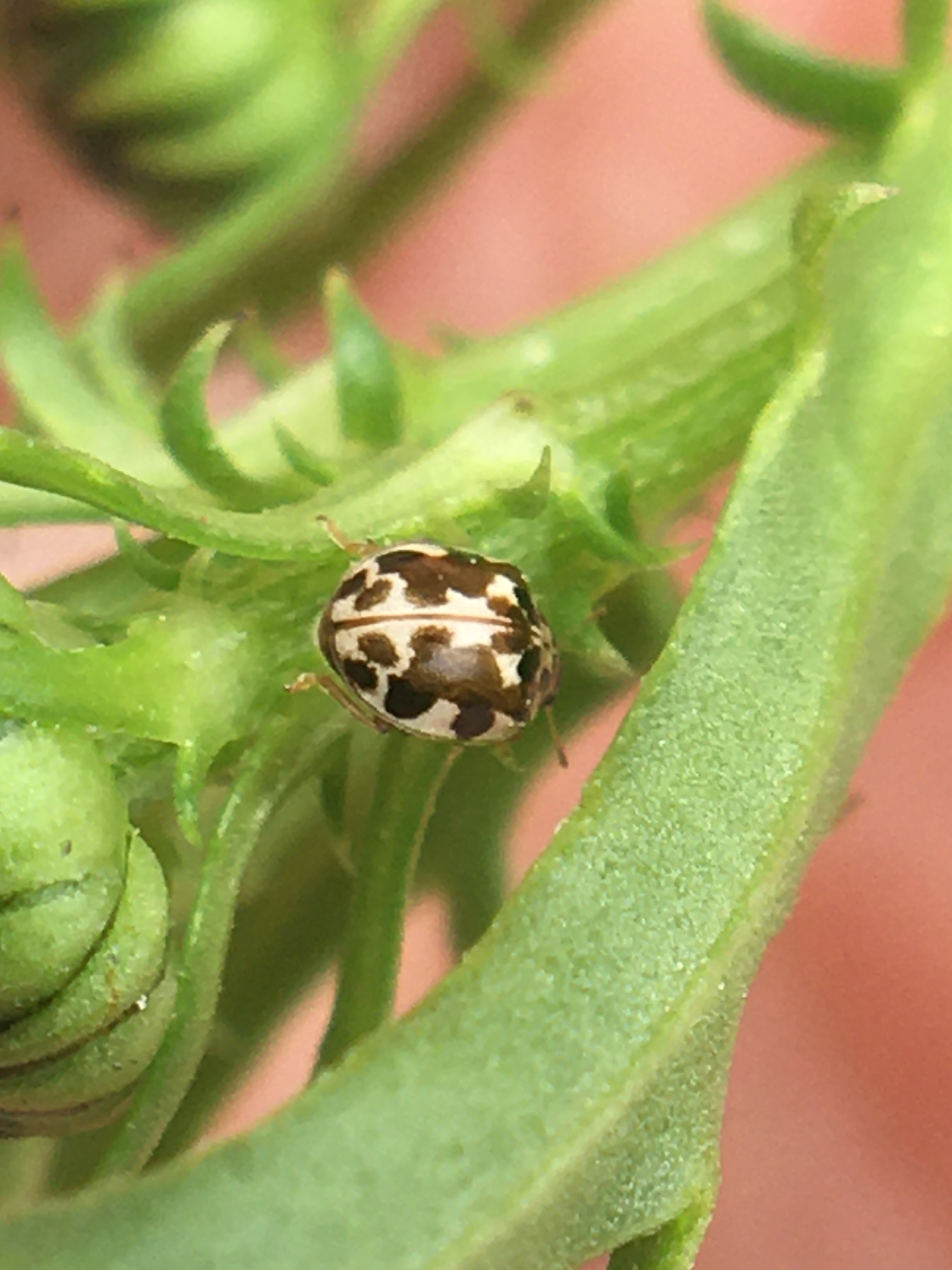
Twenty-spotted Lady Beetle (Psyllobora vigintimaculata) on daisy. This tiny ladybug almost went unnoticed when I was watering flowers the other day. It wasn’t easy to get a photo and she crawled down headfirst into the flower bud. I suppose she was feeling shy!
After reading a bit more about these, I discovered the best place to look for them is at the base of skunk cabbage in early spring. AND, this is the best part. Later in the season, these little beetles switch to plants that have powdery mildew. They eat it. Definitely a garden friend!
Twenty-spotted Lady Beetle (Psyllobora vigintimaculata) on Daisy – May 30, 2021 San Juan Island, WATwenty-spotted Lady Beetle (Psyllobora vigintimaculata) on Daisy – May 30, 2021 San Juan Island, WA
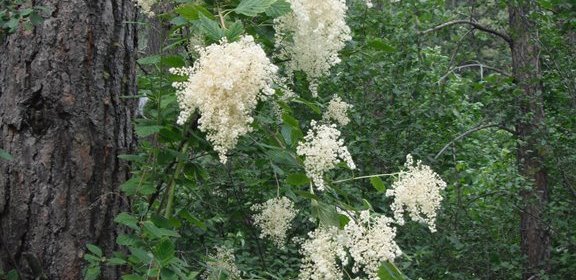
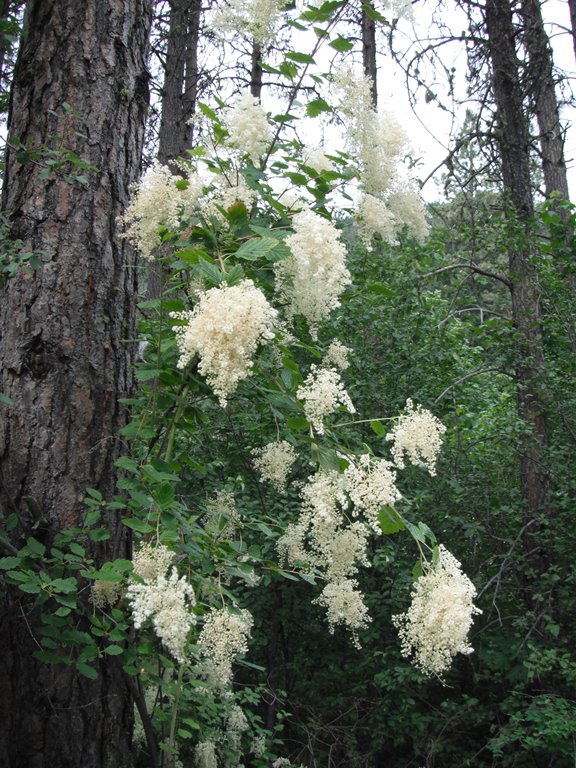
Did you know Ocean spray is one of our native plants? Lots of folks don’t even know this and label it as “invasive,” or a “fire hazard,” then rip it out of the ground to replace it with non-native ornamentals or worse, leaving the formerly healthy, forested understory devoid of vegetation.
Here’s a bit of historical trivia – Ocean spray is sometimes called Indian arrowwood because Native Americans made use of its straight hardwood branches for arrow shafts. They also used oceanspray for treating viral and skin diseases. Other names for this plant are Holodiscus discolor, ironwood or creambush. There is actually a novel phenolic component in the plant called Stilbene a Xyloside that has been associated with varied biological and medicinal activities.
Some reasons I’d like you to appreciate Ocean Spray….
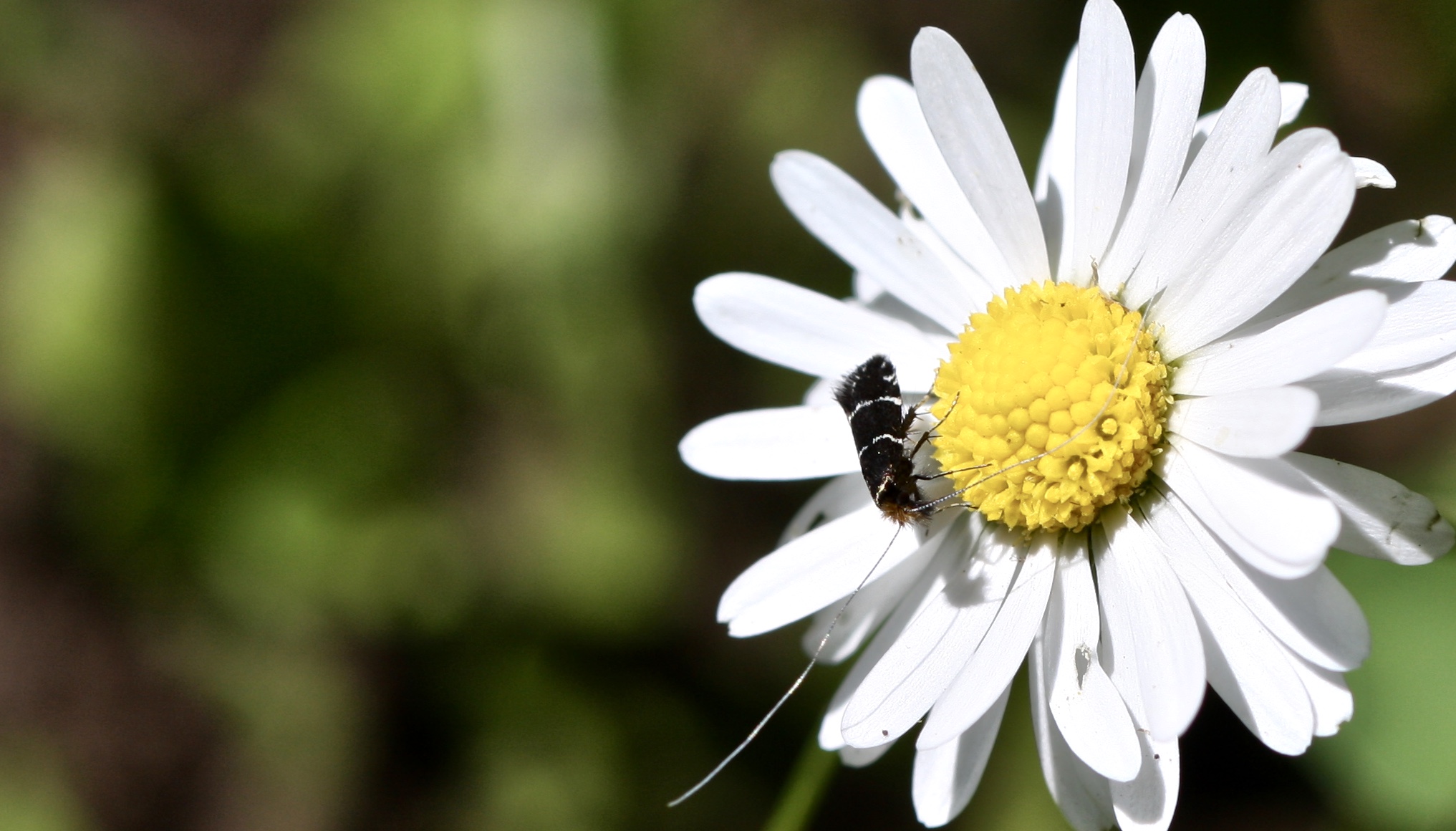
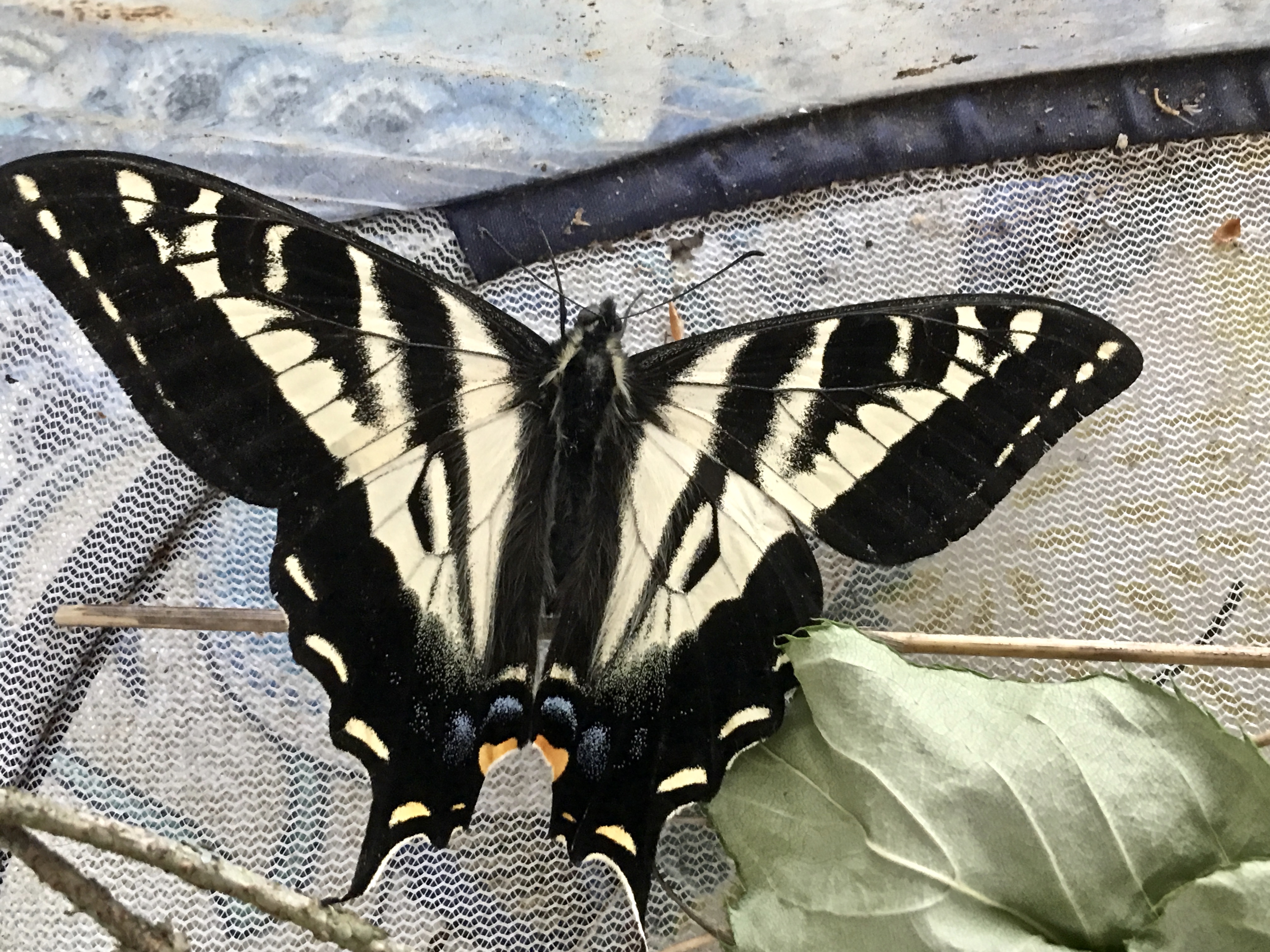
It is a larval host plant to some of our native butterflies and moths. These include the beautiful Pale Swallowtail (Papilio eurymedon), Spring Azure (Celastrina sp.), Lorquin’s Admiral (Limenitis lorquini), and Gray Hairstreaks (Strymon melinus). One particularly notable one here on our island is the delicate Fairy Moth (Adela septentrionella). Calscape (California Native Plant Society) lists 14 confirmed species of Lepidoptera associated with Ocean Spray (and 23 as likely) for a total of 37 species native to the state of CA. I could not find published studies for this in WA state, but link the Calscape page here https://calscape.org/plantleps.php?hostsloc=california&species=Holodiscus+discolor
Ocean spray provides cover and forage for wildlife. Birds, small amphibians, and deer rely on native plant species like Ocean Spray that make up part of the forest understory and are a component of a healthy ecosystem. Fire-scaping may be on your mind, but one way around this is to look at installing adequate water cachement around your home to help keep vegetation from drying out and dying in late summer and fall. We want to live in the forest, but if we remove the native understory, we risk altering the landscape even more and losing these beautiful creatures!
Ocean Spray flowers provide pollen and nectar for native bees! 🐝
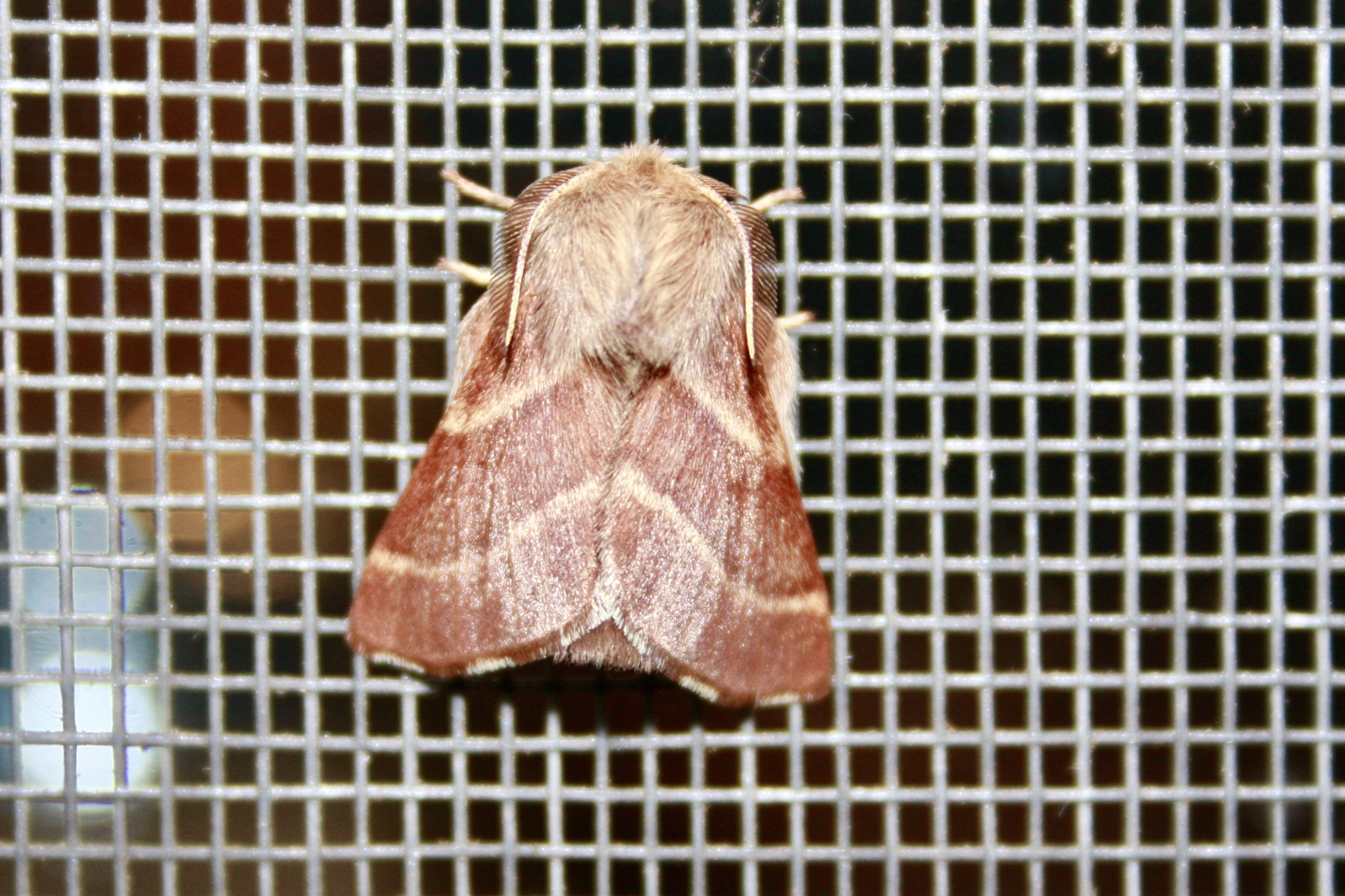
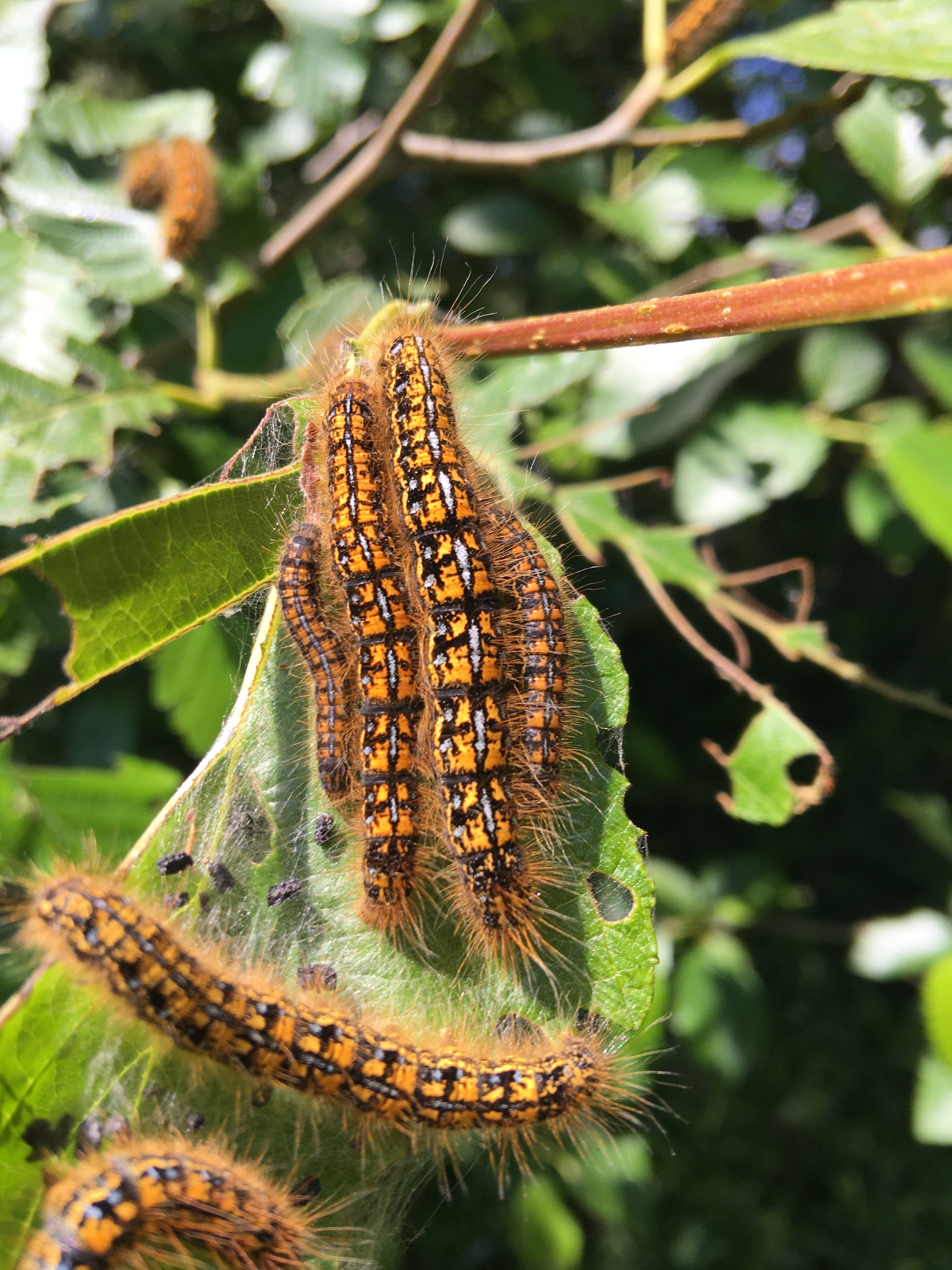
Look at this little moth- (Malacosoma californicum pluvialis). He’s got such a fuzzy hair-do and you might even think he’s cute. But he’s not a popular fella. Why? Because no one likes him when he’s a baby. He has way too many brothers and sisters and they are all really hungry and like to eat lots of leaves. Keep reading though. I want to tell you a bit more about “Melvin.”
Melvin did indeed have lots of siblings in his tent crib high up in the tree. They were awfully crowded and terribly hungry. Folks looked up in that tree and shook their heads. What ARE we going to do about them. They are going to eat our whole tree. They went to the store to get the pesticides.
(Malacosoma californicum pluvialis)
But what would happen if those same folks sat under that tree for a few days and watched the nursery full of Melvin’s siblings? They’d see the bat fly through in the dark of night to carry off some of them for dinner. In the early morning, they’d find more disappear when the hungry woodpecker and nuthatch stopped to peck at the crib and take away caterpillars to feed their hungry chicks. In the panic, some of Melvin’s siblings slipped out of the crib and fell to the ground. That afternoon, a lizard and garter snake found those and ate them right away. Near dusk, a few more dropped out of the nursery web, and little miss mouse carried those off to feed to her babies.
This was actually a good year for those caterpillars. Last year, the wasps came and laid eggs in them. They felt fine for a bit and even kept growing and eating, but then the wasp babies hatched and ate them from the inside out. Gross right? Well, that was a lucky year for Melvin. He was the only one who survived to fly off and tell me this story.
*Note – “According to research conducted at the Minnesota Agricultural Experiment Station 60 birds species have been documented to eat tent caterpillars including cuckoos, orioles, jays, chickadees and nuthatches. This same study also found that tent caterpillar outbreaks are controlled by native predators and parasites including 127 insect parasites, 28 insect predators, frogs, mice, bats, reptiles, squirrels, skunks, and bears. By sifting through one day’s worth of bear poop (fun job) researchers found that a single bear on average ate around 25,000 caterpillars in a one day.” Conservation Research Alliance – https://www.rivercare.org/…/tent-caterpillars-are-for…https://www.oregonlive.com/…/the_western_tent…
What people find unsightly and annoying for a few months some years is a welcome gift of easy food for many species of wildlife and the species that in turn feed on them. Another thing to consider. (Malacosoma californicum pluvialis) is actually native to our region! If you can, refrain from spraying, which harms our pollinators and native insects that are predators of the caterpillars. Clipping affected areas is one acceptable alternative. Just leave the clippings on the ground. The birds, and other insects will thank you.
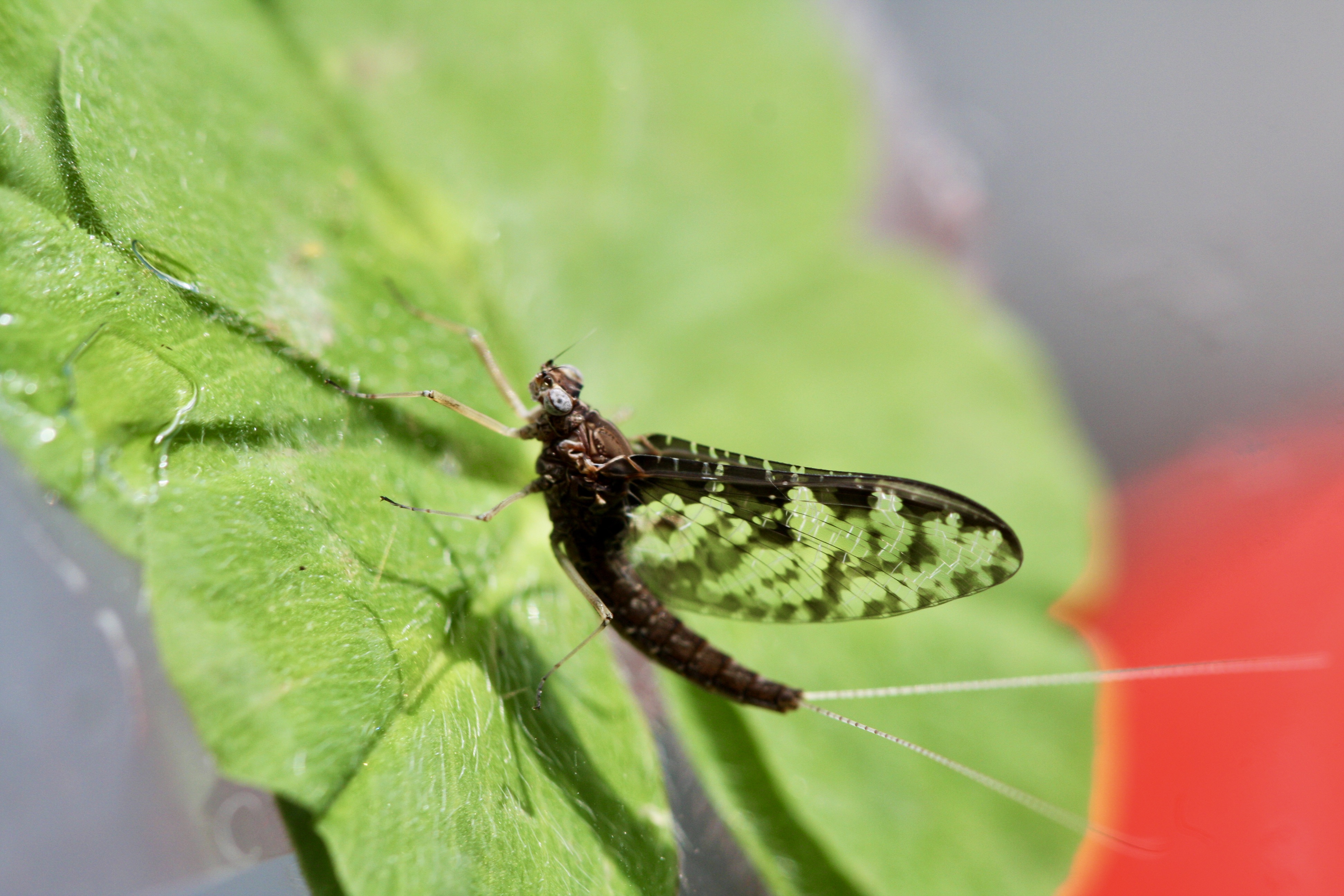
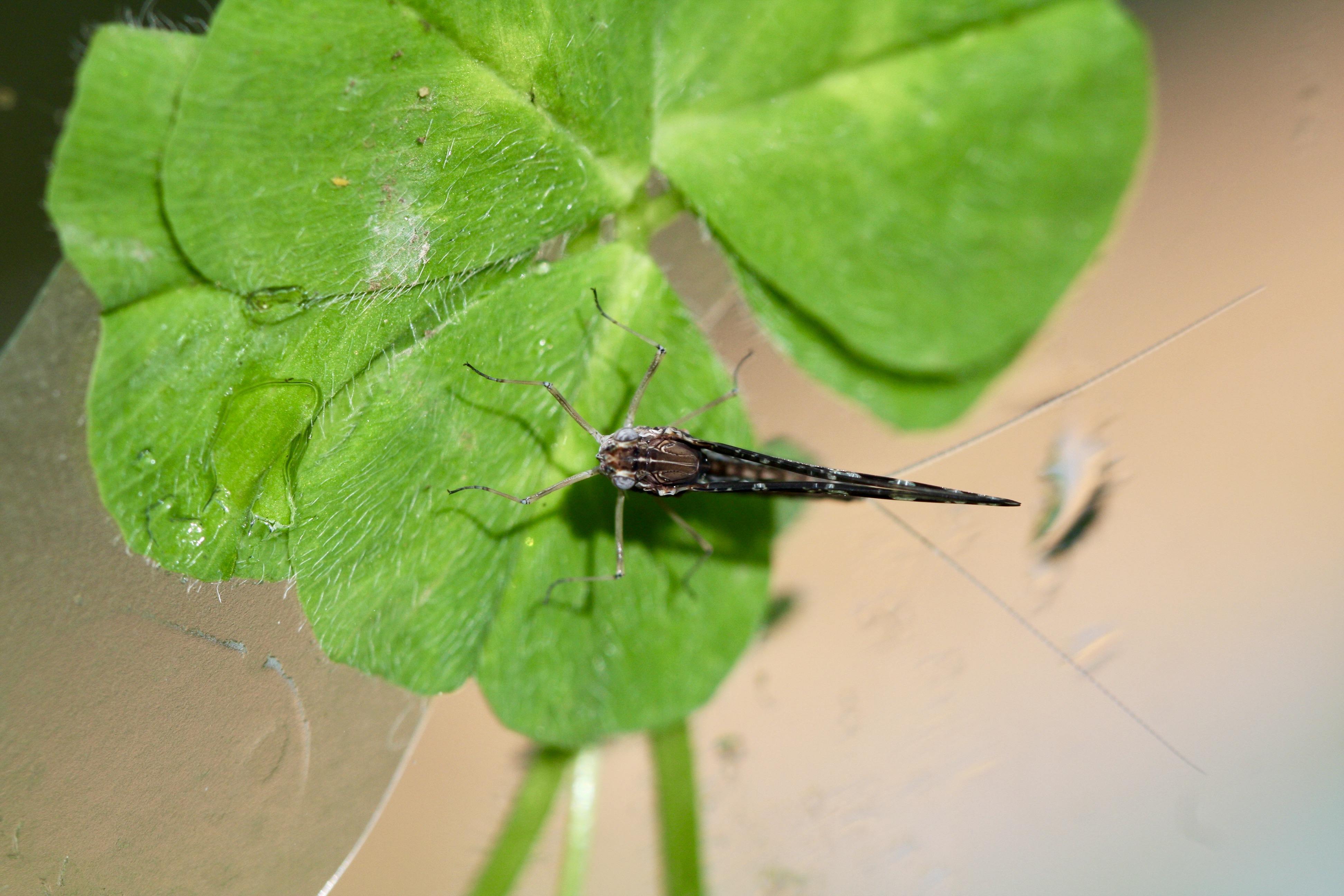
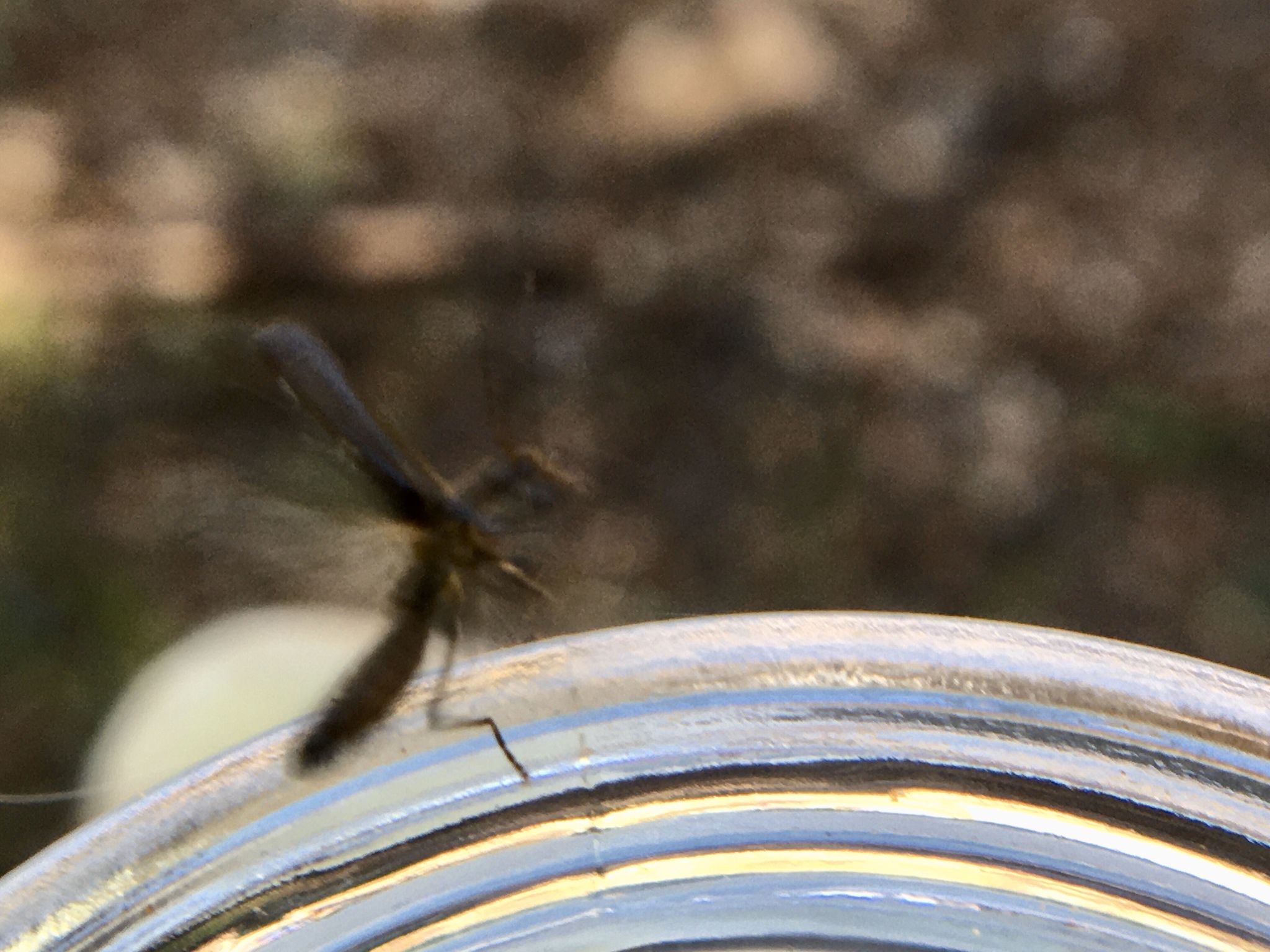
April showers bring Mayfly’ers! This tiny creature spent the night on the glass window of my greenhouse. When I found my very first mayfly on San Juan Island, I used a key on this site ~ http://ibis.geog.ubc.ca/…/FamiliesofEphemeropteraofBC.html to help me with ID. I’ve been able to narrow the taxonomy down to family Baetidae or “minnow” mayfly.
Mayflies are in the insect order Ephemeroptera which comes from the greek words “epi” (upon), “hemera” (day), and “pteron” (wing). Put this all together and you get something like “wing upon a day!” It just describes the ephemeral quality or brief lifespan of the mayfly adult.
The adult, or imago stage of this insect, does not eat. They will emerge in large numbers typically in the month of May. The Baetidae are among the smallest in size (hence the name “minnow”) within mayfly families, but there are over 520 species described in this family worldwide. The Baetidae have only two caudal filaments and the hindwings are reduced in size. All mayfly larvae develop in water and as they are very sensitive to pollutants, their presence (or absence) can be a good indicator of water quality. They’re also favorites of fishermen because they make great bait!
Mayfly (Baetidae sp.)
Some people want to build homes too close or even in fill in these streams and wetland areas. Destroying wetlands for homes, driveways, and barns is devastating to delicate ecosystems, ruining them forever. Humans aren’t supposed to live in wetlands….but mayflies, many other species of invertebrates, and creatures like newts, salamanders, and birds thrive in them.
Mayfly (Baetidae sp.)Mayfly (Baetidae sp.)
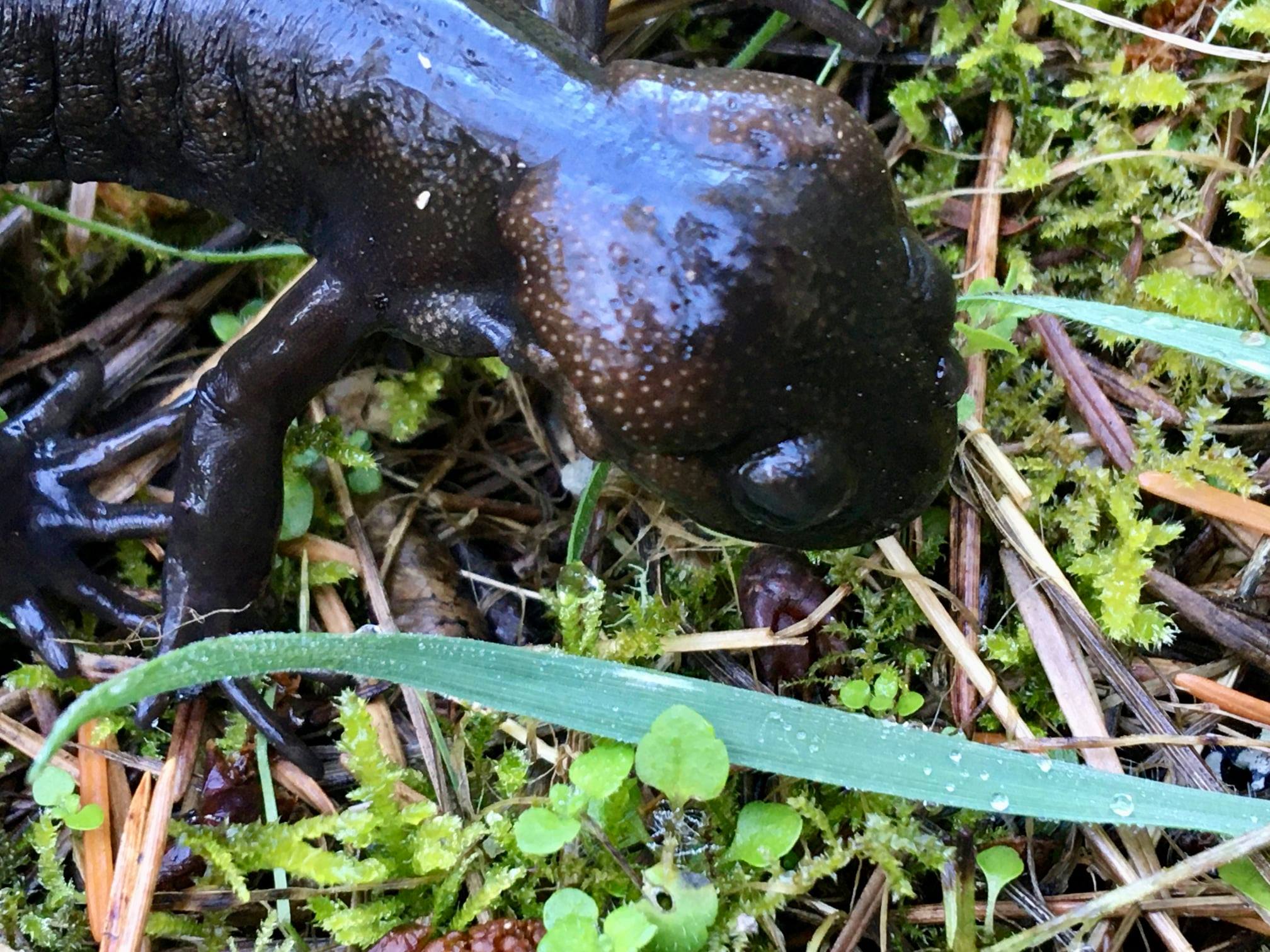
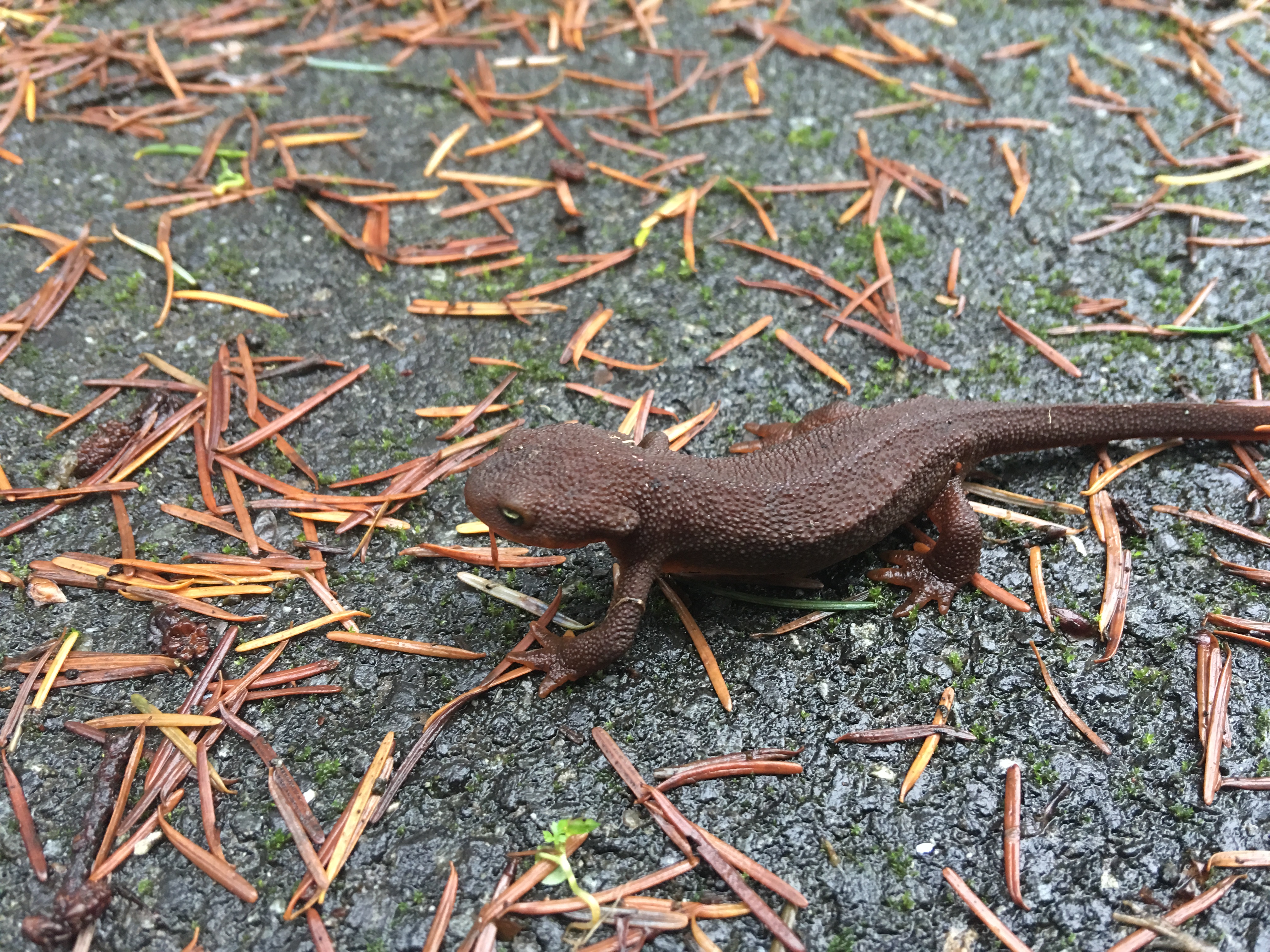
Some other amazing creatures that need clean wetlands and streams to live and reproduce include this alien-like Northwestern Salamander (Ambystoma gracile) I found a few weeks ago, slowly making its way across the road.
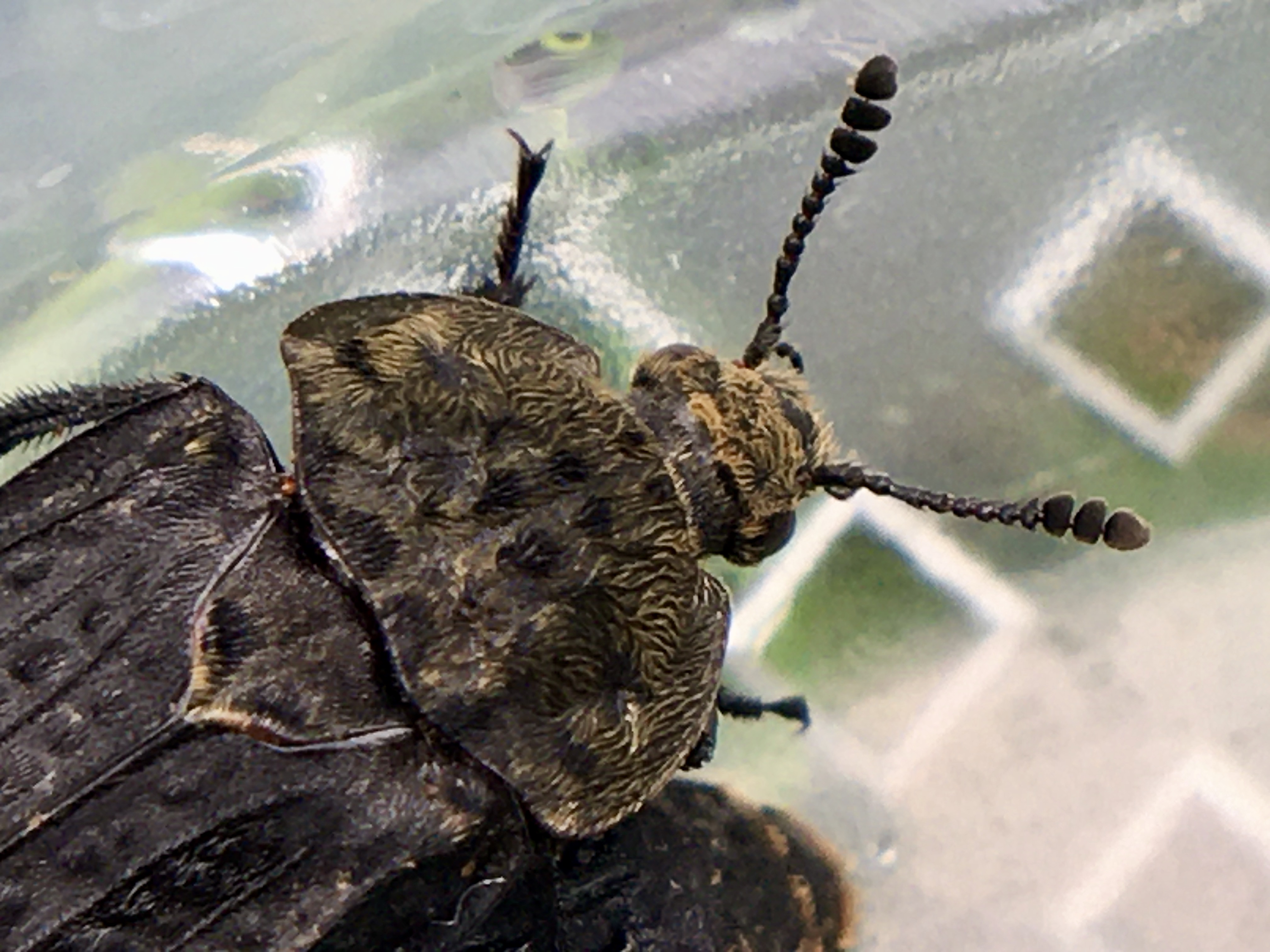
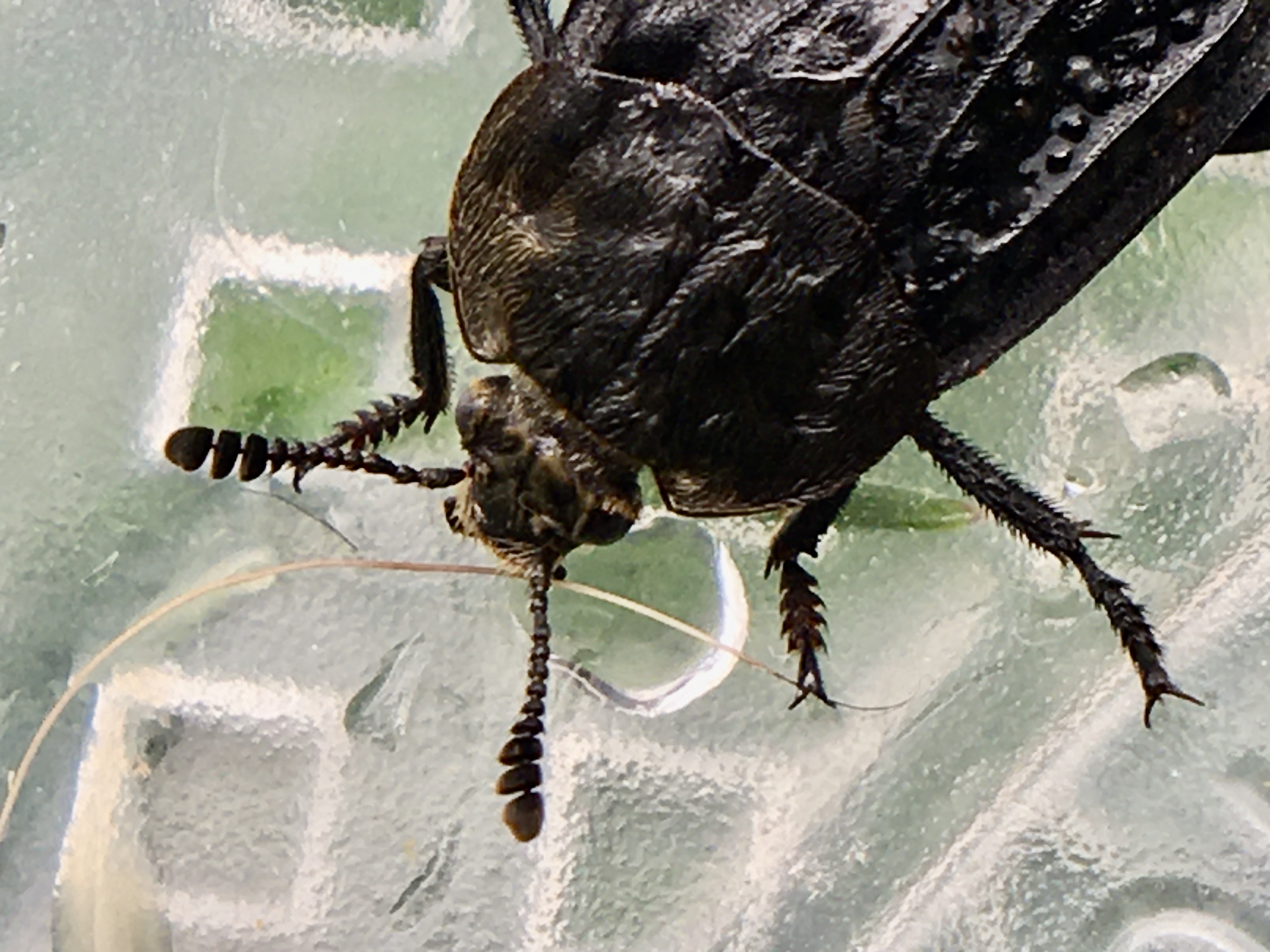
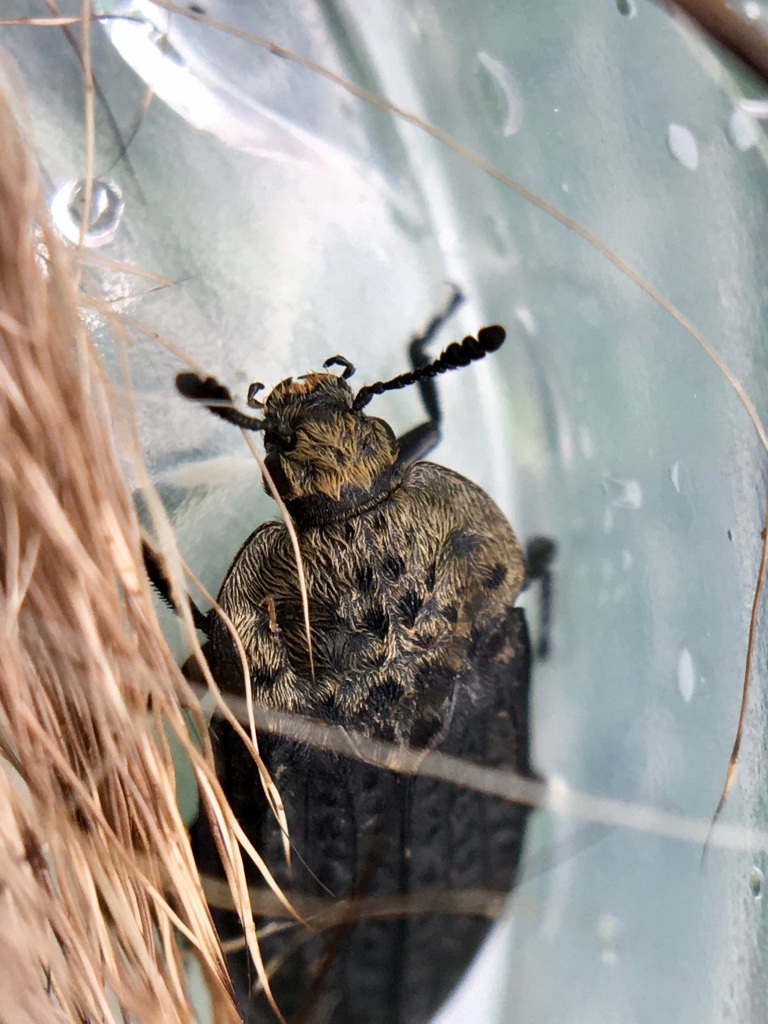
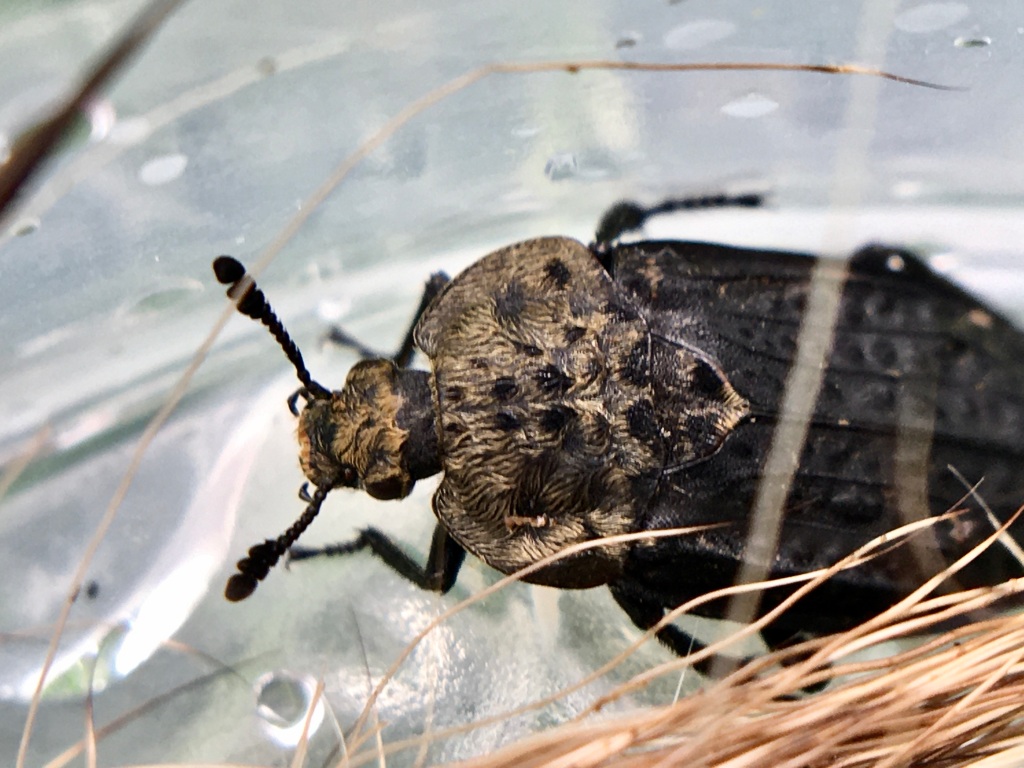
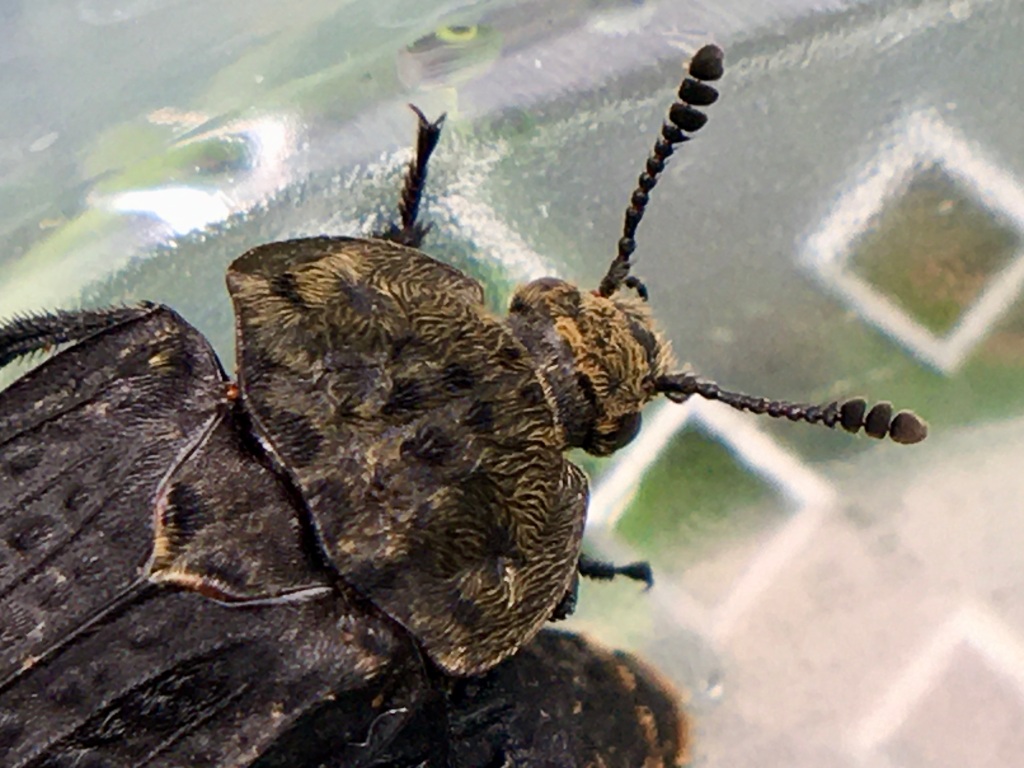
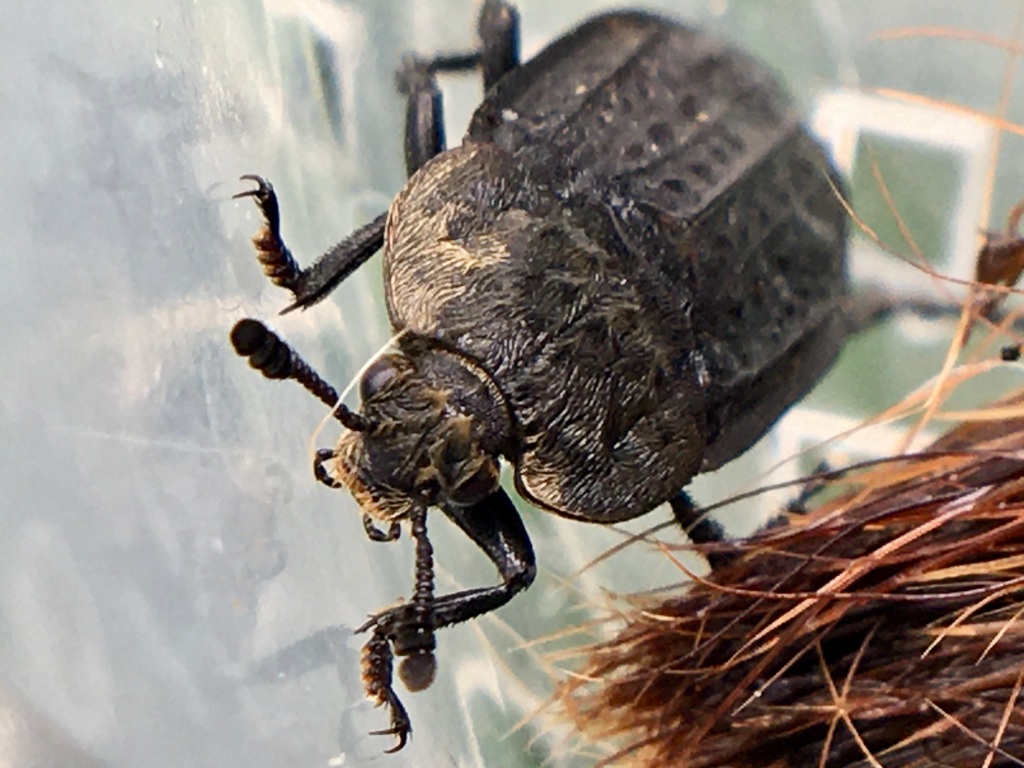
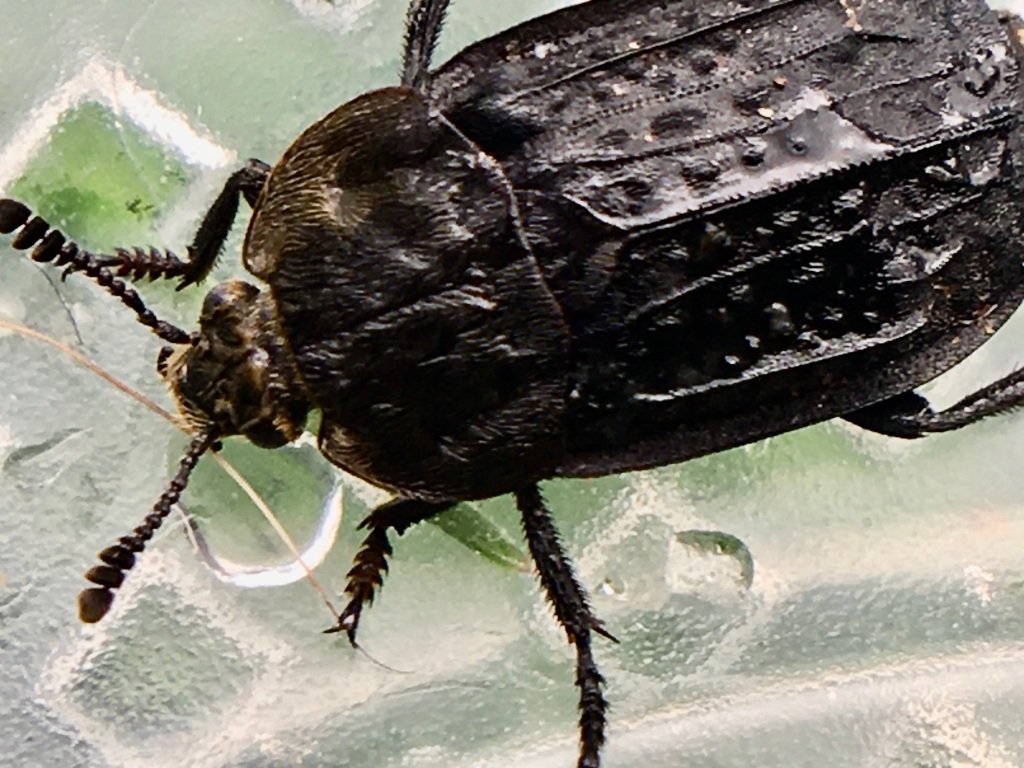
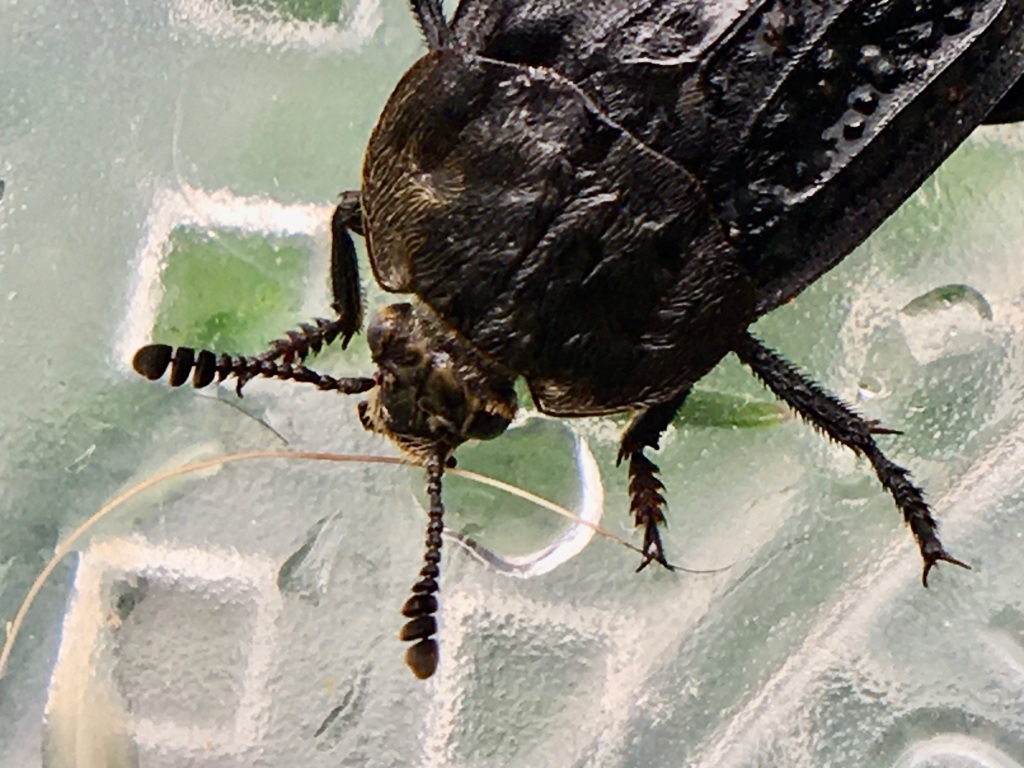
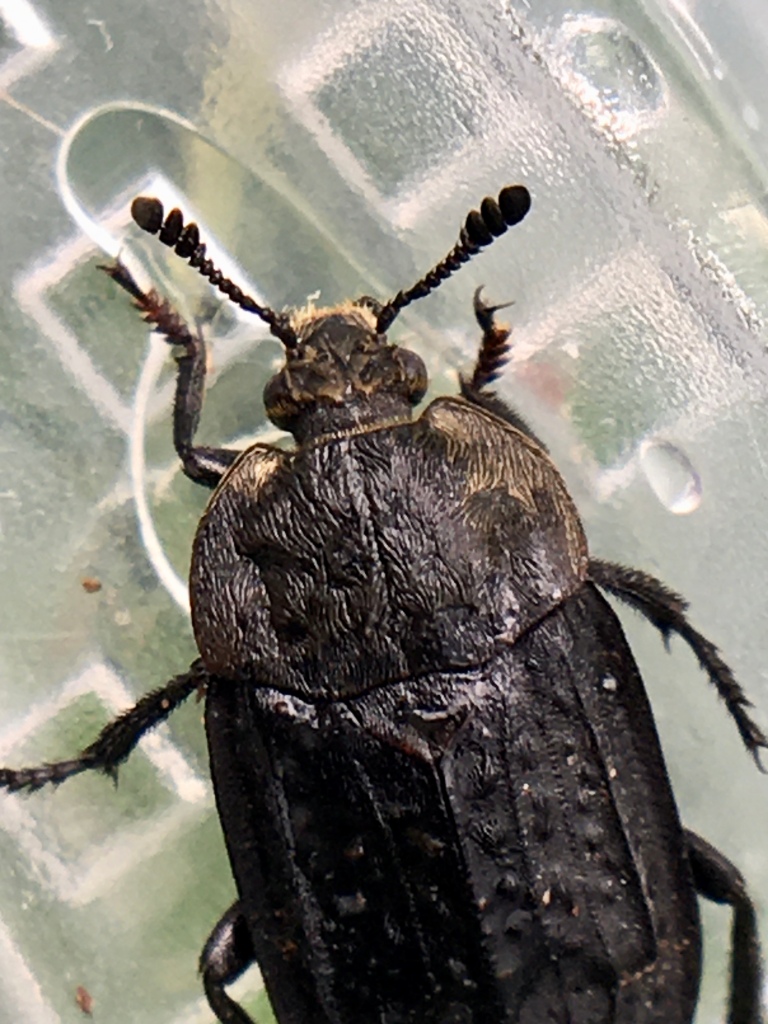
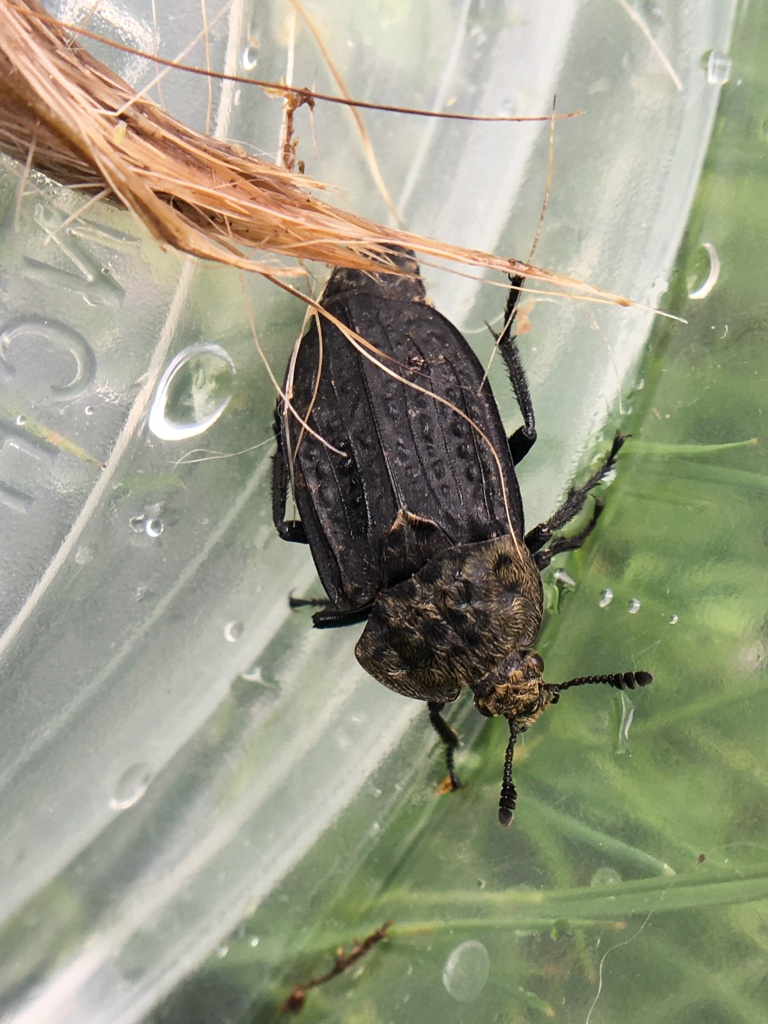
This is a Northern Carrion Beetle – Thanatophilus lapponicus, one of the carrion beetles in the family Silphidae. The origin of the name Thanatophilus is from Greek thanatos (θανατος)- “death” + philos (φιλος)- “loving, liking” (Bugguide.net, 2003-2021).
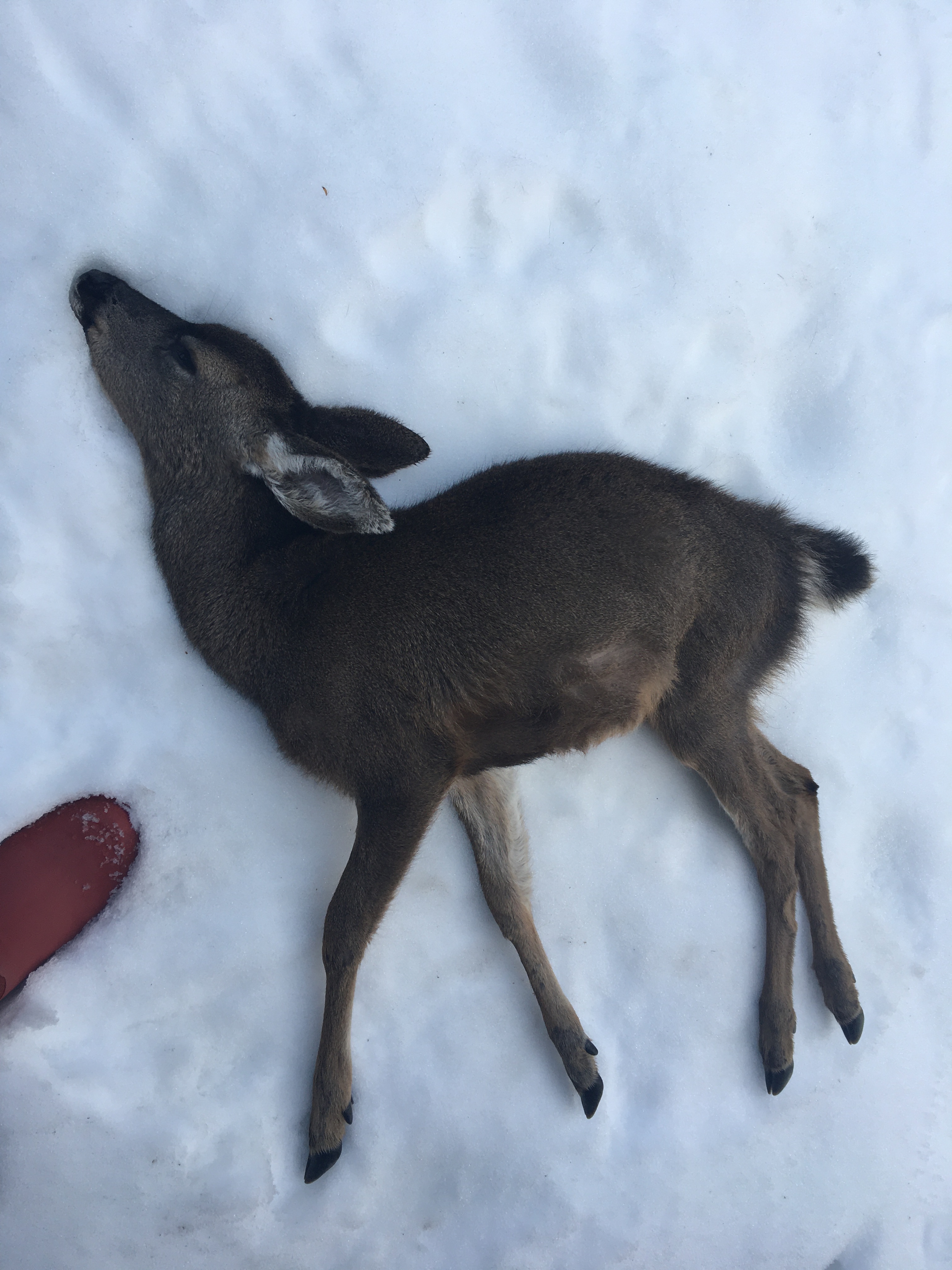
Death is part of a biological process that can be unsettling for many of us. That said, death makes way for new life. This past February, a small fawn died on our property.
February 17, 2021
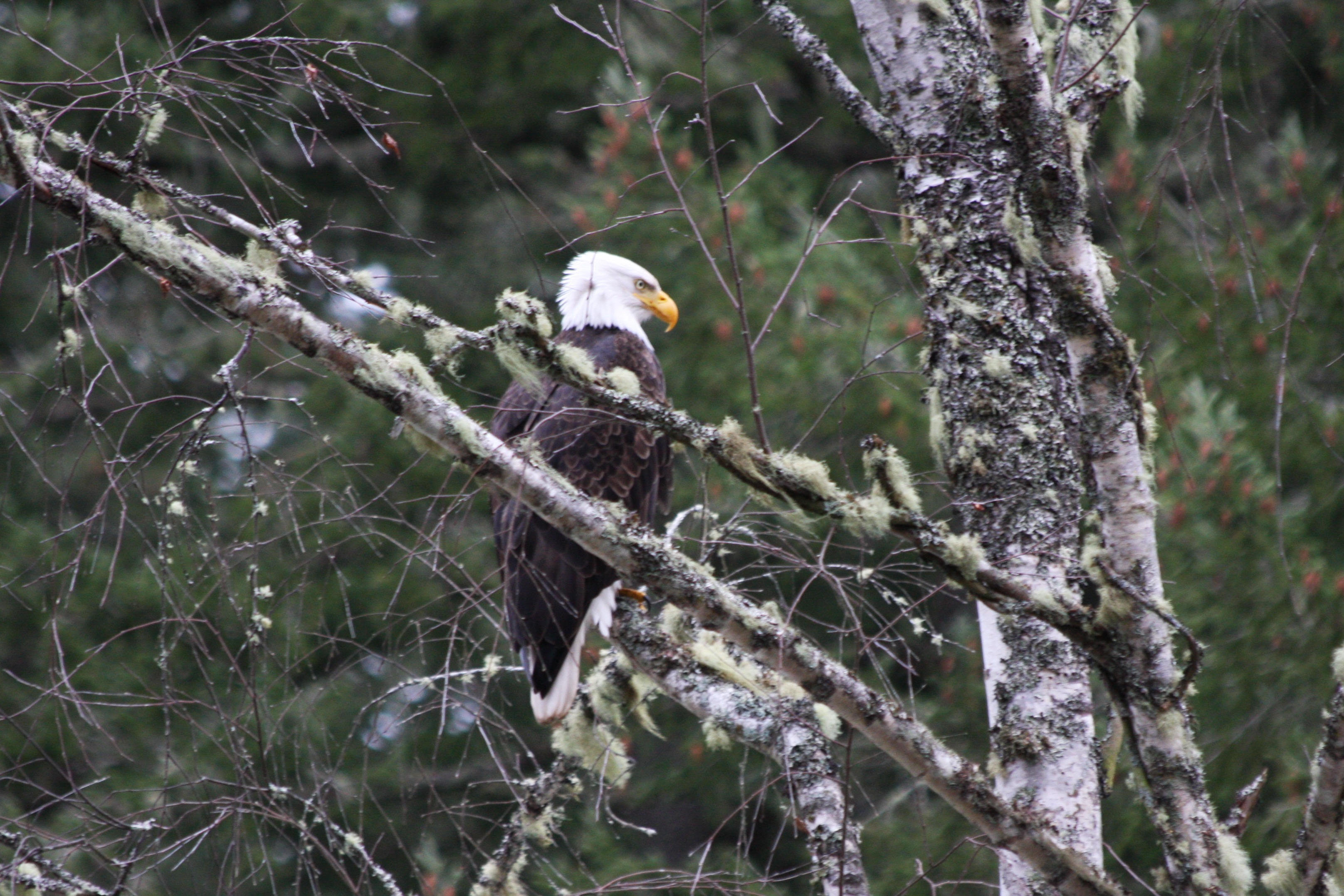
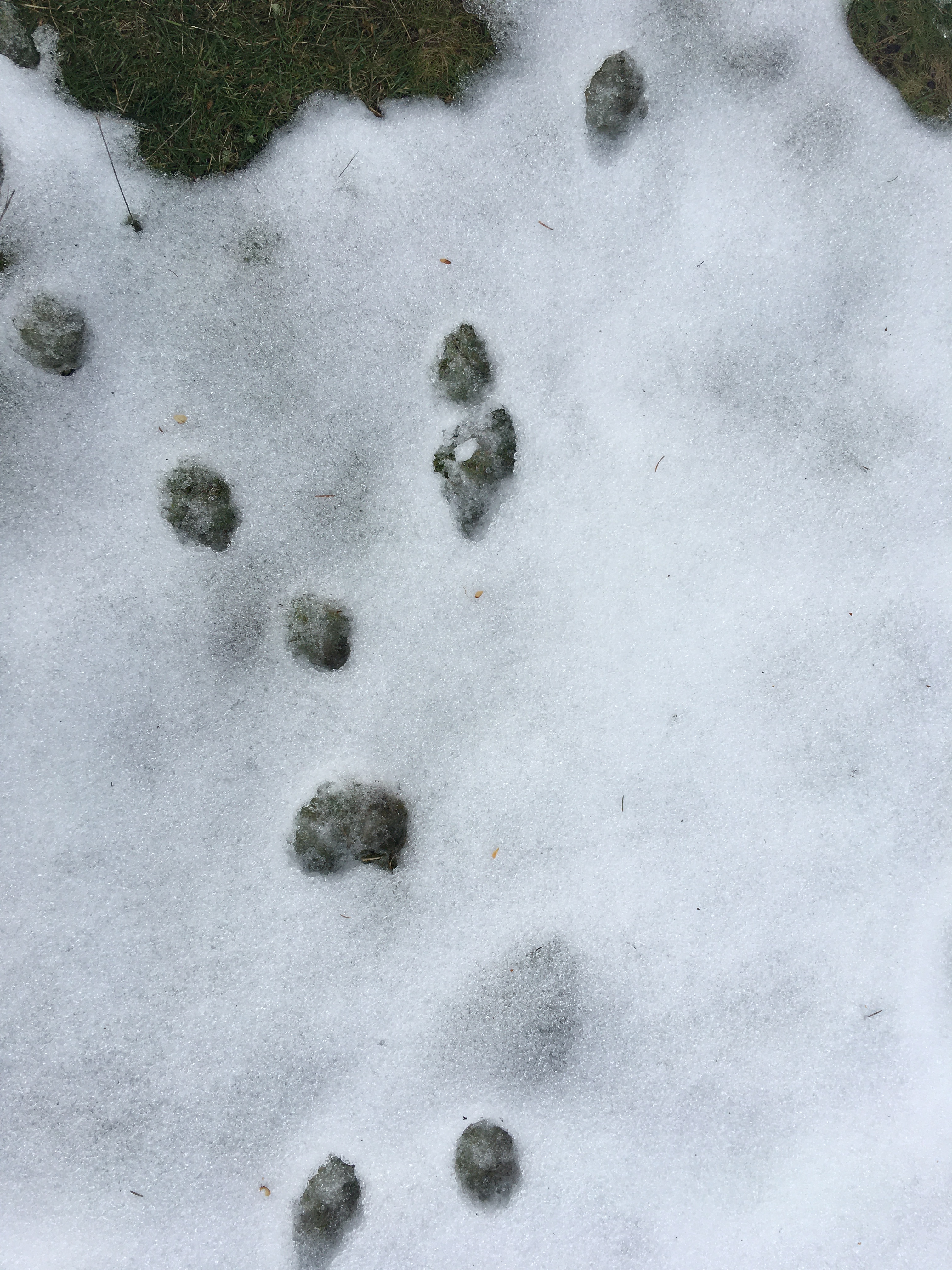
We left the body where it lay. First the eagles came, then a pair of ravens. I believe a fox visited too (tracks in the snow).
Bald Eagle 2.18.2021Fox (?) tracks in snow
Over the course of the past 12 weeks, I’ve found some very cool bugs developing in the carcass, even now in the bits of hide and bones that remain.
Did you know?
There is actually an entire field of scientific study (Forensic Entomology) where time of death of a body can be estimated by the presence and developmental stage of certain insects involved in the decomposition process. This is called determining the Post Mortem Interval or PMI. Forensic entomologists can aid law enforcement in crime investigations by surveying for species of arthropods on a corpse, and determining stages of development and feeding behavior of the arthropods present (Barnes, 2000).
Carrion beetles in the family Silphidae fall into two subfamilies: the Nicrophorinae and Silphinae. While both feed on the remains of animals, the Nicrophorinae or Burying Beetles are associated with smaller corpses like birds, mice, voles, etc., weighing under 300g, while the Silphinae utilize larger cadavers (Watson & Carlton, 2005). This preference or niche, makes them ideal for investigations related to human death or death of larger species of wildlife (as in poaching or other crimes against animals).
Distribution. Thanatophilus lapponicus ranges broadly throughout Canada and Alaska, across the norther United States from coast to coast, and south to Southern California, Arizona, and New Mexico (Anderson and Peck 1985, Peck and Kaulbars 1987). It is also found in Northern Europe and Asia (Hatch 1928, Schwaller 1982).
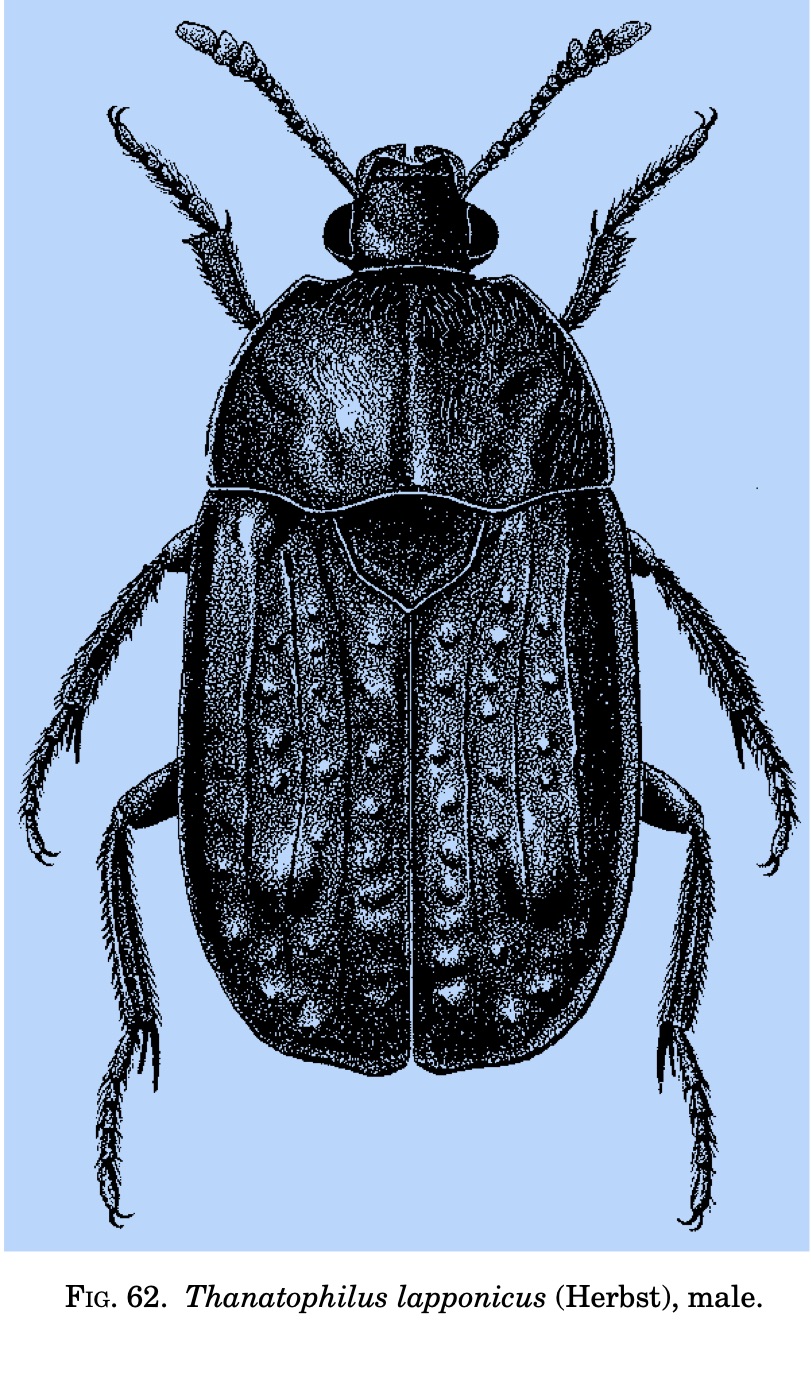
Remarks. Thanatophilus lapponicus is readily identified because of the presence of a row of small tubercles on each of the elytra intervals (Figs. 31-32, 62); it is the only silphid in North America with this distinctive form of elytra sculpturing.
The larval stage was described by Dorsey (1940) , and a brief synopsis was given by Anderson and Peck (1985). The larva of this species is characterized by a dark brown to black color on the dorsal surface, urogomphi that are about two times the length of the 10th abdominal segment, and antennae with a large sense cone on the second segment (as in Fig. 40).
Anderson and Peck (1985) reported that individual females lay about ten eggs in the soil surrounding a carcass. The egg stage lasts 5-6 days, the first instar about 7 days, the second instar 8-10 days, and the third instar 10-12 days. While Anderson and Peck did not observe pupae, they did note that T. lapponicus is a cold-adapted species that occurs at higher elevations in the western Mountains of North America. It is often the only silphid present in some of these areas. Thanatophilus lapponicus shows a strong preference for open areas (Anderson 1982c).
Clark (1895) observed extensive predation on fly larvae by adult beetles.
Size. 9-14mm
Time of Year Seen. March-October
References:
Anderson, R.S. and Peck, S.B. (1985) The carrion beetles of Canada and Alaska. The insects and arachnids of Canada, part 13, 1–121.
Watson, E., & Carlton, C. 2005. Succession of Forensically Significant Carrion Beetle Larvae on Large Carcasses (Coleoptera: Silphidae). Southeastern Naturalist,4(2), 335-346. Retrieved April 27, 2021, from http://www.jstor.org/stable/3877967
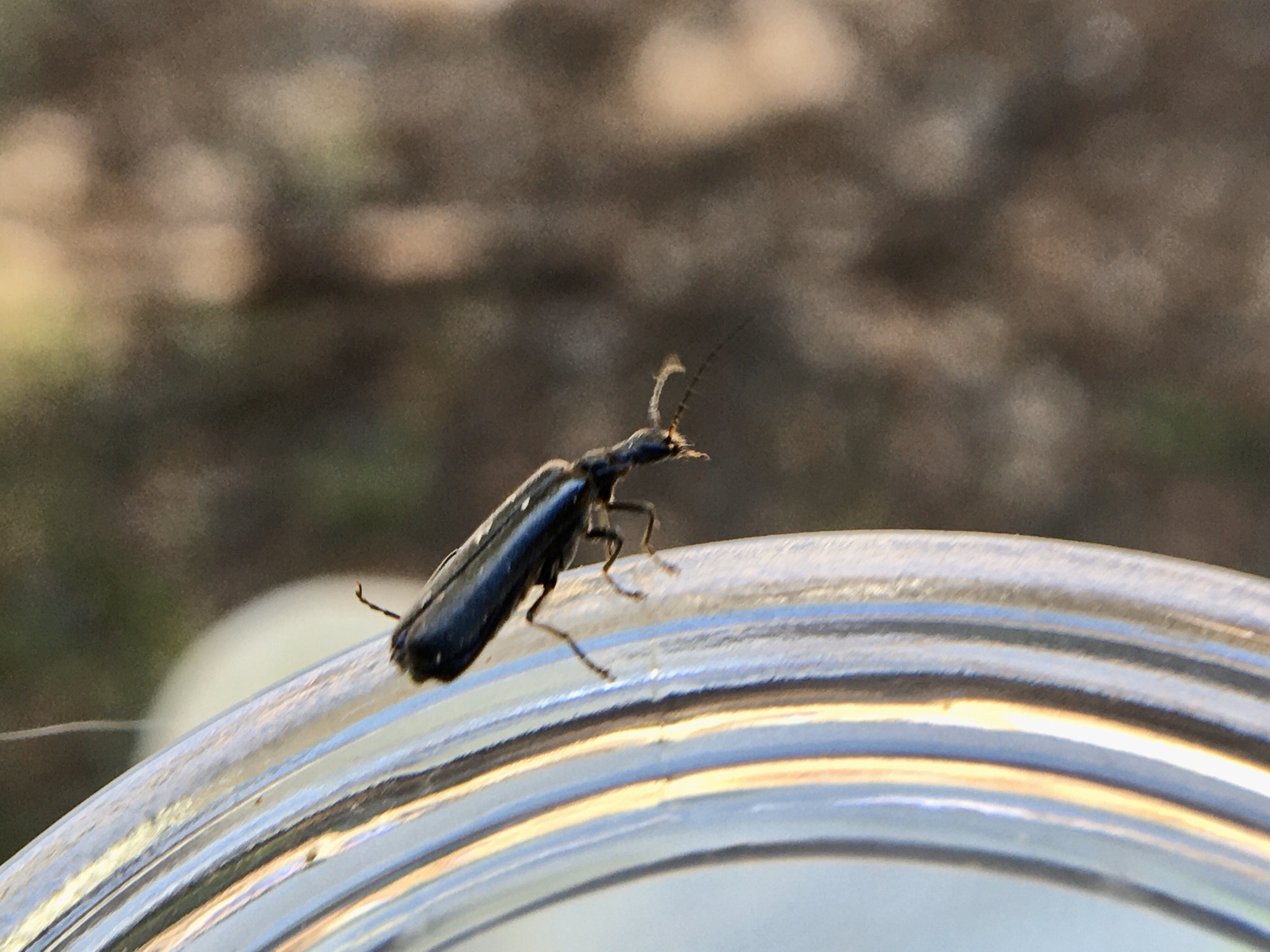
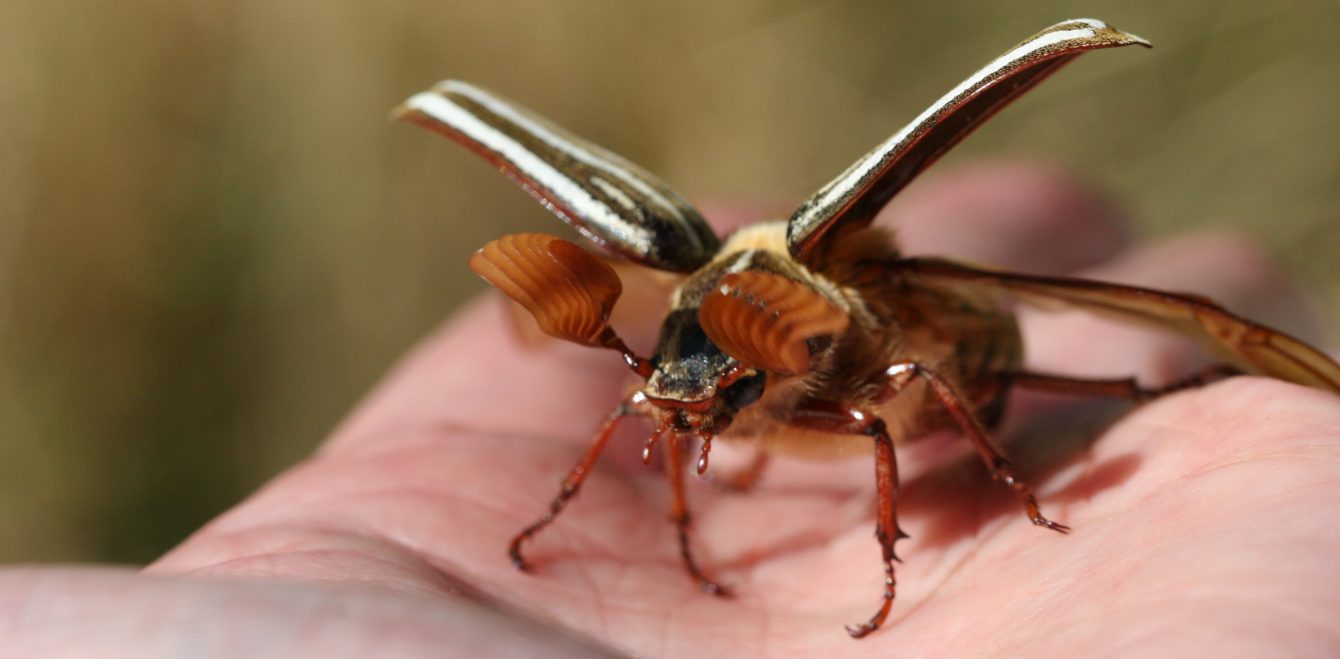
This little guy got into my pants yesterday! 😁 What is it? This is a Treehugger Soldier Beetle (Dichelotarsus piniphilus) in the family Cantharidae or soldier beetles ( because their wings resemble military uniforms). More interesting though is the Greek translation of Cantharis or κανθαρισ, translating to ‘blister beetle.’
I’m pointing this out because this little Treehugger got confused yesterday and when it was hugging my leg and my pants were hugging back a bit too tightly, it either bit me or exuded some of the defensive chemicals that they use to repel would-be predators . In either case, I was fine aside from a bit of a temporary stinging sensation.
Treehugger Soldier Beetle
This species is common in the west. Surprisingly, very little is known about the life histories of these beetles. I’ve spotted them on nettle this time of year. Adults are known to feed on insects (including aphids), nectar, and pollen.
I wondered if there is some uptake of the chemical constituents of the nettle to produce the defense secretions in the beetle, either via consuming pollen from the nettle, or via feeding on another insect feeding on the nettle. A literature search failed to yield any supporting information, though I did find an older publication listing insects found in association with nettle. Quite a few were some of our lovely Lepidoptera, so you might want to leave those nettle patches instead of clearing them away 🦋
I found another “new-to-me” bug on the island the other afternoon. This fly was a surprise. It is really small at about 3mm, with big red eyes, and clear wings with a little black dot on each one . Guess what? It’s a SWD! That’s the abbreviated form of Spotted-Wing-Drosophila or Drosophila suzukii (also sometimes called the Vinegar Fly). I’m attaching an info. sheet here for you to reference http://entnemdept.ufl.edu/creatures/fruit/flies/drosophila_suzukii.htm
It’s amazing how quickly the SWD fly can reproduce. I’m curious as to whether they’ve been seen out and about by other folks on San Juan. We have an apple orchard, but honestly, I didn’t check the fruit this year for pests and I wouldn’t use spray anyway because I love our birds. We’ve had lots of chickadees, nuthatches, and juncos in our trees, as well as gorgeous round orb weaver spiders in the garden and around the house, so I’m banking on them keeping these (and other) insects categorized as pests in check.
Drosophila suzukii – Spotted Wing Drosophila or (SWD)
I had a feeling today was going to be one of THOSE days, but really had no idea how bad it would get. This time of year on the island, we’ve lost our sunshine and are headed into the Time of DARKNESS. I have no idea who got away with marketing the “Sunny San Juan’s!” They advertise that HERE is the special place where you’ll have a whopping 247 Days of Sunshine, but that is just WRONG!
This statistic has been creatively manipulated and someone got away counting an entire day of sunshine when the sun maybe, just MAYBE peeks out for a whole 5 minutes. Yep, two bits of advice I received when I moved here was 1) if the sun is out at all anytime between October and April, go outside and, 2) get a raincoat.
But I digress from the events of the day! So, being under the umbrella of COVID, I hardly ever, go to town anymore. There is the likelihood that I might venture out only once during the week for a grocery/mail run. Well, that was today.
I stopped first at the post office. There was the now normal line winding down the hall. I waited my turn patiently. It’s an island and I’ve learned to be on island time. There’s always someone who hasn’t yet learned this yet, and that was the guy in line ahead of me.
He was complaining loudly. He went into the office even though the sign clearly states “only THREE people at a time.” Poor postal staff had to point this out. His reaction? Well, you might ask that. He was even louder about having to WAIT and HE had MUCH MORE IMPORTANT THINGS TO DO!
“J” whispered to me when it was my turn at the counter, “Did you HEAR that guy?” I nodded my head, commenting “there’s always one!” Little did I know there was one more someone who would be breaking the RULES.
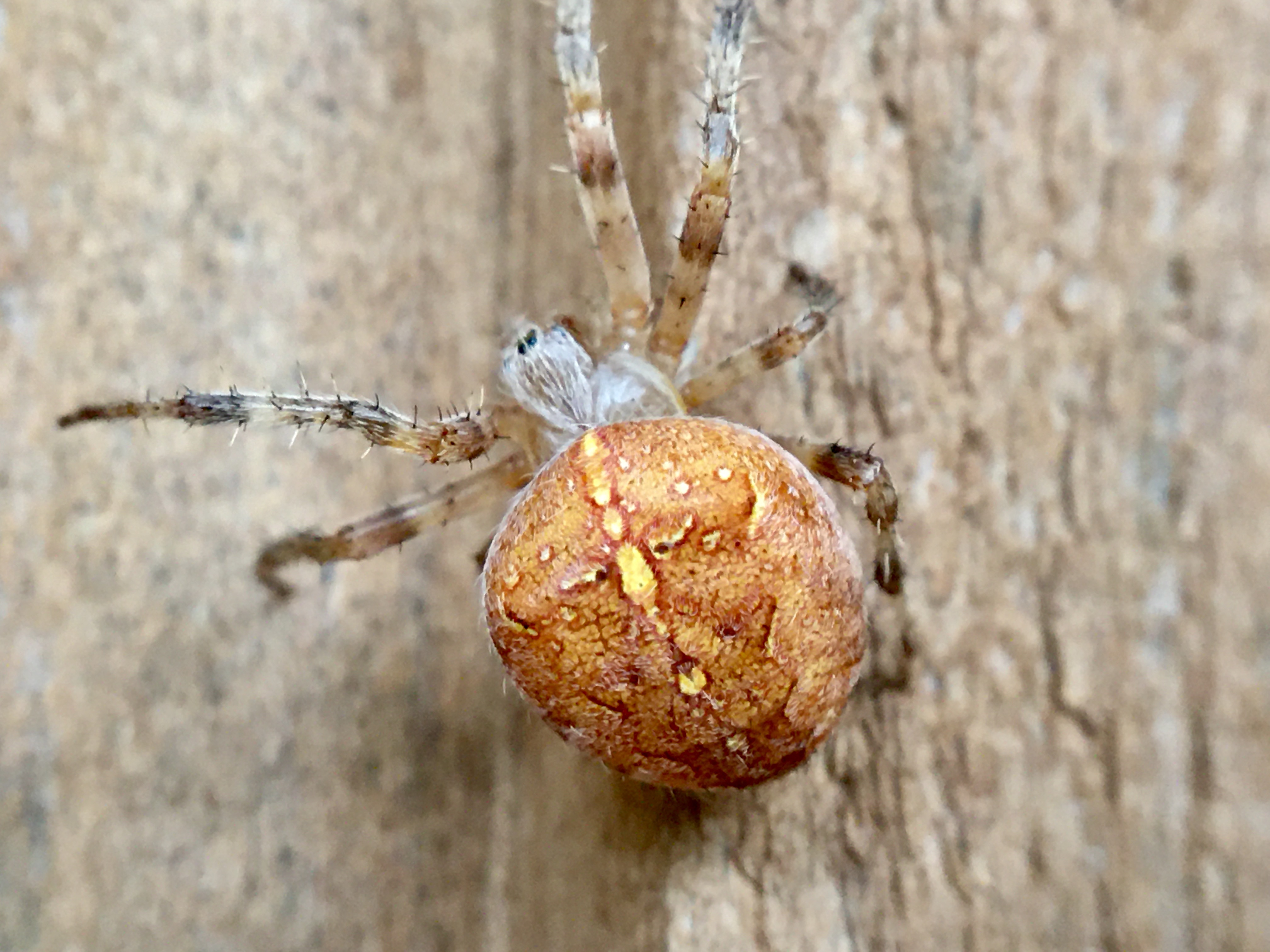
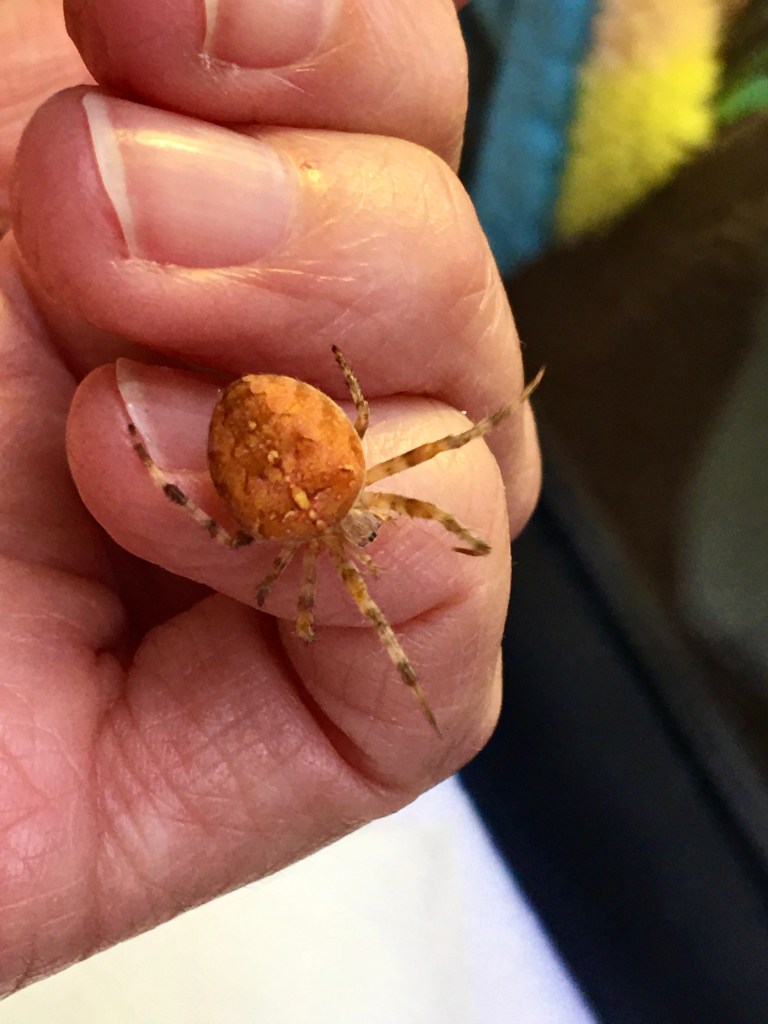
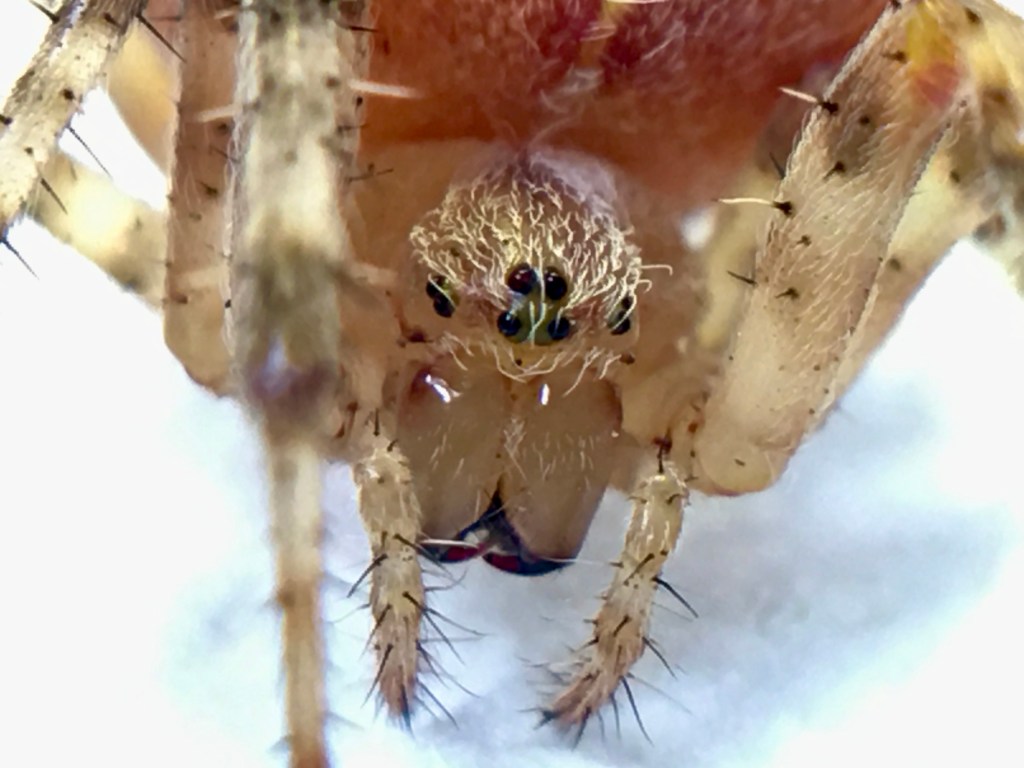
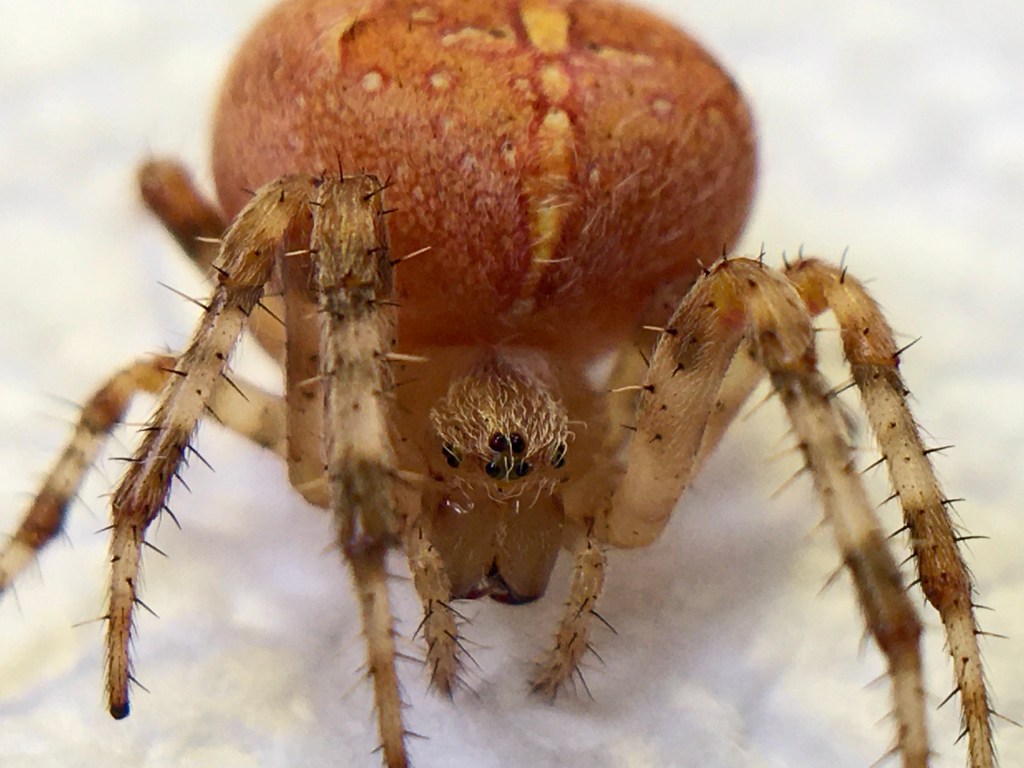
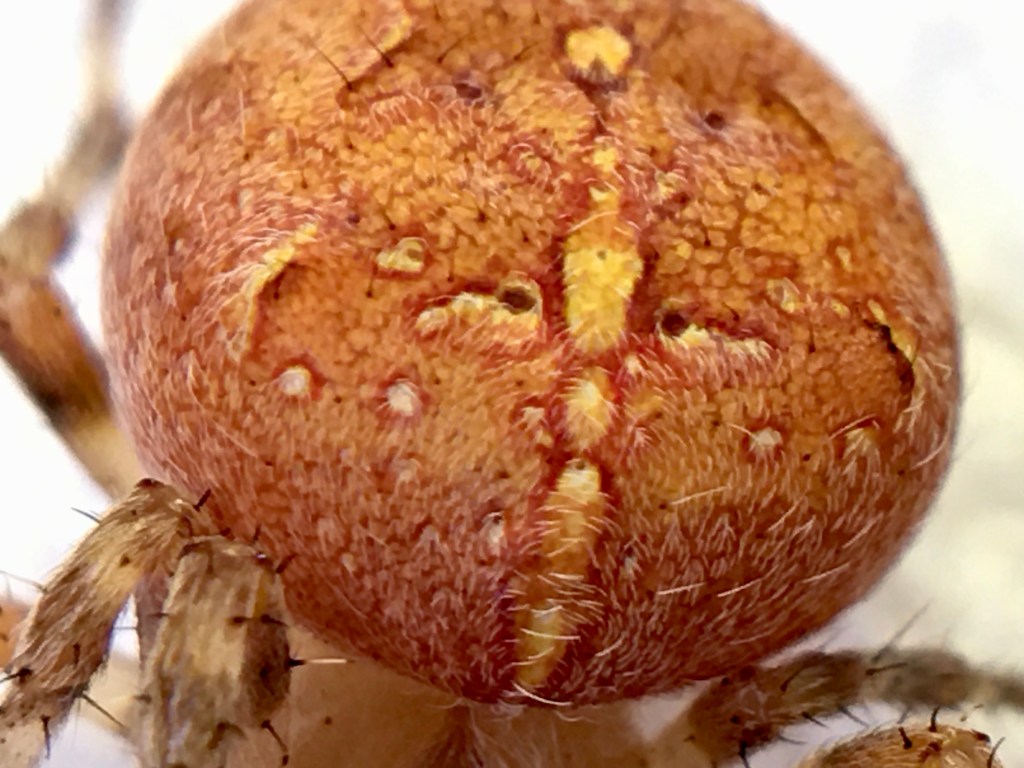
My next stop was to grab a spider left for me at my husband’s office. A pumpkin-colored Orb Weaver. I love spiders!!! After collecting my 8-legged friend, I made my next stop at the Market.
At this point, I’m feeling a bit scattered. I have my purse, keys in hand, my “list” of things I need to pick up for the next few nights of dinners, and I walk across the parking lot and into the store. The next thing I hear is “MA’am, Ma’am!” I looked towards the voice and all of a sudden the sound is ringing in my ears as I realize the “Ma’am” is meant for ME.
“You forgot your mask,” the store employee is saying as she walks in my direction! I feel my face, groping for my mask, that I JUST HAD ON at the post office, which seemingly has disintegrated, leaving feeling the equivalent of walking into the store NAKED.
I was MORTIFIED!!! Thankfully she handed me a mask as I pretty much just stood there, unable to move. “Don’t worry,” says another clerk. “People all over the island are pretty much losing it. You’re not the first!” I feel marginally better, but not much.
Somehow I managed to finish my shopping, check out, and make it back to my vehicle. I called my daughter on the way home. Hands free. She tried to make me feel better and we had a good laugh about it.
“It’s getting to everyone! ”she says. Then, “I am starting to feel like there’s no point in figuring out what I want to do with my life, because I really wonder if we are going to have a LIFE after all of this.” I want to tell her it will be fine, but even though we joke about it, there is really nothing funny about the state of the world…OUR world. I find myself wanting to tell her to take up retail therapy to make herself feel better. Exactly how much is the limit on that credit card?
My daughter asked if I got my ballot at the post office. Then, she laughed and told me her friend, who says he ISN’T voting because he hates both parties wrote in FIDEL CASTRO and dropped his ballot in the box. Yes, I do believe folks are losing it! Big time.
Oh, and here are some photos of that lovely Orb Weaver I brought home (and released). This spider is Araneus diadematus, one commonly seen about in early fall. Now that I’m back in my “safe” zone, I can focus on Bugs that don’t require me to wear a mask!
My husband said this title was far to risque’ but I’m going with it anyway. I would tell you to “get your mind out of the gutter,” but this is a SPIDER sex story. Sex education is not a bad thing and it’s good to know how it all works, right?
So male spiders have these fuzzy, enlarged “paws” that sort of hang down in front of their face. People who study spiders call them palps. They are sort of like a 5th pair of legs, but used by the spider to manipulate food and “smell” things. These palps are also where the sex organs are housed in adult male. The hairs on the palps have chemoreceptors that help the fellas follow the pheromone trails of SHE spiders. This is the mating season for one of our commonly seen spiders in the San Juans…the Giant House Spider (Eratigena duellica) who happens to be harmless, just horny.
How do spiders DO it? Well, an adult male spider will weave a small silken sheet called a sperm web. He deposits a drop of semen on the sheet and then dips the tips of his palps into the semen, drawing it up into what is called the emboli. The emboli act like a syringe, drawing the fluid up to be held in the palp for transfer to a SHE spider. With his palps “charged and loaded,” he gleefully wanders off to woo all the ladies.
Some of these male spiders really go all out to impress a gal. They will drum (with their palps), dance, and display all sorts of postures to show how great they are. They better do EVERYTHING they can to impress her too since SHE might eat them if it’s not good enough. Watch a jumping spider perform his quirky courtship ritual here –
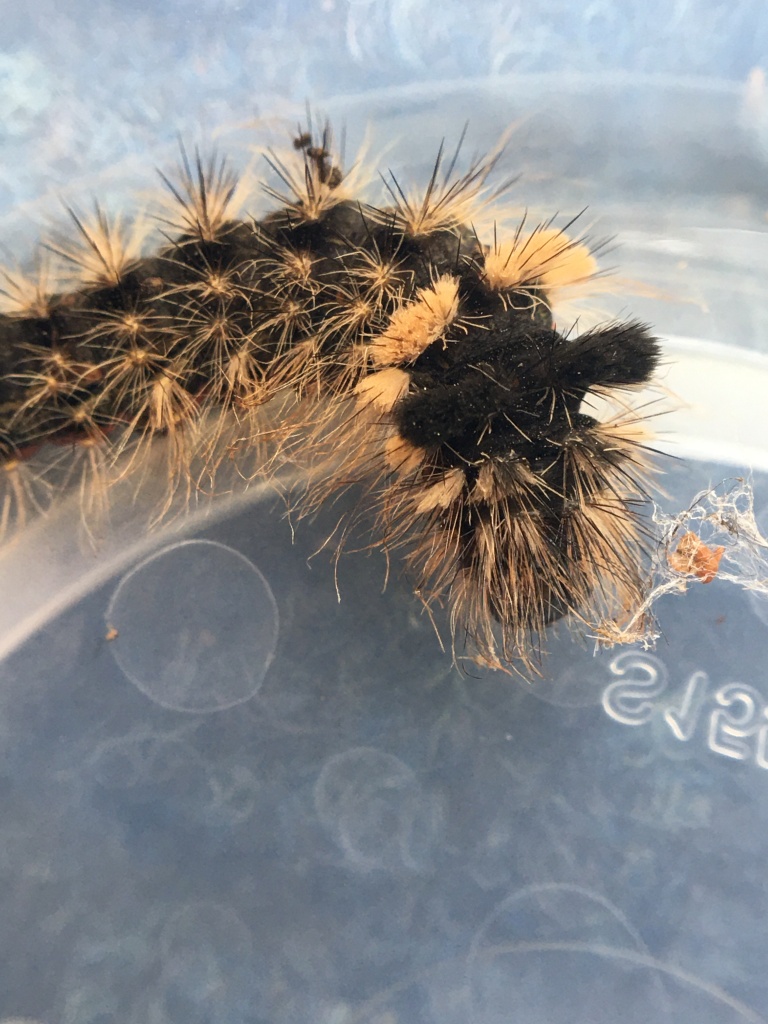
Saturday, September 19, 2020. San Juan Island, WA – Caterpillar rescue!
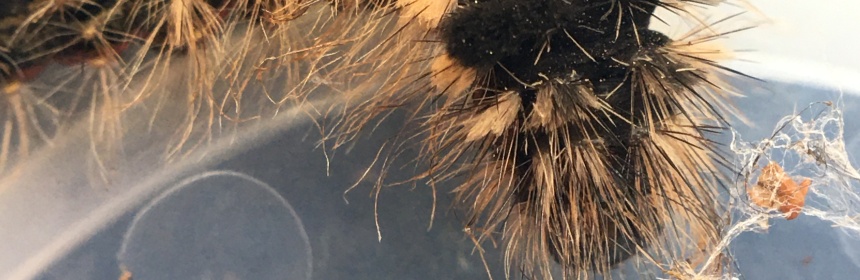
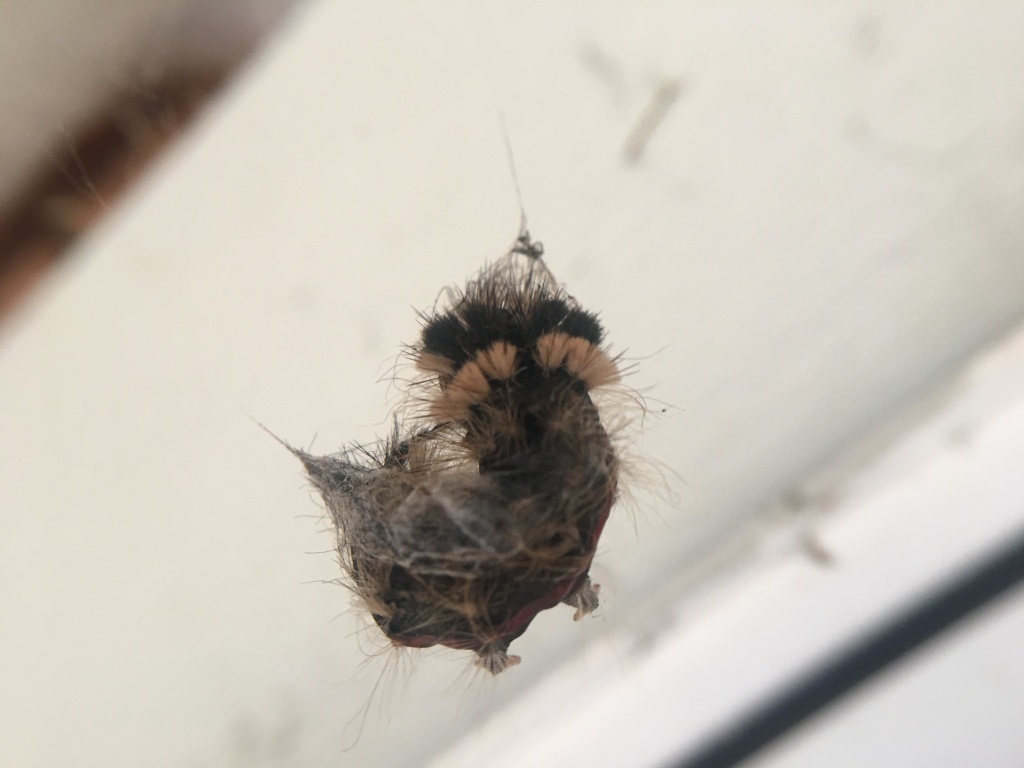
Acronita impleta – Yellow-haired Dagger Moth caterpillar. San Juan Island, WA 09.19.2020
I found one of these several years ago (September 20, 2017 to be exact), so I recognized it immediately when I saw it squirming in the spider webbing along the house this morning. My husband said I should just leave it alone. “Nature is ugly sometimes and you can’t interfere.” Well, when it was still there four hours later, suspended mid air, and still squirming, my tendency to SAVE things kicked in. The spider living above that web was actually dead. I’m not feeling very guilty about stealing food from a dead spider.
Acronita impleta – Yellow-haired Dagger Moth caterpillar. San Juan Island, WA 09.19.2020
Acronita impleta – Yellow-haired Dagger Moth caterpillar. San Juan Island, WA 09.19.2020
I got a cup and gently pulled at the web and began the process of freeing this caterpillar. It took finding my reading glasses and getting some fine-pointed tools to gently ply away the sticky bonds and clean the strands off the caterpillar hairs.
Acronita impleta – Yellow-haired Dagger Moth caterpillar. San Juan Island, WA 09.19.2020
Yellow-haired Dagger Moth (Acronita impleta)
I think it looks pretty good! I even picked it some dinner and we’ll see if I can keep it healthy through pupation and adulthood.



 fly through in the dark of night to carry off some of them for dinner. In the early morning, they’d find more disappear when the hungry woodpecker and nuthatch stopped to peck at the crib and take away caterpillars to feed their hungry chicks. In the panic, some of Melvin’s siblings slipped out of the crib and fell to the ground. That afternoon, a lizard and garter snake found those and ate them right away. Near dusk, a few more dropped out of the nursery web, and little miss mouse carried those off to feed to her babies.