Category Archives: Uncategorized

Neophasia menapia – Pine White Butterfly

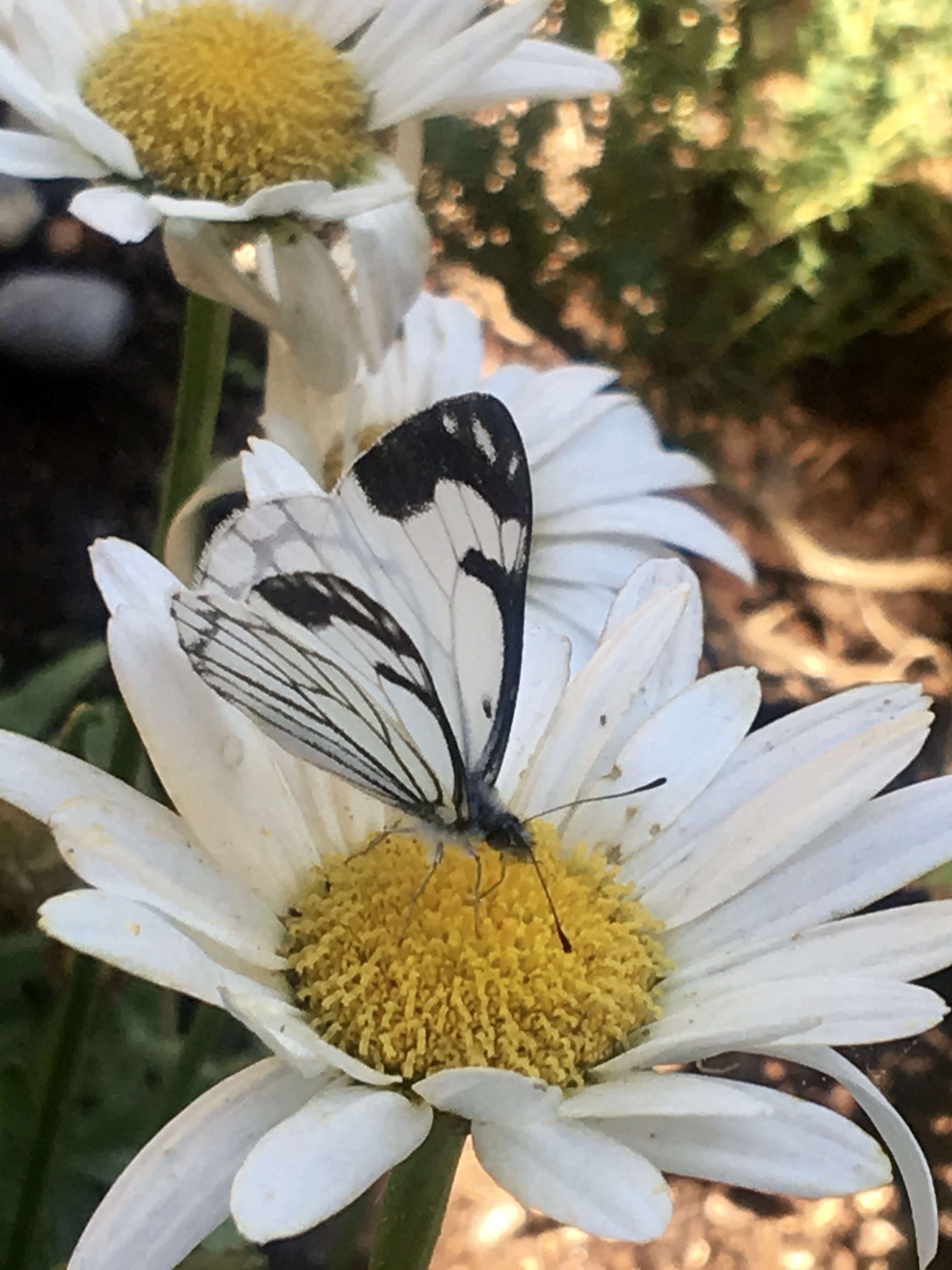
It was breezy earlier this afternoon when I spotted this beauty feeding on my daisies. This is a Neophasia menapia – or the Pine White Butterfly. I’ve been worried since we’ve put up deer fencing that the butterflies wouldn’t be able to find their way through the fence into my flower garden, but I shouldn’t have worried. The butterflies ever-so-gracefully float over the top.

I’m sure the butterflies and other pollinators appreciate that my daisies aren’t headless amputees this year, courtesy of our resident deer who now can only gaze at them. It’s hard to understand why the deer would even want to eat those flowers because they’re kind of stinky. To my nose, they smell a bit of cat urine. Lots of insects seem to like those sorts of smells though. These daisies can stay outside. I won’t be displaying them in a vase on my dining table.

Pine White Butterfly on Daisy
Neophasia menapia 
July 26, 2019
San Juan Island, WA

The Pine White Butterfly larvae feed on Ponderosa Pine and Douglas fir. Adults emerge typically between the months of July and October. Look for little green eggs on the needles of pines and firs sometime beginning in October. The eggs will overwinter and hatch sometime in June the following summer, coinciding with the emergence of new foliage on the trees. Larvae typically only feed on old needles, but can become a “pest” when they feed on the new needles and/or population levels are high and the tree is repeatedly defoliated. Natural controls help keep caterpillar populations balanced. Larvae pupate in late July for about 15-20 days before emerging as adults to begin a new cycle.

Pine White Butterfly (Neophasia menapia ) on Daisy
July 26, 2019
San Juan Island, WA

Would you like to read more? Check out the links I’ve added below.

https://bugguide.net/node/view/69083

https://www.fs.usda.gov/Internet/FSE_DOCUMENTS/stelprdb5347775.pdf

http://web.forestry.ubc.ca/fetch21/FRST308/lab5/neophasia_menapia/pine.html

Aliens in the Garden

I’ve seen some pretty fascinating insects over the years, but using this clip on macro lens https://www.amazon.com/dp/B07LG651ZD/ref=sspa_dk_detail_3?psc=1&pd_rd_i=B07LG651ZD my husband bought me to use with my iPhone has opened up a whole new world. Last night we went down to our garden and while he was busy picking lettuce and tomatoes, I wandered around inspecting leaves and flowers with my new “eye.” I saw aliens! 👽

While I can’t tell you the exact names of all of these creatures, I can tell you that 7 pm must be dinnertime for some of them…like these micro beetles all over my flowering parsley. https://youtu.be/9_NRtS1HJTg

Unidentified micro beetles on Parsley blossoms
July 21, 2019
San Juan Island, WA

One of my favorites was this ladybug larva. I’ve been seeing several different species of ladybugs in the garden. This larva is probably Coccinella septempunctata or the Seven Spotted Lady Bug. A voracious predator, ladybug adults and larvae love to eat aphids. Curiously, while I saw plenty of aphids in my garden, I also saw some strangely mutant ones, so keep reading and scroll down for photos.

Ladybug larva
July 21, 2019
San Juan Island, WA
photo by Cynthia Brast-Bormann

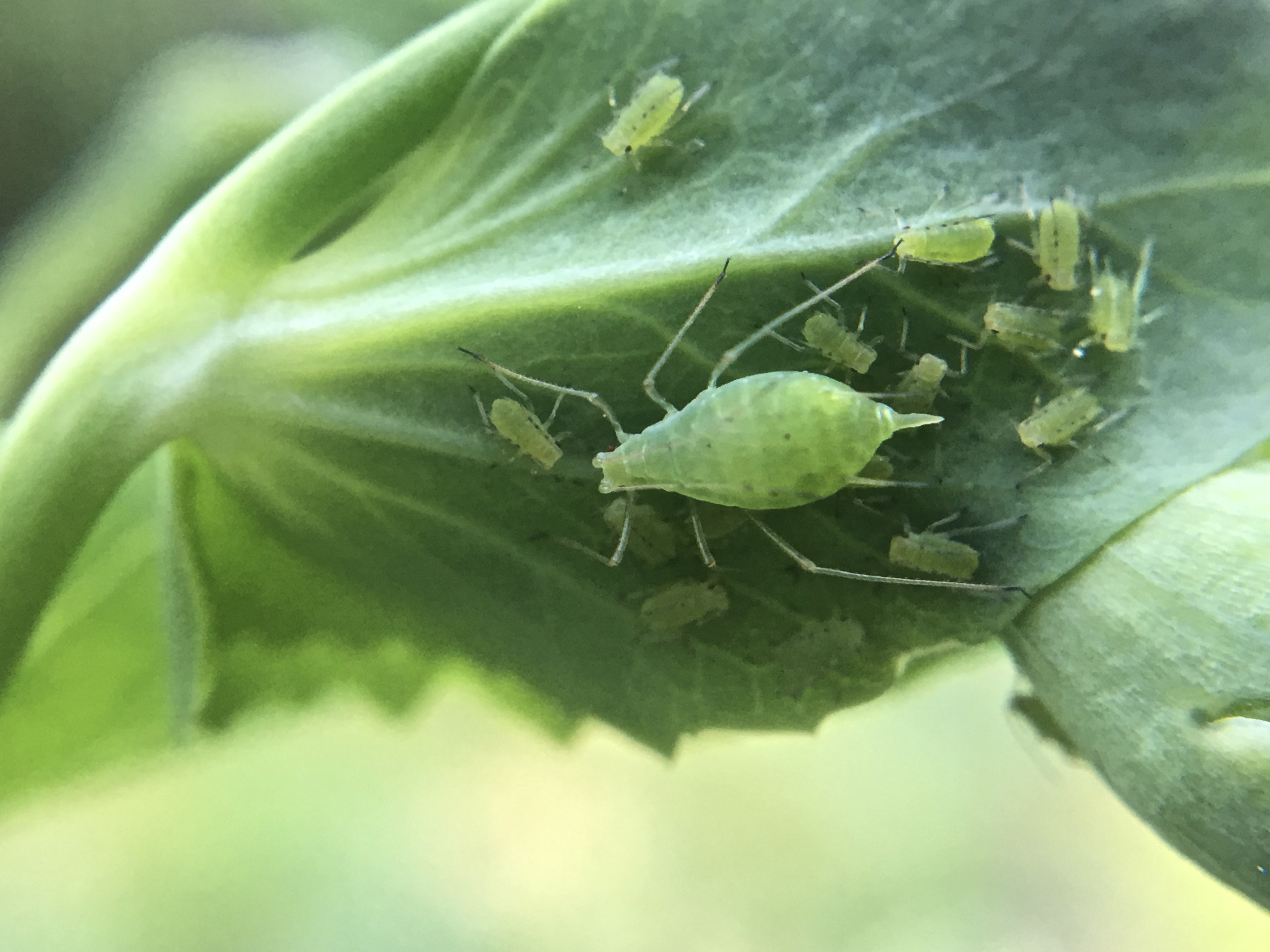
The normal, healthy aphids look like this one. Isn’t she sort of cute watching over all her little babies on the leaf!

Mom aphid with young nymphs
July 21, 2019
San Juan Island, WA
photo by Cynthia Brast-Bormann
Mom aphid with young nymphs
July 21, 2019
San Juan Island, WA
photo by Cynthia Brast-Bormann

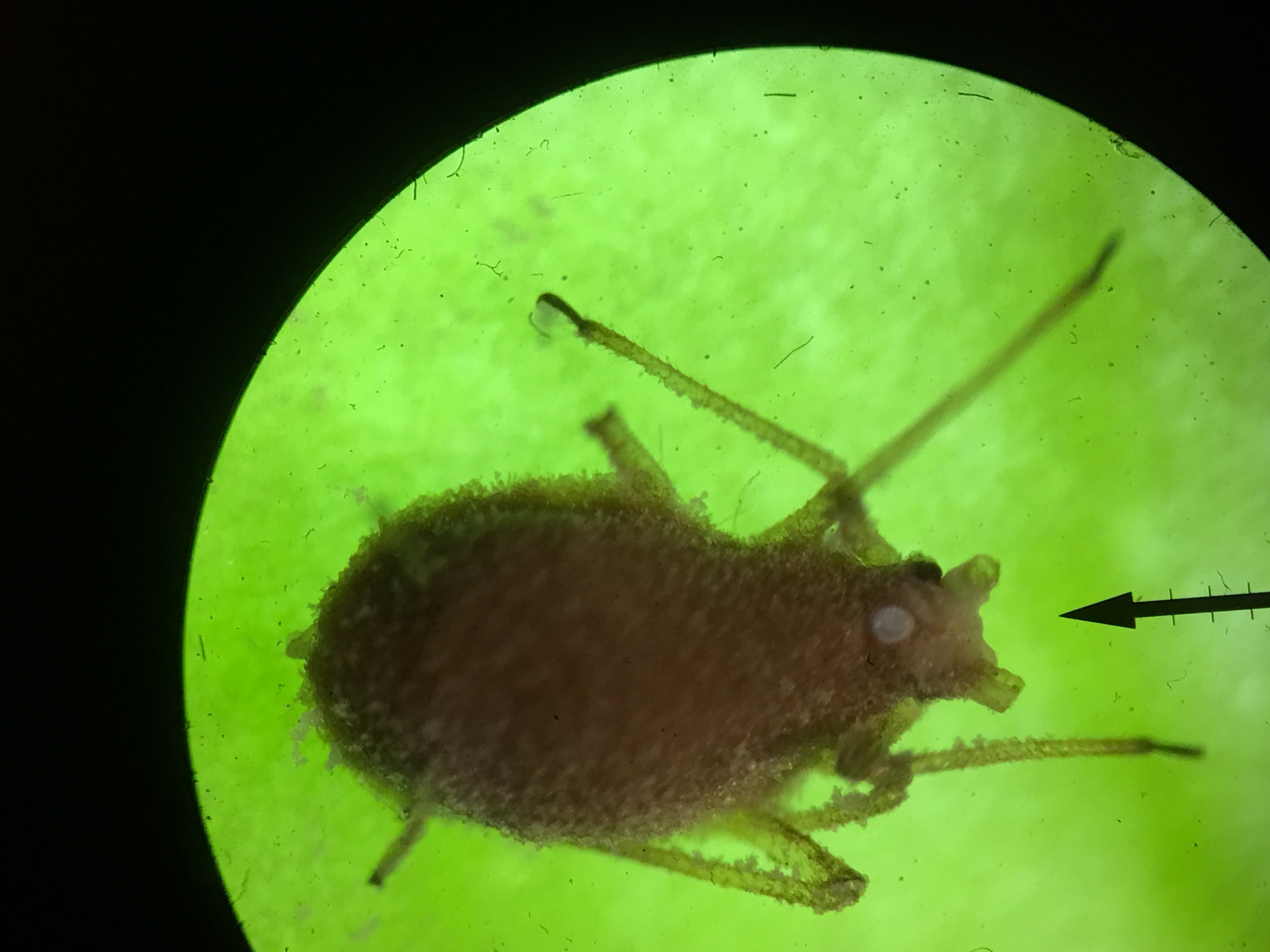
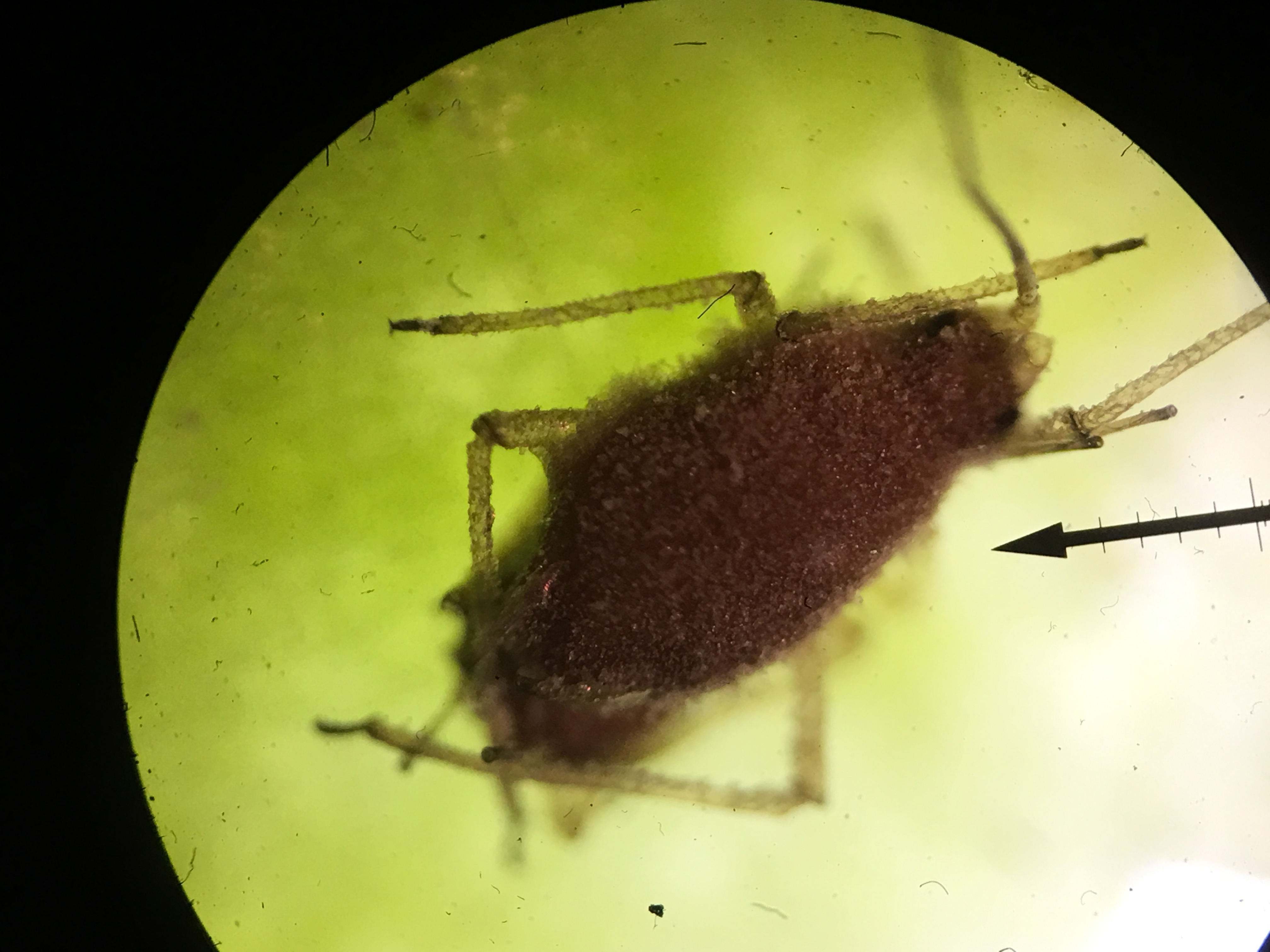
The strange aphids I noticed when I was picking peas. I am not 100% certain, but I believe this is a pea aphid that has been infected with fungi. After doing a bit of reading about these fungal pathogens, I believe it could possibly be (Pandora neoaphidis), an aphid specific entomopathogenic fungus that acts as a biocontrol for aphid populations. The taxonomy and ecological roles of fungi is beyond the scope of my knowledge and experience, so if you decide to read more about this, I suggest googling “Pandora neoaphidis” with “biocontrol.” One interesting bit I did note in my reading was that certain native ladybugs won’t eat aphids that are infected with the fungi, but that the non-native Asian ladybird beetle, Harmonia axyridis eats aphids indiscriminately, fungal infected ones too! Since I was eating peas while I was picking, I’m glad I stopped before popping the pea with these in my mouth. While I’m not entirely opposed to eating insects, I imagine my taste to be a bit more like the native lady bugs.

Pea aphid with fungal pathogen, possibly ( Pandora neoaphidis)
July 21, 2019
San Juan Island, WA
photo by Cynthia Brast-Bormann
Pea aphid under the microscope
possibly infected with (Pandora neoaphidis)
July 21, 2019
San Juan Island, WA
photo by Cynthia Brast-Bormann
Pea aphid with entomopathogenic fungi
July 21, 2019
San Juan Island, WA
photo by Cynthia Brast-Bormann

The next image is of the weirdest looking creature yet. This is another aphid, but instead of entomopathogenic fungi, it is the victim of a parasitic wasp that has injected it with eggs that will hatch, consume the remainder of the aphid body, then eat their way out. Here’s a link to another photo I found online of this stranger-than-strange occurrence in nature. http://www.aphotofauna.com/hymenoptera_wasp_praon_mummified_aphid_22-09-14.html

The Alien
Mummified aphid infected with parasitic wasp larva
July 21, 2019
San Juan Island, WA
photo by Cynthia Brast-Bormann

Beetle larva versus earthworm

I love finding strange and unusual things when I’m out and about. This definitely can be categorized as one of those moments when the microfauna is weirdly charismatic. And in a parking lot no less. I came upon this European Ground Beetle larva after visiting my husband at his office. We’d gone out for a nice lunch and upon our return, I discovered we weren’t the only ones having lunch. This fellow could give those people who enter contests to eat the most hotdogs some serious competition!

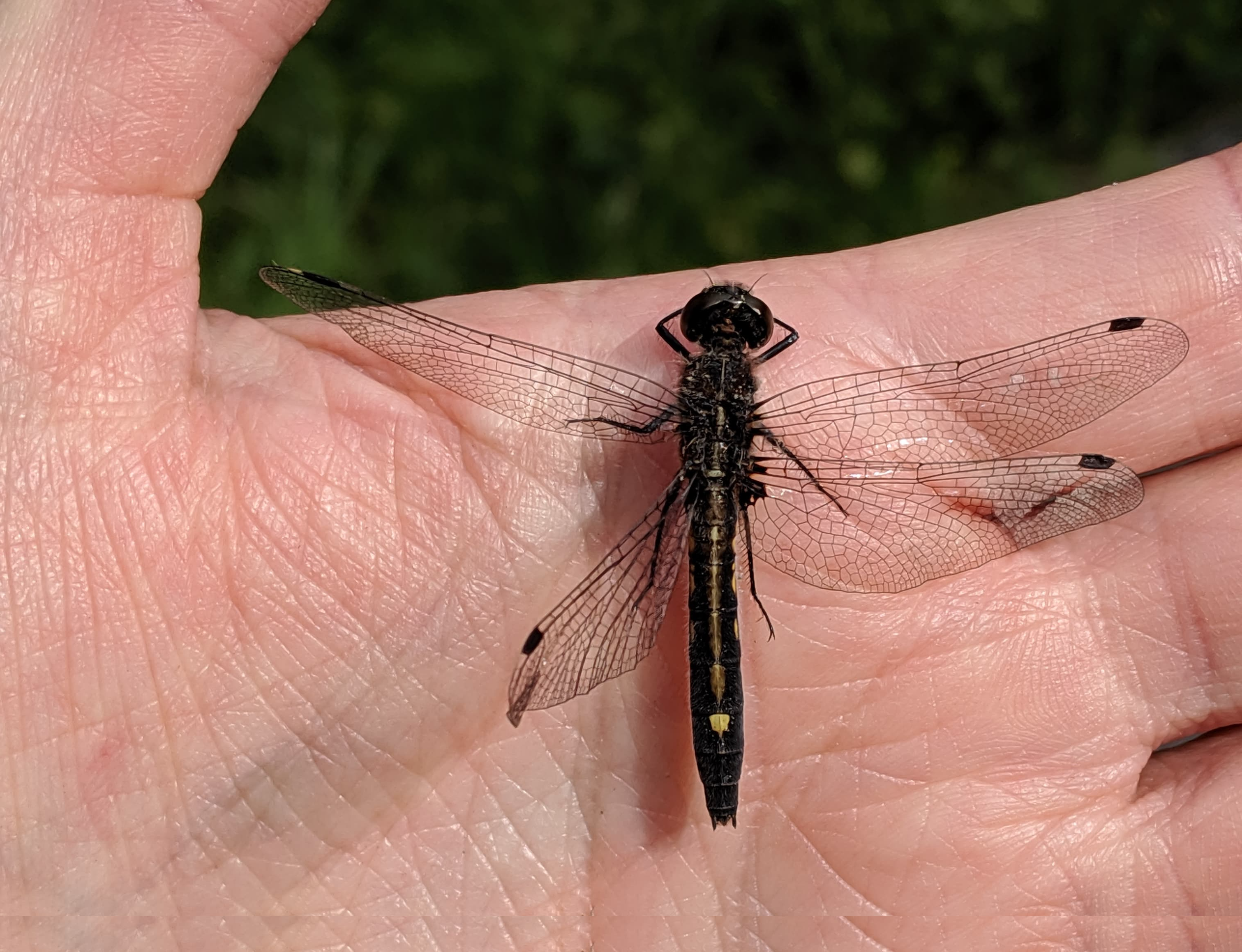
Dot-tailed Whiteface Dragonfly (Leucorrhinia intacta)

I found this Sunday morning, July 7, 2019 as I walked near my home on San Juan Island. It seemed to have been stunned by a car and was upside down in the dirt road. This dragonfly is classified as a Skimmer in the family Libellulidae. They are found Spring through Summer in vegetated areas near ponds, bogs, and wetlands. Adults of this species will eat most any soft-bodied flying insect, including mosquitoes, flies, mayflies, ant and termite alates (dispersing winged reproductives), moths and butterflies.

Harmonia axyridis, The Asian-Spotted Ladybird Beetle

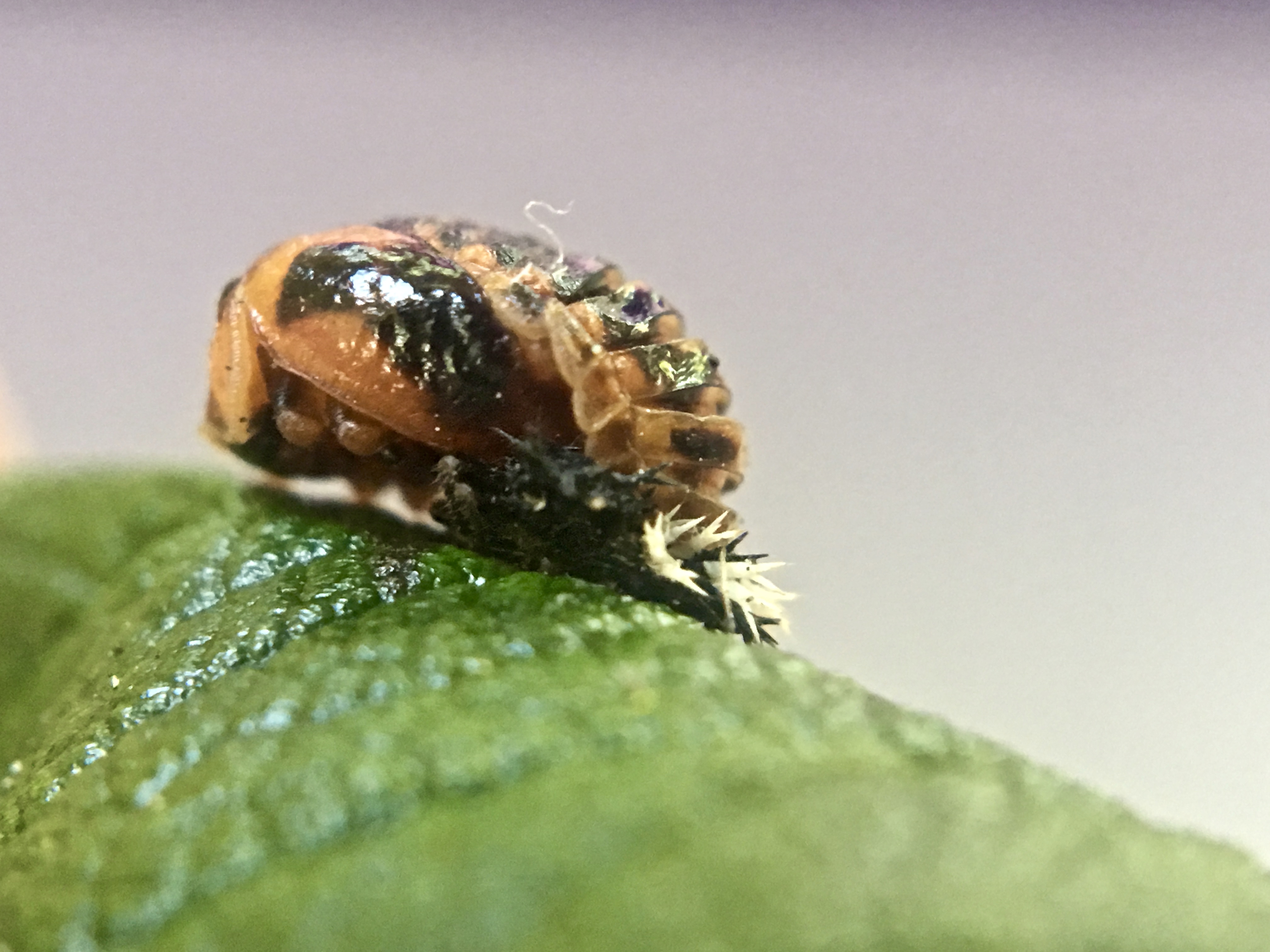
I found this weird little creature stuck to a leaf on a rose bush by the picket fence in front of the San Juan County Land Bank office on Monday, June 24, 2019 when I walked down Argyle and rounded the corner onto Caines (does anyone on the island actually use street names? Where the heck is Caines, right?) 

Ladybird pupal case, June 24, 2019

Brought it home because I couldn’t resist the mystery of figuring out what it might be.  What on earth are those spiny things at the end? Is it some sort of pest insect?   

Ladybird pupal case
June 24, 2010

After taking a few photos, I did what drives my husband crazy sometimes.  I left the leaf with this little spiny-ended thing on the table, in a cup, without a lid.  Yep.  Just like when I left the really fat deer tick I had on my desk.  The one that laid eggs…that hatched when I wasn’t paying attention.  This is when it’s really handy to have sticky tape nearby, otherwise you have to vacuum every 10 minutes for about a month to finally sleep at night without feeling like things are crawling all over you and burrowing into your skin. This link should take you to my facebook page post about “Big Bertha.” https://www.facebook.com/buggingyoufromSJI/posts/2375866245969416

This morning, after my cat got me up with incessant meowing right in my ear, I sat down at the table with a cup of coffee. Millhouse (the cat) isn’t supposed to be on the table, but when my husband isn’t around, anything goes!  He was staring something down that was m.o.v.i.n.g!  Fortunately, I reacted faster than he did.  I tipped over the little medicine cup I’d put the leaf in to thwart this little creature’s attempt at a fast getaway.  

Asian Spotted Ladybird Beetle (Harmonia axyridis)
July 27, 2019
San Juan Island, WA

Carefully sliding a piece of paper under the cup, I could see it looked like a ladybug.  Ladybugs come in different colors, with different spots, and there are quite a few species one could encounter on San Juan Island.  This beetle goes by an assortment of names.  It’s often referred to as the Multi-colored Asian Lady Beetle or sometimes the Halloween Beetle because in some places they show up in large numbers at Halloween! 🎃😱

This beetle’s scientific name is Harmonia axyridis (The Asian-spotted Ladybird Beetle).  It was imported to the United States as early as 1916 to help control pests as a biocontrol agent.  While “Miss Harmonia” eats aphids, thrips, and scale insects (and manages these pests fantastically in soybean crops), she isn’t native and these pest insects aren’t all she eats.  Asian-spotted Ladybird Beetles also eat native coccinellid beetles (native lady bugs) and even butterfly eggs.  In the winter, she can bring her friends and invade your home.  When handled, the ladybird beetles can excrete a stinky defensive chemical from their leg joints.  This makes removal of large numbers of them from inside homes somewhat problematic.  You don’t want to have them discharging this awful odor that will linger….all…winter! 

Newly emerged adult (Harmonia axyridis)
June 27, 2019
San Juan Island, WA

Another unfortunate consequence of importing these beetles is their love of wine grapes.  🍇 🍷 Asian-spotted ladybirds will eat grapes and then the grapes end up contaminated with an awful smell lingering on them.  While I personally don’t drink wine, I know lots of people do and they’d be very unhappy if it tasted like essence of ladybug…a twist on a new aromatic bitter perhaps! 

Did I squish her? Nope.  I put her in the tree near our bird feeder.  It’s possible she will become part of the food chain.  While not all birds eat these beetles, some do. Insects and arachnids like robber flies, dragonflies, ants, various ground beetles, and cellar spiders also eat them.   

If you see them, should you squish them?  That’s up to you and how confident you are that you’ve identified it correctly. I wouldn’t want to mistake a helpful native ladybug as an invader.  I recommend that instead of buying ladybird beetles at the garden store to release in your garden you establish native habitat to attract and support native species of ladybugs.

As I looked a bit more into the literature about Harmonia axyridis, I was intrigued with the publication of some research about the biochemistry of the liquid they secrete.  It has been found to have strong antimicrobial action against strains of bacteria that are pathogenic to humans. This fluid has even been examined for its action against malaria.  Perhaps these beetles don’t belong in the garden, but in your medicine cabinet instead.  

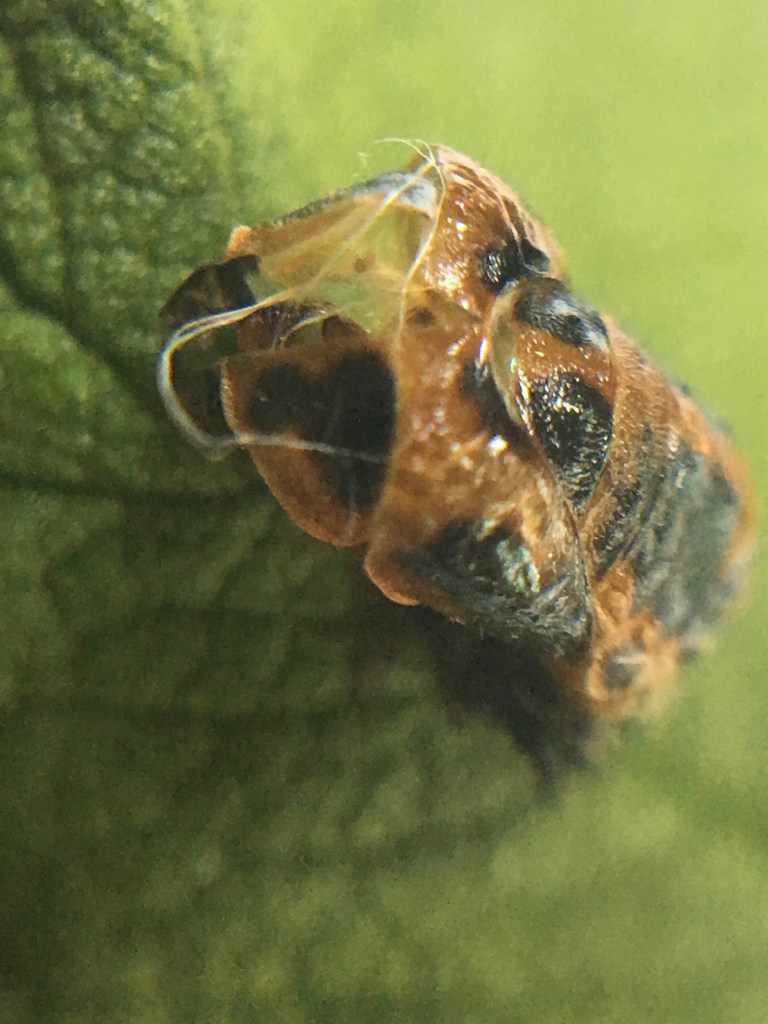
empty pupal case
Asian spotted Ladybird Beetle (Harmonia axyridis)
July 27 2019
San Juan Island, WA

References and further reading

  1. https://plunketts.net/blog/ladybugs-vs-asian-lady-beetles/
  2. https://royalsocietypublishing.org/doi/full/10.1098/rsbl.2011.0760?url_ver=Z39.88-2003&rfr_id=ori%3Arid%3Acrossref.org&rfr_dat=cr_pub%3Dpubmed&
  3. https://www.ncbi.nlm.nih.gov/pmc/articles/PMC524671/
  4. https://bugguide.net/node/view/397

Clickety clack, jump-up jack!

I brought this guy home long enough to get him to do his trick for you and then took him back outside so he could go on his way. Please be assured that he came to no harm and he even left this little rhyme for you to enjoy!

Clickety-clack, I’m jump up Jack! Turn me over and I’ll flip right back.

Jump Up Jack
Wait for it…

A Blistery Spring Day

I walked down the road last Tuesday (April 9, 2019) with my husband.  It was late afternoon and although it rained a bit earlier that morning, the sun was peeking out.   The wind wasn’t blowing, but it was soon to be a Blistery Spring day!

If you know any entomologists, you’ll understand rule #1 about going on ANY walk is to take a collection jar and a camera.  Last week, I failed to do this and missed an opportunity to identify and document this very cool bumble bee mimicking fly (genus Laphria ~ a bee-like robber fly).  This time I made certain to take my phone.  Sure enough, at the bottom of the hill, I see a black beetle crawling about on the chip-sealed road.  Fortunately, I refrained from my very bad habit of grabbing things with my bare hands. This is one beetle you do NOT want to pick up!  It was a BLISTER BEETLE.

Lucky me! I came home with some great photos and some video footage instead of a dermatological eruption that would have landed me in the doctor’s office.  I left the beetle in the road to continue whatever it was doing.

Back at home, I used my reference books to compare the photos and video I took of the beetle and narrowed down an ID to the genus Meloe.  I would need more help figure out the species.  I sent some photos off to Merrill Peterson at WSU with the suggestion that it might be a male Meloe niger.  Merrill wrote back that he thought it was M. strigulosus, but hard to confirm with only a photo.  He agreed it was indeed a male.
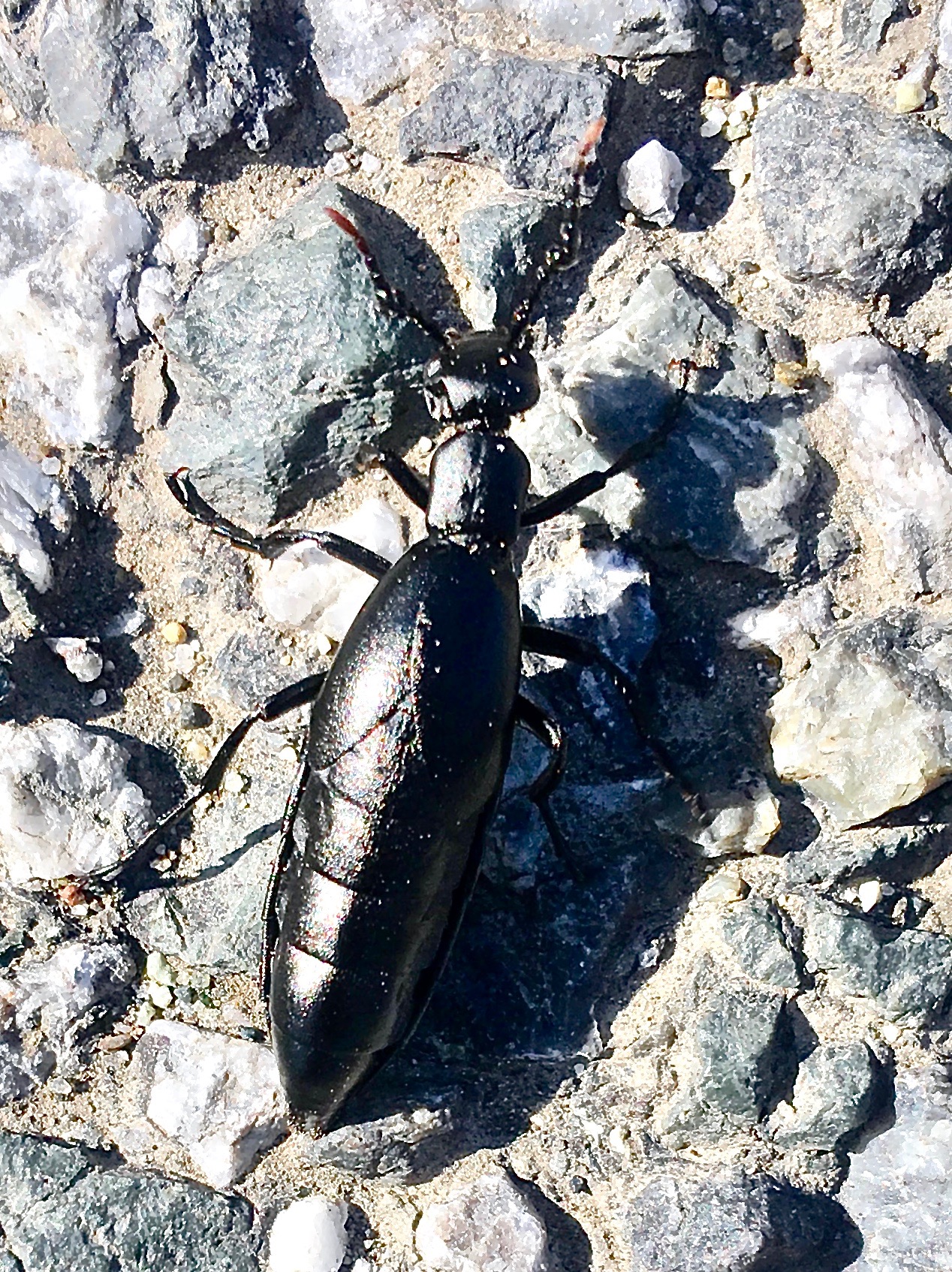
Meloe niger Black Meloe Blister Beetle

Meloe strigulosus (male)

You might ask how one goes about determining whether a particular beetle is male or female.  Often, as in this case, the male antennal segments are larger or varied in shape from the female.  This beetle’s antennae had a distinctive kinked platform on their fifth segment.  I would learn later that this kinked part enables them to grasp the antennae of the female during mating.

Meloe strigulosus (male)

Meloe strigulosus photo by Cynthia Brast April 9, 2019 Three Corner Lake Road San Juan Island, WA

Antennae

kink in antennal segment of M. strigulosus (male)

Merrill also sent me a link to what I will refer to as the Blister Beetle bible.  Published in 1970, this research was compiled by the legendary systematics entomologist, John D. Pinto, currently professor emeritus at U.C. Riverside with Richard B. Selander.  Hopeful, I sent off my photos in an email to Dr. Pinto and felt really privileged when I got an almost immediate response.

According to Dr. Pinto, the specimen I photographed was indeed a male Meloe strigulosus.  If you’re interested, you can read “The bionomics of blister beetles of the genus Meloe and a classification of the New World species”by linking here https://archive.org/details/bionomicsofblist42pint  Aside from the wealth of information published in this book, I love the artistic rendering of the female beetle on the cover.
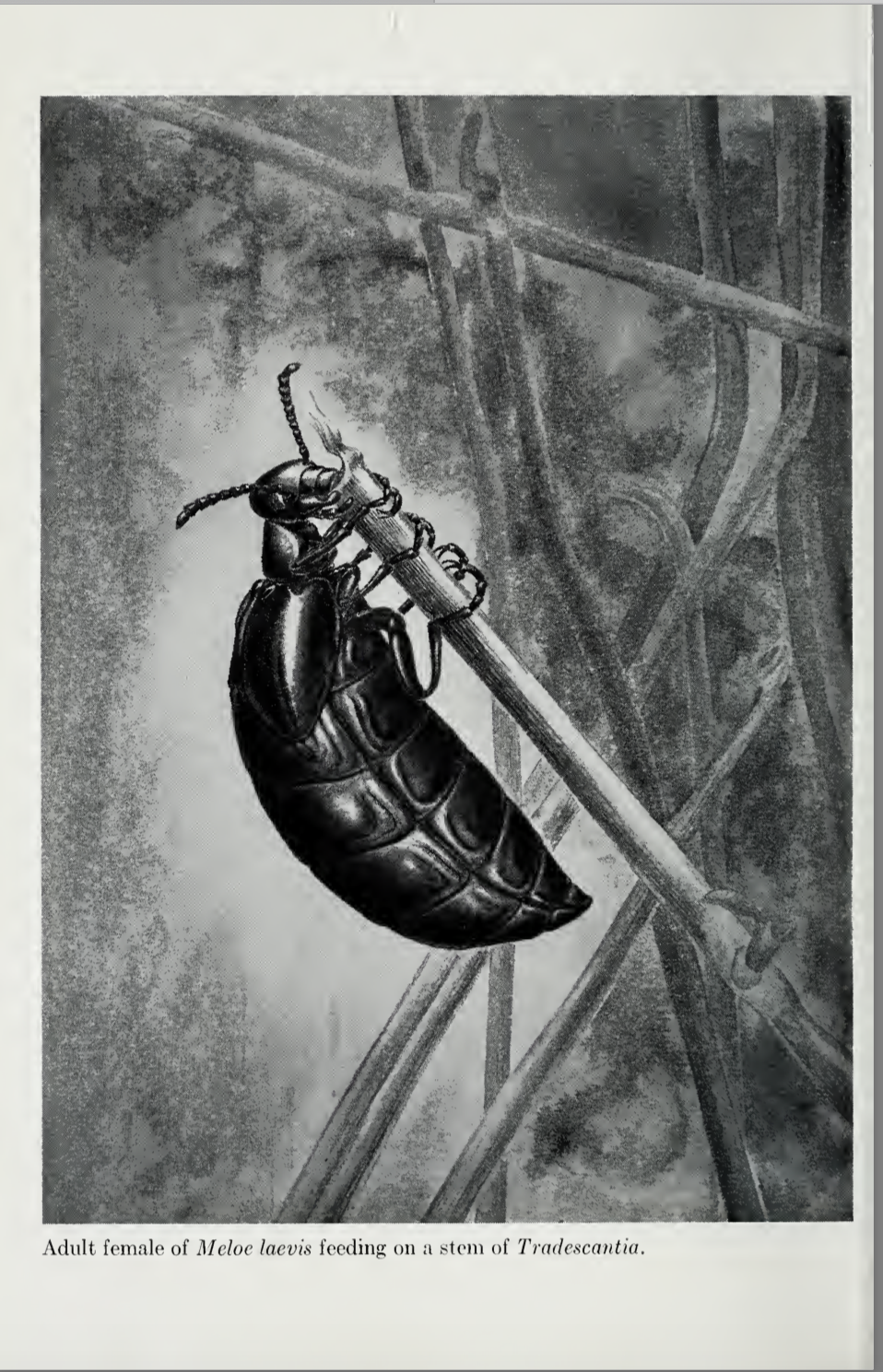
Screen Shot 2019-04-15 at 11.53.12 AM.png

Illustration from Pinto and Selander’s “The bionomics of blister beetles of the genus Meloe and a classification of the New World species.” 

According to Dr. Pinto, there are 22 species of Meloidae in North America.  They are named Blister Beetles because they release a toxic terpenoid blistering agent called cantharadin when they are threatened or handled.  Sometimes people call them “Oil Beetles” because it’s oily. You can find the chemical profile of cantharadin here ~ https://pubchem.ncbi.nlm.nih.gov/compound/cantharidin#section=Drug-Indication

Curiously, this toxic secretion has been utilized to treat various medical conditions.  Among these was the topical application of the “oil” to treat rheumatism or to remove warts and lesions of Molluscum contagiosum, a contagious, viral infection of the skin (https://www.mayoclinic.org/diseases-conditions/molluscum-contagiosum/symptoms-causes/syc-20375226).  Cantharidin is also famously known for its use as an aphrodisiac (Spanish Fly).   This substance was historically used as a treatment for hydrophobia (rabies).  Male beetles were preserved in honey, mixed with other equally toxic ingredients then administered in an attempt to cure the patient. Maybe dying from cantharadin poisoning was less traumatic than dying of rabies.

Blister beetles are economically important because they contaminate alfalfa hay and they are highly toxic to livestock, especially horses.  There are instances where a horse has died from ingesting just ONE beetle. According to this Colorado State Extension publication (https://extension.colostate.edu/topic-areas/insects/blister-beetles-in-forage-crops-5-524/), just the release of cantharadin oil from the beetle can contaminate the hay.  Although reports of cantharadin poisoning in livestock are rare in the West, here’s one case where someone’s goat became very sick from ingesting hay contaminated with cantharidin ~ https://www.vetmed.ucdavis.edu/news/uc-davis-veterinarians-discover-blister-beetle-toxicity-goat

Another interesting fact about these beetles is that the larvae are phoretic parasites of solitary bees and grasshopper egg pods.  The first instar larvae, called triungulins” crawl onto flowers to await a visiting bee, then hitch a ride back to the nest where they will consume the pollen, nectar, and even the bee larvae.  Check out this link from National Geographic to view some extraordinary images of bees covered with blister beetle larvae ~ https://www.nationalgeographic.com/animals/2018/09/bees-blister-beetles-evolution-parasites-pheromones-news/

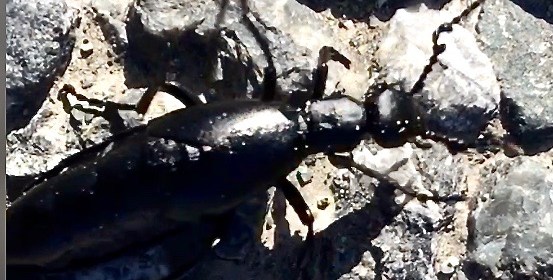
This was the first blister beetle I’ve seen on San Juan Island, but I do know of one other sighting by San Juan County Land Bank steward, Doug. M. from April of 2016.  I sent the photo of Doug’s beetle to Dr. Pinto as well and this was his reply, “Very likely M. niger – tho the photo is a little fuzzy for positive ID.”  Doug’s photo of the “likely” M. niger below.   

Meloe niger 2016-04-07 14.38.37

Meloe niger Mount Ben, San Juan Island, WA, April 2016                                                                     Photo by Doug. M. San Juan County Land Bank

If you’d like to read more about the particular species of blister beetle I found, I’m including the taxonomic key and geographic distribution data from Dr. Pinto’s book below.

                                               Meloe (Meloe) strigulosus Mannerheim


 Direct Key To The New World Subgenera of Meloe

Key to New World Subgenera of Meloe

Key to New World Subgenera of Meloe Pinto and Selander, 1970

Direct Key to the New World Subgenera page 104.

Direct Key to the New World Subgenera of Meloe page 104 Pinto and Selander, 1970

Key to Groups
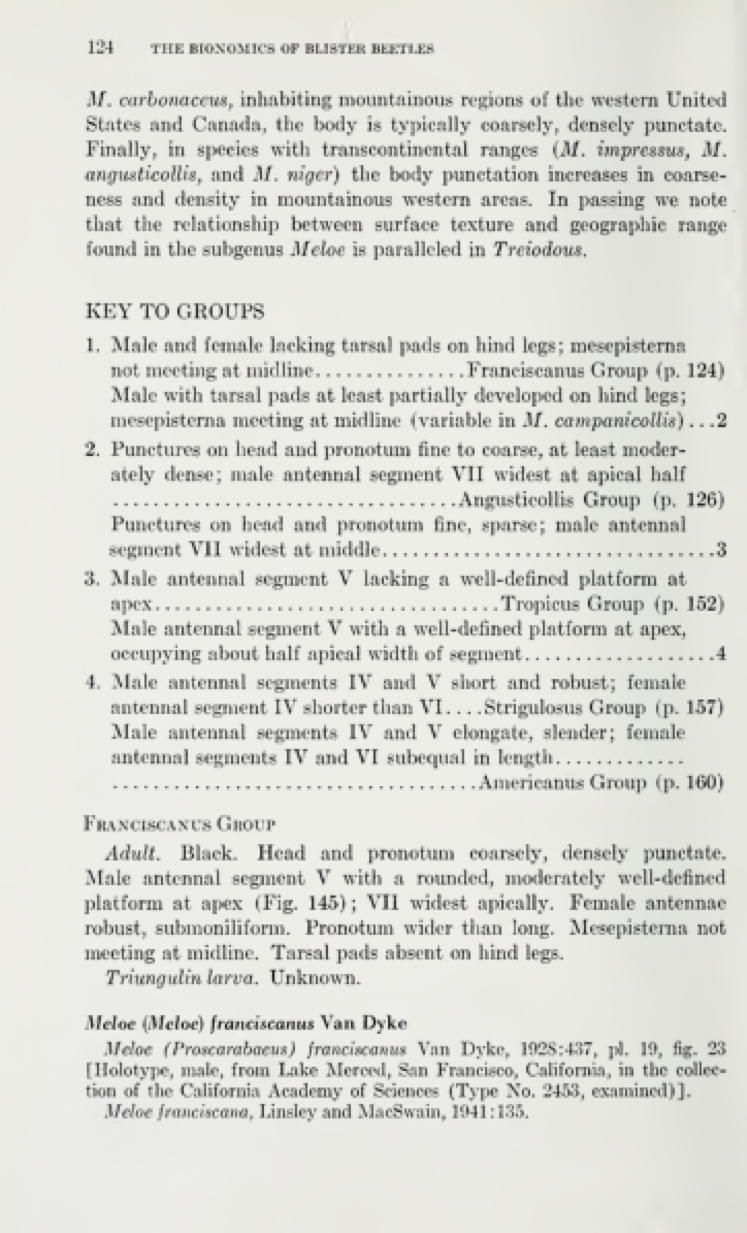
Key to Groups p. 124

Key to Groups Bionomics of Blister Beetles Pinto and Selander, 1970

Direct Key to Groups page 157

Key to Groups Bionomics of Blister Beetles Pinto and Selander, 1970

 Geographic distribution
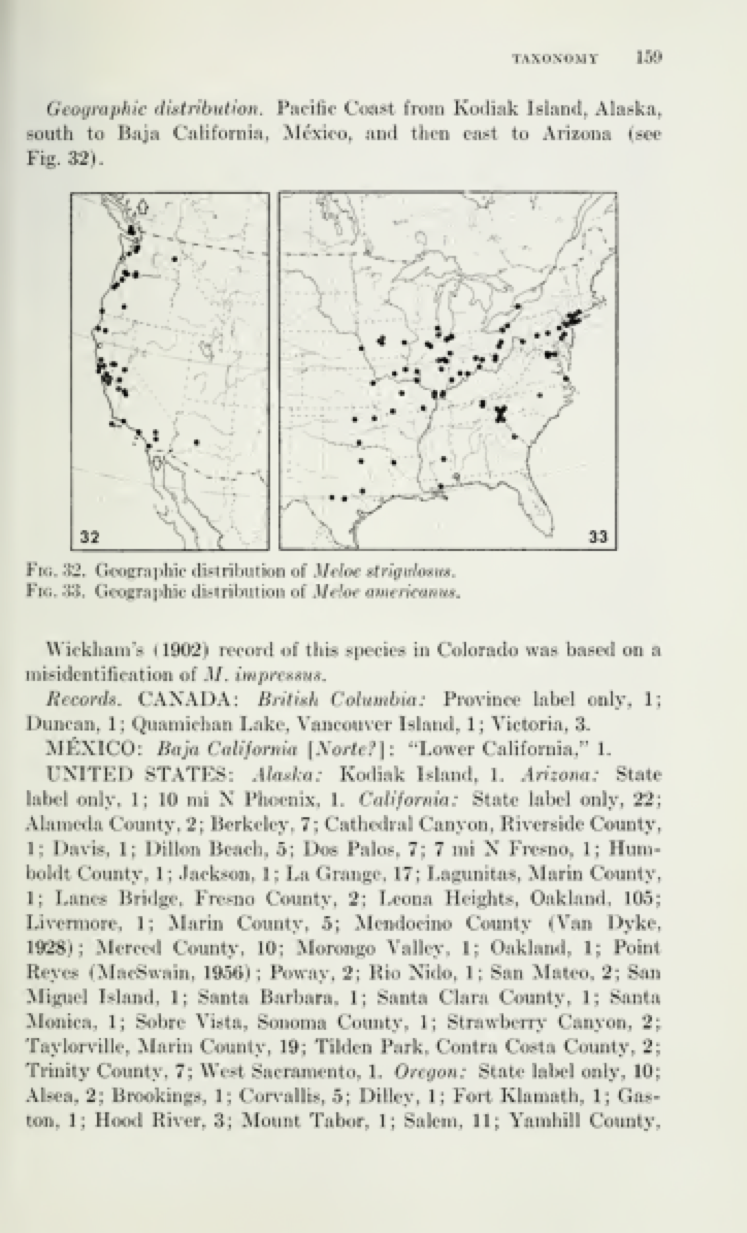
Geographic.distribution of M. strigulosus  p. 159

Geographic Distribution of Meloe strigulosus Pinto and Selander, 1970

Larval Key Meloe strigulosus
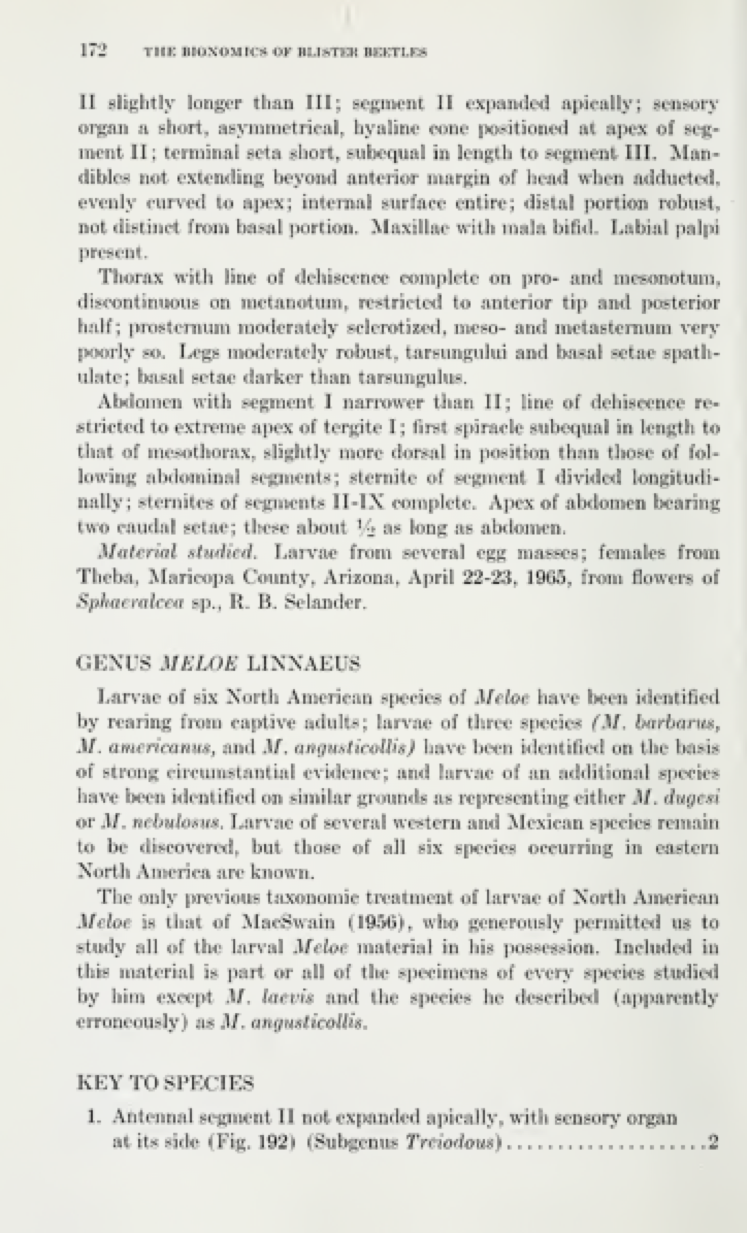
Larval.key.1

Larval key Meloe strigulosus Pinto and Selander, 1970
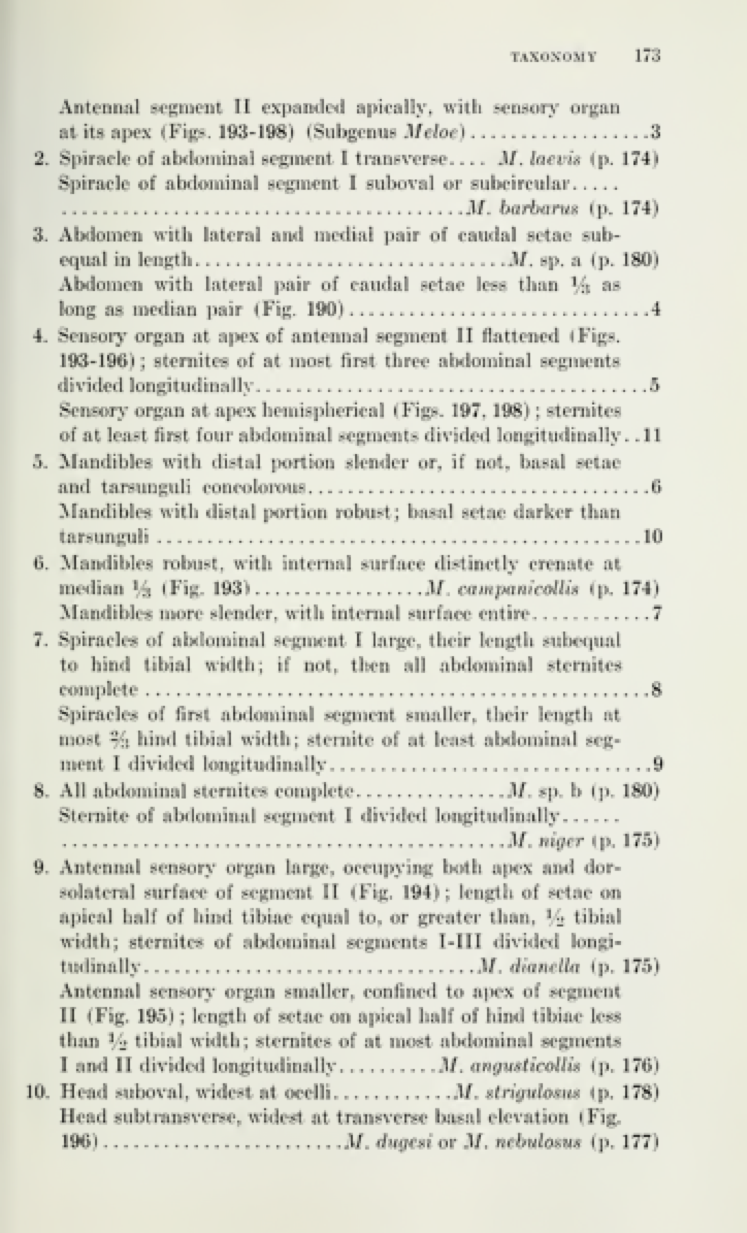
Larval.key.2

Larval key for M. strigulosus Pinto and Selander 1970

Antennal illustrations for male Meloe strigulosus, Figure 125 a. Dorsal view of segments V-VII, and b. Posterior view of segments V-VII

Male Antennae

Male antennae M. strigulosus Pinto and Selander, 1970

Antennal illustrations for female Meloe strigulosus, Figure 140

Female Antennae

Female Antennae M. strigulosus Pinto and Selander, 1970

References

Bittell, J. 2018.  Sex, Lies, and Grappling Hooks: How Parasitic Beetles Trick Bees. Animals Weird and Wild. National Geographic.  https://www.nationalgeographic.com/animals/2018/09/bees-blister-beetles-evolution-parasites-pheromones-news/

Hafernik, John and Saul-Gershenz, Leslie. 2000. Beetle larvae cooperate to mimic bees. Nature. 405. 35-6. 10.1038/35011129.

Kinney, K.K., F.B. Peairs and A.M. Swinker. 2010.  Blister Beetles in Forage Crops. Colorado State University Extension Publication 5.524. https://extension.colostate.edu/topic-areas/insects/blister-beetles-in-forage-crops-5-524/

Mayo Clinic. Mulluscum contagiosum. https://www.mayoclinic.org/diseases-conditions/molluscum-contagiosum/symptoms-causes/syc-20375226(accessed on Apr. 16, 2019)

National Center for Biotechnology Information. PubChem Database. Cantharidin, CID=5944, https://pubchem.ncbi.nlm.nih.gov/compound/5944 (accessed on Apr. 16, 2019)

Peterson, M. A. 2018. Pacific Northwest insectshttps://www.amazon.com/Pacific-Northwest-Insects-Merrill-Peterson/dp/0914516183

Pinto, J.D. and R.B. Selander. 1970. The bionomics of blister beetles of the genus Meloe and a classification of the New World species. Illinois Biological Monographs 42: 1-222.  https://archive.org/details/bionomicsofblist42pint

Piuser, J. 2017. UC Davis Veterinarians Discover Blister Beetle Toxicity in Goat. U.C. Davis Veterinary Medicine.  https://www.vetmed.ucdavis.edu/news/uc-davis-veterinarians-discover-blister-beetle-toxicity-goat

Quinn, M. Blister Beetles of Texas. Texas Beetle Resources. http://texasento.net/TXMeloidae.html#Meloe  (accessed on Apr. 16, 2019)
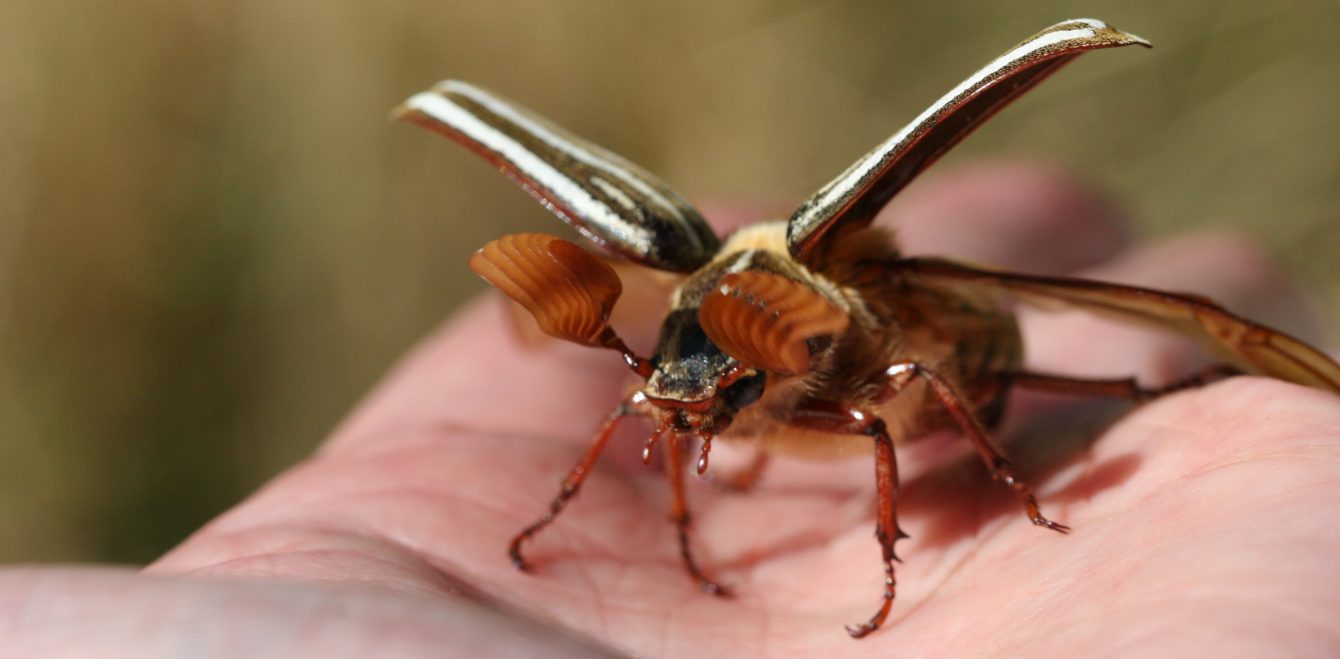
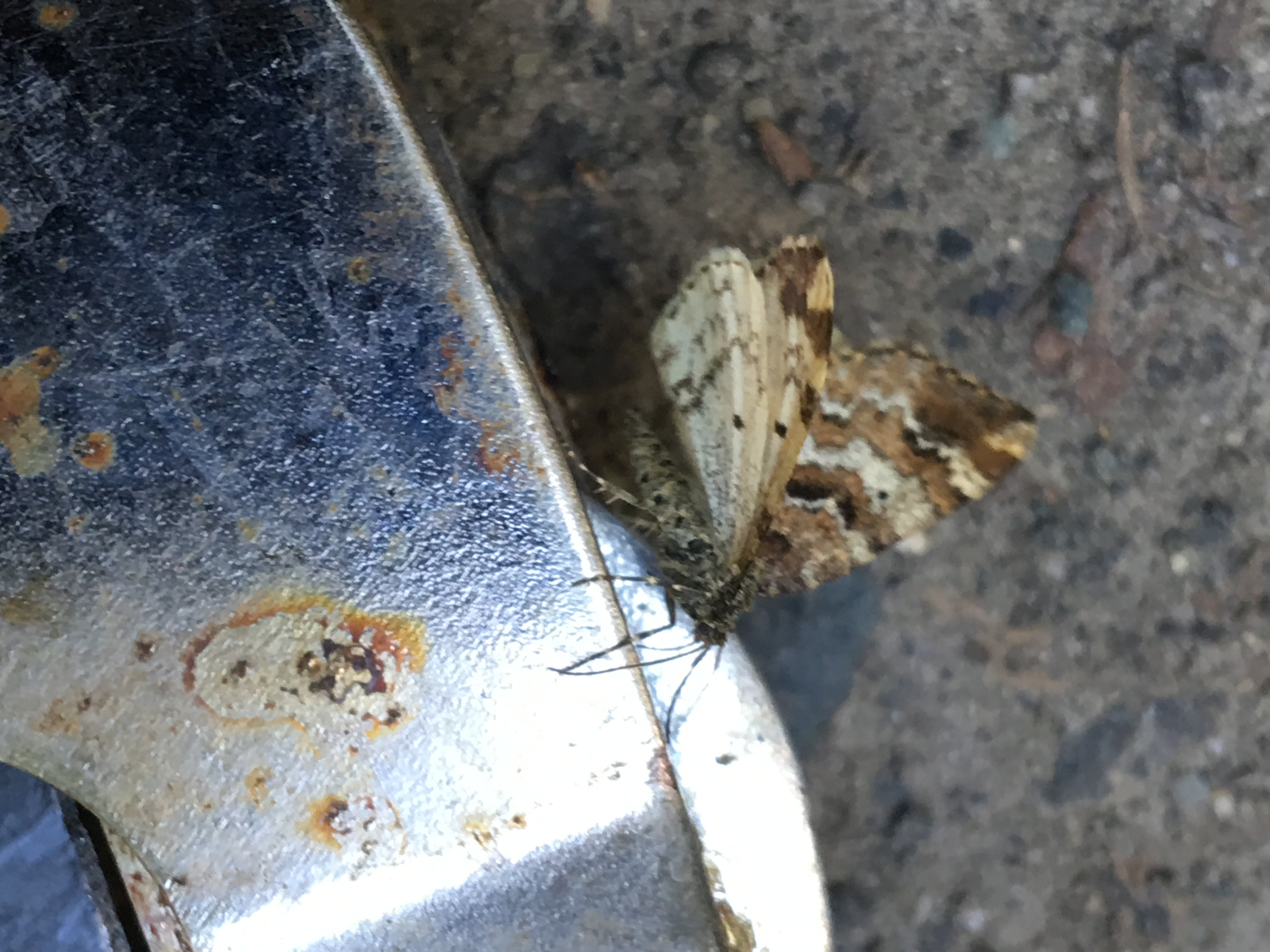
Enchoria lacteata

fullsizeoutput_2289

Enchoria lacteata

Enchoria lacteata (Packard) is a relatively small moth with forewings measuring only 0.9-1.1 cm in length.    Adults have a remarkable zig-zag pattern on forewings made up of various shades of brown and buff.  They are diurnal (daytime) fliers and emerge from late February to May.  Sightings are often in grassy areas or edges of moist woodlands.  Larval host plants are various species of miner’s lettuce, Claytonia (Portulacaceae).  Check out the following link for more information on miner’s lettuce.  It’s edible! https://www.ediblewildfood.com/miners-lettuce.aspx

Enchoria lacteata

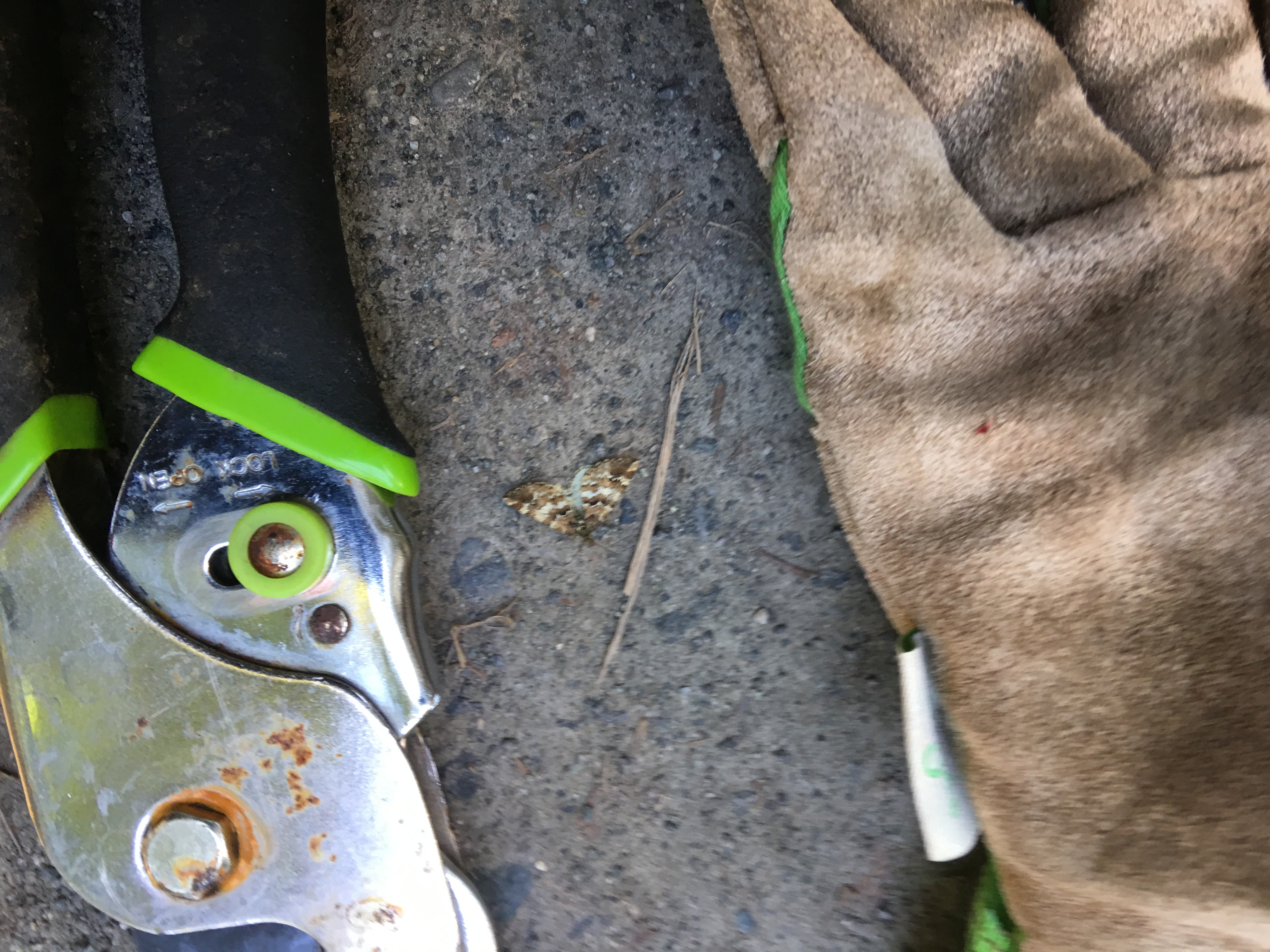
Enchoria lacteata crawling onto my pruning tool.

IMG_9131

Enchoria lacteata between my work glove and pruning tool


References:

POWELL, JERRY A., and PAUL A. OPLER. Moths of Western North America. 1st ed., University of California Press, 2009.

https://bugguide.net/node/view/46115

http://mothphotographersgroup.msstate.edu/species.php?hodges=7403


Itchy-Scratchy!

Just in time for Halloween!  Yesterday I was using the Scanning Electron Microscope (SEM) at Friday Harbor Marine Labs.  I got to take some really cool photos but in order to use the SEM, your specimen has to be dried out.  Well, I had some specimens that are really tiny and very delicate and they weren’t dried out because it is a complicated process that takes a certain chemical called Hexamethyldisilazane (HMDS).  Also, drying out your specimen for viewing under the SEM renders it useless for viewing under a light microscope and you’ve lost the ability to preserve it in a collection.

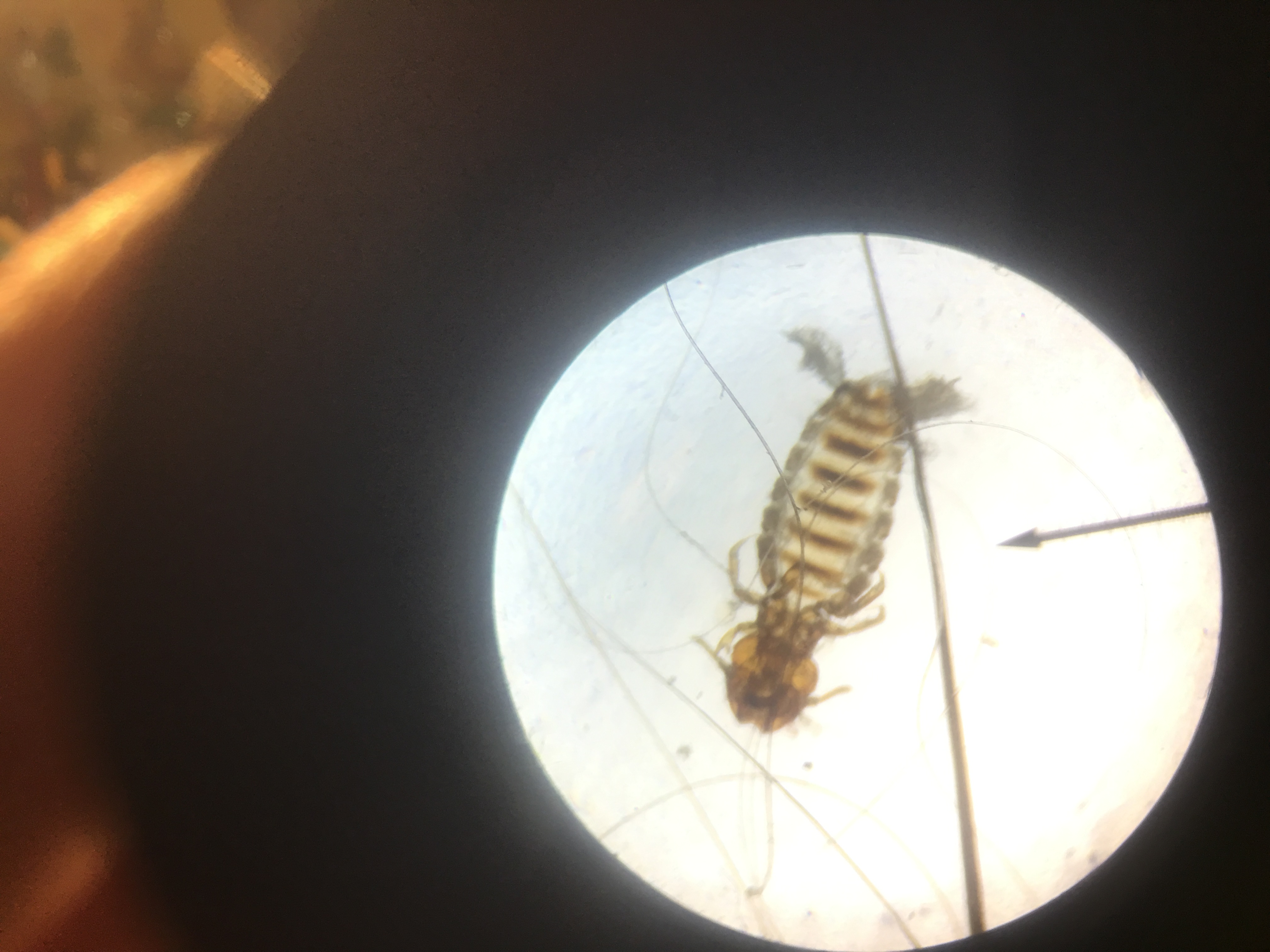
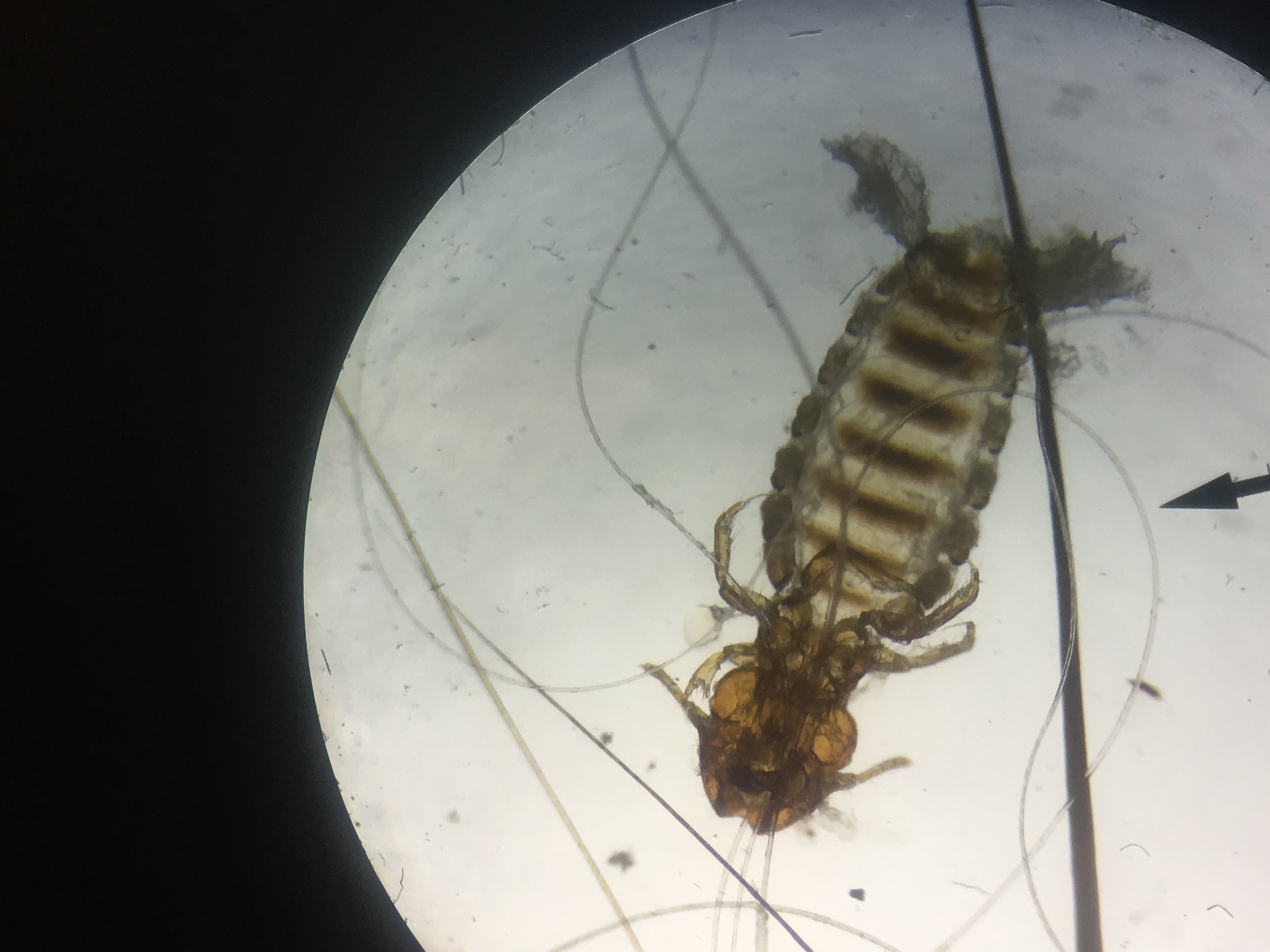
So I’m going to share how I took images of some of my specimens at home with a pretty old compound microscope, an iPhone, and a clip-on macro lens from Amazon.   First, I’ll tell you a bit about the compound microscope image posted here.  This specimen is in the genus Damalinia, most likely the exotic chewing louse, Damalinia (Cervicola).

IMG_7536

Chewing louse Damalinia spp

It lives on black-tailed deer (Odocoileus hemionus columbianus) in Washington, Oregon and California, and has been indicated in what is called HLS (Hair-loss syndrome).  They build up in large numbers on deer at certain times of the year.  One factor thought to contribute to this is lack of adequate nutrition in the deers’ diet, particularly an absence or deficiency of Selenium.

In a nutshell, these lice can reproduce at high numbers in vulnerable deer (typically old, young, and those with weakened immune systems due to nutritional deficiencies or internal parasites).  The lice cause extreme itching, irritation, and hair loss.  The deer respond to the itchiness by excessive licking and grooming.   Why hair loss? Well, these lice are called “chewing lice” because they munch on hair, skin fragments and secretions, and in some cases will feed on blood from skin wounded from scratching.  It’s a miserable condition to have.  This is what a deer looks like that is suffering from HLS caused by the chewing lice.

hairloss

Photo by Brian Murray  https://www.dfw.state.or.us/wildlife/health_program/hairloss/index.asp

Here is a larger version of my photo.  It’s not as clear as I’d like, but I’m certainly going to practice to improve. Happy Halloween and I hope you don’t spend the night scrrraatching in bed!

IMG_7537

Chewing louse Damalinia spp.

Further reading and references:

Protocol for drying insects with HDMS: https://www.cdfa.ca.gov/plant/ppd/entomology/HMDS.html

Link to Amazon clip on iPhone lens set ~

Robinson, J. (2007). Transmission of the chewing louse, Damalinia (Cervicola) sp., from Columbian black-tailed deer (Odocoileus hemionus columbianus) to Rocky Mountain mule deer (Odocoileus hemionus hemionus) and its role in deer hair-loss syndrome. Masters Thesis. Oregon State University. https://ir.library.oregonstate.edu/concern/graduate_thesis_or_dissertations/1v53k0068?locale=en

Roug, A., Swift, P., Puschner, B., Gerstenberg, G., Mertins, JW, Johnson, CK, et al. (2016). Exotic pediculosis and hair-loss syndrome in deer (Odocoileus hemionus) populations in California. Journal of Veterinary Diagnostic Investigation, 28(4), 399-407. http://journals.sagepub.com/doi/10.1177/1040638716647154

Maude, R. J., Koh, G. C., & Silamut, K. (2008). Taking photographs with a microscope. The American journal of tropical medicine and hygiene, 79(3), 471-2. https://www.ncbi.nlm.nih.gov/pmc/articles/PMC2843439/

Smartphone Microscopy by Annie Morrison.  Youtube.


Scanning Electron Images of a Cerambycid Beetle

Yesterday I had the extreme good fortune to be able to use the scanning electron microscope (SEM) at University of Washington’s Friday Harbor Labs (San Juan Island).  We put a Cerambycid beetle under the SEM and “WOW,” the photos were phenomenal!  Here’s a few for you to see.  Below is a photo of the beetle’s compound eye.  Just think of all the information each of those facets receives and processes.

IMG_7528

Cerambycid beetle compound eye, imaged under scanning electron microscope at Friday Harbor Labs, San Juan Island, WA

Next, you see an image of the beetle head.  It shows the antennal insertion points, the compound eyes, frons, clypeus, labrum, mandibles, and bristly setae.

IMG_7526

SEM anterior, dorsal view of cerambycid head.

If you’re interested in learning more about the morphological features, here’s a pretty good diagram below for reference.

morph12

image from http://www.faculty.ucr.edu/~legneref/biotact/bc-51b.htm

The last image for you is of the beetle’s tarsi (the foot).  This is an important identification feature for many insects.  Imagine that!  When I was working on my masters degree from the University of Florida, I had an amazing taxonomy professor who was an expert on Coleoptera (the beetles).   He created identification keys for Florida beetles and you can take a look at them here:  http://www.entnemdept.ufl.edu/choate/beetles.pdf IMG_7525.JPGWell, I’m looking forward to using the SEM again and my next imaging will hopefully include the sponging mouthparts of a fly.   Stay tuned!

« Older Entries Recent Entries »